When people think about outdoor riding, they often picture gas dirt bikes, mountain bikes, or all-terrain vehicles. But as battery, motor, and control technologies continue to improve, electric off-road bikes are becoming a new type of outdoor tech gear. They are not simply gas-powered machines with electric motors. They combine power delivery, energy management, ride modes, and safety-focused control in a way that can make outdoor riding quieter, smoother, and easier to manage.
For most buyers, choosing an electric dirt bike should not be only about speed or peak power. The better questions are more practical: Is the battery large enough for the route? Is the motor response smooth? Are the ride modes easy to understand? Are the suspension and brakes reliable? Does the bike fit the rider’s real outdoor environment?
The Core Value Is Control, Not Speed
Many buyers first notice motor output, torque, and top speed. Those numbers matter, but they do not tell the full story.
Outdoor riding surfaces are rarely perfect. A rider may deal with grass, gravel, loose dirt, tree roots, small slopes, and uneven camp roads. In these conditions, sudden power can make a bike harder to manage, especially for beginners. Smooth throttle response and adjustable power modes can be more useful than aggressive output.
This is where electric systems can offer a practical advantage. Different ride modes allow riders to start with a lower-output setting, build confidence, and gradually move into stronger performance as their skills improve. For newer riders, younger users, or casual outdoor explorers, that step-by-step learning process matters.
Battery Capacity Means More Than Range
Battery capacity is one of the most important parts of any electric outdoor vehicle. It affects range, but it also affects how confidently riders can plan a route.
Many buyers compare maximum range numbers, but real-world range depends on terrain, rider weight, temperature, battery condition, ride mode, and average speed. A flat dirt path and a hilly route will not use energy in the same way. A lower-output mode and a high-output mode will also create very different battery demands.
A smarter buying question is not simply “How far can it go?” It is “Does the range fit the way I actually ride?” For campground loops, private land, or short trail sessions, a moderate range may be enough. For longer outdoor routes, battery capacity, charging access, and return-trip reserve become more important.
Motor Output And Torque Affect Low-Speed Control
The motor in an electric off-road bike affects more than acceleration. It also shapes how the bike feels when starting, climbing, and moving slowly across uneven terrain.
Compared with gas-powered systems, electric motors can deliver power more directly. That can help riders handle starts, hills, and low-speed technical sections. But torque should still be matched with rider skill. Strong torque can help on climbs and soft ground, but beginners should use lower-output settings until they understand the bike.
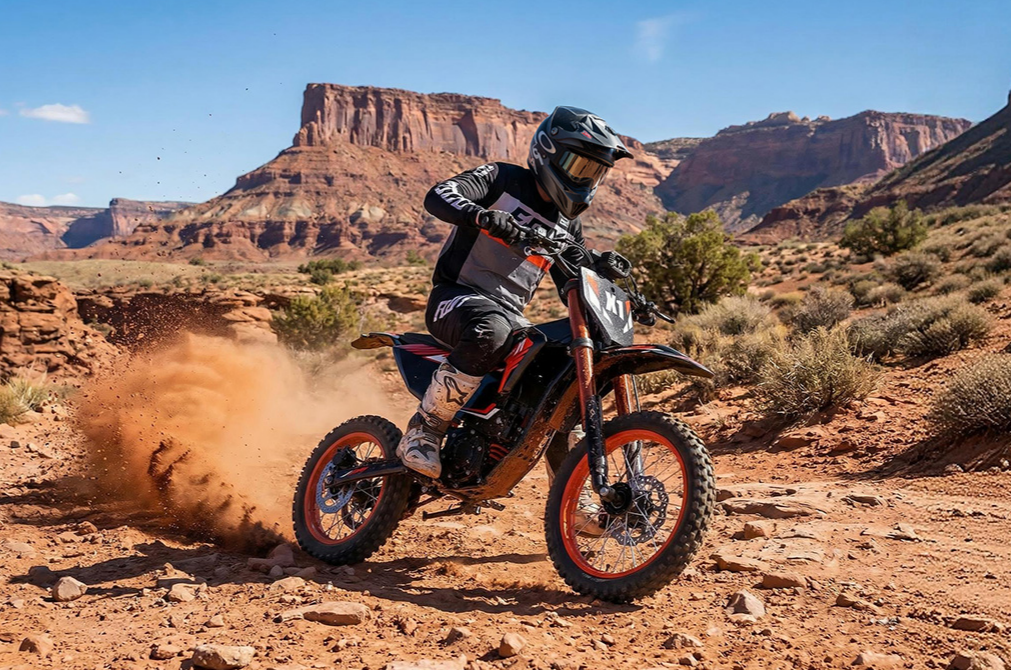
For example, the X1 Spark M is a mini electric dirt bike with a 4500W peak mid-drive motor, a 60V 28.8Ah battery, 283 Nm of torque, and 14″/12″ wheels, making it a relevant option for riders who want compact handling and light off-road capability.
Ride Modes Are One Of The Most Useful Tech Features
For everyday buyers, ride modes may be more practical than many complicated specifications.
An ECO-style mode can help beginners learn the bike and support longer, smoother rides. A balanced mode can work well for normal trail or camp road use. A higher-output mode should be used by experienced riders in appropriate environments.
This kind of layered setup matters because it allows one bike to support different skill levels and different riding situations. Instead of forcing every rider into the same power response, adjustable modes make the bike easier to manage.
For families, younger riders, and first-time electric off-road users, ride modes can make practice safer and more structured.
Suspension, Brakes, And Tires Shape The Real Ride
An electric off-road bike should not be judged only by its motor and battery. Once the bike leaves smooth pavement, suspension, brakes, and tires become central to the experience.
Suspension helps absorb bumps from gravel, grass, roots, and uneven ground. Brakes help riders manage speed before turns, descents, and obstacles. Tires affect traction across dirt, mud, sand, and loose surfaces.
New buyers sometimes underestimate these parts and focus too much on power. But if suspension support is weak, braking feels unstable, or tires do not grip well, strong power can actually make the bike harder to control. A better outdoor bike balances motor output, battery capacity, suspension, braking, tire setup, and rider control.
Electric Motorcycle Technology Needs Clear Use Boundaries
As battery and motor systems improve, more electric motorcycle products are entering outdoor recreation and light off-road categories. However, buyers should understand that these vehicles are not the same as ordinary commuter e-bikes.
Rules can vary by state, city, trail system, campground, park, and land manager. Before riding, users should confirm where the vehicle is allowed and whether local access or safety rules apply.
For most recreational riders, the safest way to understand this category is as outdoor equipment for specific environments. It is better suited for private land, ranch roads, permitted trail areas, camp roads, and open off-road settings than for general street use.
What Buyers Should Check Before Purchase
Before buying an electric off-road bike, focus on six areas.
First, check the battery. Look at voltage, capacity, expected range, and charging needs instead of relying only on the maximum mileage claim.
Second, check the motor. Peak power matters, but smooth delivery and low-speed control are just as important.
Third, review the ride modes. Beginners benefit from adjustable output rather than being forced into high power from the start.
Fourth, check suspension and brakes. These parts directly affect confidence on rough outdoor surfaces.
Fifth, think about size. Compact models can be better for light off-road riding, camp use, and low-speed practice, while larger models may suit more experienced riders.
Sixth, look for clear product information. Brands such as Qronge can make the buying process easier when they clearly show battery size, motor output, torque, wheel setup, range, suspension, and ride modes.
Safety Checks Are Part Of Using The Technology
Electric off-road bikes may reduce some maintenance tasks compared with gas-powered machines, but they still require inspection.
Before each ride, check battery level, tire pressure, front and rear brakes, chain, bolts, throttle response, and suspension condition. If the bike requires a firmware update or first-ride setup, follow the official instructions before use. New riders should begin in a wide, flat, open area away from vehicles and pedestrians.
Protective gear is also essential. A helmet, gloves, knee protection, elbow protection, eye protection, and proper riding shoes should be treated as basic equipment. Electric off-road bikes can make riding more accessible, but safety awareness still comes first.
Electric off-road bikes are becoming outdoor tech gear because they combine battery systems, motor control, ride modes, and practical off-road design. Their value is not only in going faster. Their value is in making outdoor riding more controlled, more adaptable, and easier for more riders to understand.