
Walk into a traditional pallet warehouse and you will notice something wasteful hiding in plain sight: the aisles. In a standard wide-aisle racking layout, as much as half of your expensive floor space exists just so forklifts can drive around. The pallets, the things you are actually paying to store, occupy the other half.
Pallet shuttle systems attack that waste directly. By sending a compact robot into the racking instead of a forklift down an aisle, they pack pallets deep and tight, recovering space that was going to driving lanes. For operations running out of room, dealing with rising rent, or expanding cold storage where every cubic meter costs a fortune, few technologies deliver a faster, clearer win.
Here is how these systems work, the crucial difference between two-way and four-way shuttles, and how to know if deep lane storage fits your operation.
What Is a Pallet Shuttle?
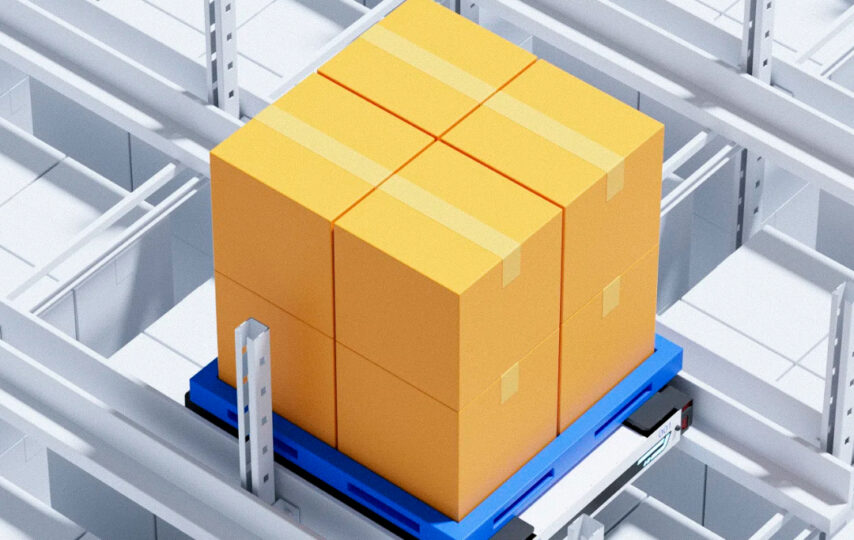
A pallet shuttle is a low-profile, battery-powered robot that travels inside the rails of a racking system, carrying pallets to and from storage positions. Instead of a forklift entering the rack structure, the driver or an automated system places a pallet at the entrance of a storage lane, and the shuttle carries it deep into the rack, sets it down, and returns for the next one.
The result is called high-density or deep lane storage. Pallets sit in continuous lanes that can run ten, twenty, or more positions deep, with no aisle between them. Storage density improves dramatically, often by 60 to 80 percent compared with conventional selective racking, because the space once reserved for forklift aisles now holds product.
Shuttles handle serious weight too. Modern units carry payloads up to 1,500 kg while keeping their own weight low, and slim designs around 125 mm tall squeeze extra storage levels out of the same building height.
Two-Way vs Four-Way: The Distinction That Changes Everything
Not all pallet shuttles are equal, and the biggest dividing line is how they move.
Two-way shuttles travel in a straight line, forward and backward, within a single lane. They do their job well, but they come with a limitation: to move a two-way shuttle to a different lane, a forklift or transfer car has to physically relocate it. That adds handling steps, requires equipment and coordination, and caps how much of the system can run without human involvement.
Four-way shuttles remove that limitation. A 4-way pallet shuttle travels not only along storage lanes but also across them, switching direction at rail intersections. Pair it with lifts and it changes levels on its own too. One four-way shuttle can therefore reach any position in an entire storage block: every lane, every level, without a forklift ever touching it.
That mobility transforms the economics and the operation. Fewer shuttles serve more locations. The system runs as true automated storage and retrieval, not just assisted deep lane storage. And because any shuttle can reach any location, the system keeps working even if one unit goes down for maintenance, since another simply takes over its tasks.
Manufacturers have pushed the performance of these robots impressively. Atomix, for example, builds its four-way pallet shuttle with a 1,500 kg load capacity, roughly 8 hours of battery life per charge, autonomous obstacle avoidance, and smart path planning that chooses the most efficient route through the racking. The unit carries CE Full Directive Certification from SGS and is rated for environments from minus 25 to plus 45 degrees Celsius, which brings us to one of the most valuable applications of all.
Why Cold Storage Loves Four-Way Shuttles
If deep lane storage is valuable in an ambient warehouse, it is gold in a freezer.
Cold storage space costs several times more to build and run than ambient space, because every cubic meter must be cooled around the clock. Packing pallets densely means cooling less empty air per pallet stored. On top of that, freezer environments are genuinely hard on human workers. Shifts are shorter, turnover is higher, and recruiting is a constant struggle at minus 25 degrees.
A four-way pallet shuttle system solves both problems at once. The robots work continuously in temperatures where humans need frequent breaks, and the high-density racking shrinks the refrigerated footprint needed for the same inventory. For food distributors, pharmaceutical cold chains, and frozen goods 3PLs, this combination is often the single strongest automation business case available.
Where Deep Lane Storage Fits Best
Pallet shuttle systems are powerful, but they are not the answer for every profile. They shine under specific conditions.
High pallet counts per SKU. Deep lanes work best when many pallets of the same product sit together. If you store 20, 50, or 200 pallets per SKU, lanes fill efficiently and the density gains are enormous. Beverage producers, food manufacturers, and consumer goods distributors fit this perfectly.
FIFO or LIFO flows. Shuttle lanes naturally support last-in-first-out from one side, or first-in-first-out when lanes load from one end and unload from the other. Products with batch or date control, like food and pharma, benefit from the disciplined flow.
Expensive or constrained space. Urban warehouses, cold stores, and any facility where expansion means major capital are prime candidates. When adding a building costs millions, recovering 40 percent of your existing floor is a bargain.
Buffer and dispatch zones in factories. Production output often arrives in big, uniform batches, which is exactly what deep lanes digest best.
Where shuttles fit less well is the opposite profile: thousands of SKUs with one or two pallets each. In that case, other configurations such as mixed systems that combine shuttles with pallet AMRs and bin handling usually make more sense. Integrated approaches like the Atomix Storage Mix exist precisely for these blended profiles, combining pallet and bin automation under one software brain so different storage types work as a single system.
What to Evaluate Before You Buy
If a shuttle system looks like a fit, dig into these points during vendor selection.
Movement capability. Confirm whether the shuttle is genuinely four-way and how level changes are handled. The difference between two-way and four-way defines how automated your operation can become.
Software intelligence. The shuttles are only half the system. Ask how the control software plans paths, manages multiple shuttles in the same block, sequences retrievals, and connects to your WMS.
Reliability data. Look for hard numbers such as mean time between failures, battery life under real loads, and safety certifications from recognized bodies. A shuttle fleet with MTBF above 2,000 hours behaves very differently from one that needs weekly attention.
Environment rating. If cold storage is in your future, buy shuttles rated for it now, even if phase one is ambient.
Scalability. The best systems let you start with one block and a couple of shuttles, then grow by adding units and racking, without redesigning what you already installed.
Support and spare parts. Shuttles are hard-working machines. Ask where service engineers are based, how quickly spares arrive, and whether remote diagnostics are included. A great system with slow support becomes an average system very quickly.
Final Thoughts
Deep lane storage done right comes down to a simple idea executed with modern technology: stop paying for aisles, and let a smart robot do the driving inside the rack. Two-way shuttles opened that door years ago. Four-way shuttles, with their ability to roam every lane and level independently, have turned it into full automated storage and retrieval that runs day and night, in the freezer or out of it.
For operations leaders staring at full racks, rising rents, or a cold store that cannot find workers, the pallet shuttle conversation is worth having this year, not someday. The space you need is probably already inside your building. It is just hiding in the aisles.