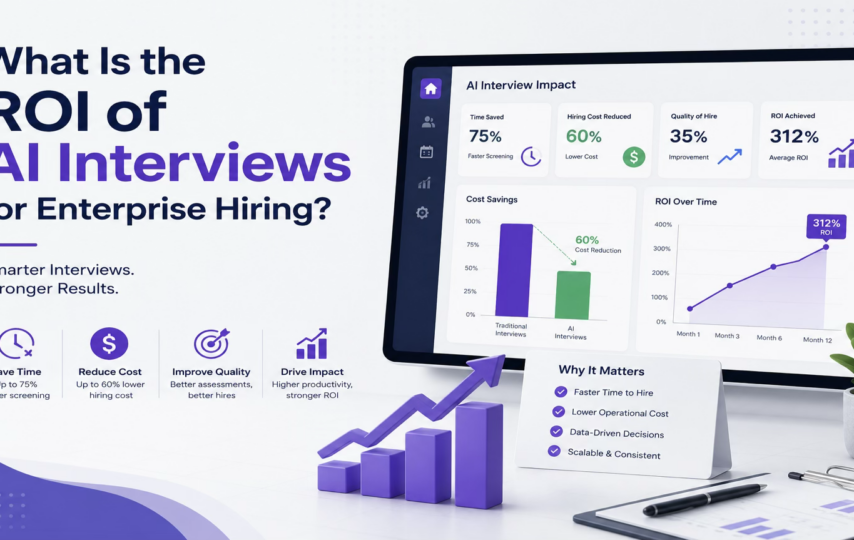

The return on investment from AI interviews for enterprise hiring is driven by four measurable levers: lower cost per hire, reduced time to fill, decreased regrettable turnover, and reallocated recruiter capacity. For organizations hiring at scale, these levers commonly translate into six figure to seven figure annual savings, depending on hiring volume, role mix, and how deeply AI interviews are integrated into the broader talent acquisition function.
This is not a marginal efficiency gain. It is a structural shift in how large organizations allocate recruiting spend, and it is why AI interviews have moved from a pilot initiative to a standard component of enterprise talent acquisition strategy. Below is a breakdown of the financial mechanics behind that ROI, supported by current industry benchmarks.
The Baseline Cost of Enterprise Hiring Today
Before evaluating the ROI of AI interviews, it is necessary to understand the cost structure they are being measured against.
- The average cost per hire in the United States for non executive roles is $5,475, according to SHRM’s 2025 Benchmarking Report (SHRM). Executive hires average $35,879, a figure that rose 21 percent from 2022 (SHRM).
- Median time to fill a role stands at 44 days (SHRM), though Employ’s 2026 Recruiting Benchmarks Report found the figure improving to 63.5 days among tracked companies in early 2026, down from 67.7 days in 2025 (Employ).
- A bad hire costs up to 30 percent of that employee’s first year salary, according to the U.S. Department of Labor (U.S. Department of Labor).
- Replacing an employee altogether, factoring in recruiting, onboarding, training, and lost productivity, costs between 50 and 200 percent of that employee’s annual salary, according to Gallup (Gallup). SHRM separately estimates full replacement cost at six to nine months of salary for many roles (SHRM).
- Voluntary turnover costs U.S. businesses approximately 1 trillion dollars per year in aggregate (Gallup).
At enterprise scale, these figures compound quickly. An organization hiring 500 people annually at the SHRM non executive average is carrying roughly 2.7 million dollars in direct recruiting cost before factoring in vacancy losses, bad hire risk, or recruiter overhead. This is the baseline that AI interviews are reducing.
Lever One: Reduction in Cost Per Hire
AI interviews reduce cost per hire primarily by compressing the labor intensive stages of the hiring funnel, specifically screening, first round evaluation, and scheduling coordination.
- Industry data indicates AI interviewing and screening tools save recruiters between 30,000 and 80,000 dollars per recruiter annually in reclaimed time, based on aggregated figures from multiple applicant tracking system providers (PeoplePilot).
- 89 percent of HR professionals whose organizations use AI in recruiting report that it saves time or increases efficiency, with the impact concentrated most heavily in screening and scheduling automation, according to SHRM’s 2025 Talent Trends Survey (SHRM).
- AI screening has been shown to reduce time to shortlist by 60 to 80 percent across multiple applicant tracking system platforms (PeoplePilot).
For an enterprise running a recruiting team of ten, reclaiming even a conservative portion of this per recruiter time savings represents a direct reduction in headcount cost, agency reliance, or overtime spend, without reducing hiring volume.
Lever Two: Reduction in Time to Fill
Time to fill is one of the most direct financial levers in enterprise hiring because every open day carries a quantifiable cost in lost productivity, delayed revenue contribution, or coverage gaps.
- With a median time to fill of 44 days, an open role generating even a modest 500 dollars per day in vacancy cost accumulates 22,000 dollars in losses before a single recruiting fee is paid (SHRM, Pin).
- A senior revenue generating role left open for 45 days can represent over 112,500 dollars in lost output, depending on the role’s contribution to revenue (TuraHire).
- AI screening and interviewing tools that operate in parallel across candidates, rather than sequentially through a single interviewer’s calendar, are the primary mechanism behind these reductions, since scheduling coordination and interviewer availability are consistently cited as the largest sources of hiring delay.
For enterprises hiring across multiple business units simultaneously, the parallel processing advantage of AI interviews scales in direct proportion to hiring volume, meaning the time to fill benefit compounds rather than plateaus as headcount needs grow.
Lever Three: Reduction in Bad Hire and Turnover Risk
A less visible but financially significant component of AI interview ROI is quality of hire and its downstream effect on turnover.
- The U.S. Department of Labor estimates a bad hire costs up to 30 percent of that employee’s first year salary (U.S. Department of Labor).
- Gallup estimates full replacement cost, once lost productivity and ramp up time are included, at 50 to 200 percent of annual salary, with leadership and management roles trending toward the higher end of that range and frontline roles toward the lower end (Gallup, Wellhub).
- Structured, consistent evaluation criteria, which AI interviews apply uniformly across every candidate, is associated with more predictive hiring outcomes than unstructured human interviews, a finding consistent with decades of industrial and organizational psychology research on structured interviewing.
For a large enterprise, even a modest reduction in mis-hire rate across a workforce of several thousand employees produces meaningful savings, since the cost of a single senior mis-hire alone can exceed 100,000 dollars once salary, replacement, and lost productivity are accounted for.
Lever Four: Recruiter Capacity Reallocation
The final ROI lever is less about direct cost reduction and more about the reallocation of high value recruiter time toward work that AI cannot replace, namely relationship building, negotiation, and strategic workforce planning.
- 75 percent of HR professionals report AI as their top technology investment priority, reflecting the extent to which recruiting leaders view this capacity reallocation as a strategic priority rather than a cost cutting exercise alone (Second Talent).
- Organizations that redesign recruiter workflows around AI tools, rather than layering AI on top of existing processes without change, report substantially larger returns, including up to 12 hours per week reclaimed per recruiter and a 14 day average time to fill in the most mature implementations (Pin).
- This distinction matters for enterprise buyers evaluating ROI. Gartner’s October 2025 survey of 114 HR leaders found that 88 percent report their organizations have not yet realized significant business value from AI tools, underscoring that ROI is concentrated among organizations that operationalize AI interviews deeply rather than adopt them superficially (Gartner).
Enterprise Adoption Context
The scale of enterprise adoption itself is useful context for benchmarking ROI expectations, since AI interviewing is no longer an early stage experiment among large employers.
- 80 percent of large enterprises use AI for some part of the recruiting process, the highest adoption rate of any HR function tracked by Gartner (Gartner, via PeoplePilot).
- Enterprise companies report 78 percent AI adoption in recruiting overall, representing 189 percent growth since 2022 (Second Talent).
- Technology companies lead adoption at 89 percent, followed by financial services at 76 percent and healthcare at 62 percent, indicating that regulated, high compliance industries are also moving toward AI-enabled hiring rather than avoiding it (Second Talent).
This adoption curve matters for ROI benchmarking because it indicates the competitive baseline is shifting. Enterprises evaluating AI interviews today are not comparing the technology against a static status quo, but against competitors who are already capturing these efficiency gains.
Calculating ROI for Your Organization
For C-suite and HR leadership evaluating AI interviews, a defensible ROI model should account for the following inputs, drawn from the benchmarks above:
- Current cost per hire, benchmarked against the SHRM non executive average of 5,475 dollars and executive average of 35,879 dollars (SHRM), adjusted for your organization’s actual role mix.
- Current time to fill, benchmarked against the 44 to 63.5 day range reported by SHRM and Employ, with vacancy cost calculated per role based on productivity or revenue contribution.
- Current mis-hire rate, informed by the Department of Labor’s 30 percent of first year salary estimate and Gallup’s 50 to 200 percent replacement cost range.
- Recruiter capacity, valued against the 30,000 to 80,000 dollar per recruiter annual time savings reported across ATS platforms (PeoplePilot).
Applied consistently, these four inputs produce a first year ROI model that most enterprise organizations can validate against their own hiring data within a single quarter of implementation, since cost per hire and time to fill are typically already tracked metrics within existing talent acquisition reporting.
Conclusion
The ROI of AI interviews for enterprise hiring is not a single number but the aggregate effect of four compounding levers: reduced cost per hire, reduced time to fill, reduced mis-hire and turnover risk, and reallocated recruiter capacity toward higher value work. Given that 80 percent of large enterprises already use AI somewhere in their recruiting process (Gartner), the strategic question for hiring leaders is no longer whether to adopt AI interviews, but how deeply to integrate them in order to capture the full range of financial return the data supports.