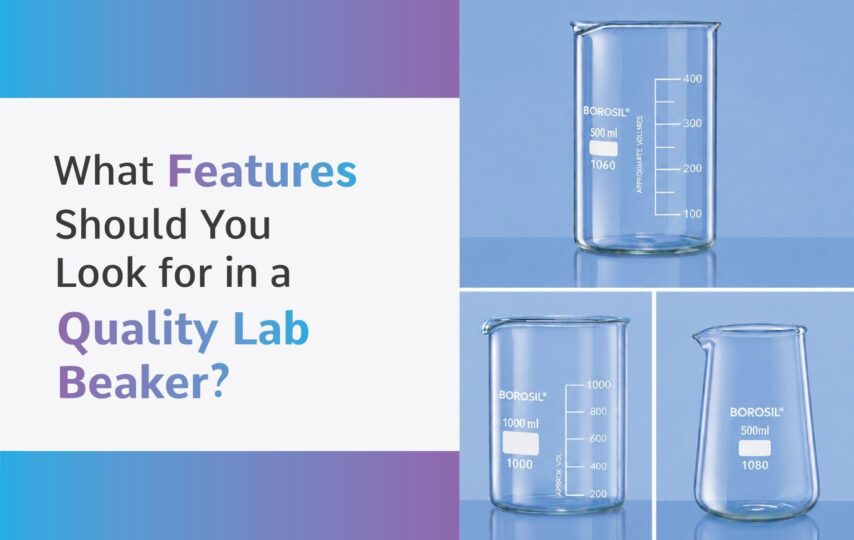

Selecting the right lab beaker is important for achieving safe and reliable laboratory results. Although beakers are among the most commonly used pieces of laboratory glassware, their quality can influence durability, handling and performance during routine procedures. Factors such as the type of glass, design features and manufacturing standards all contribute to their suitability for different applications. Understanding these features helps laboratory professionals and students make informed choices based on the requirements of their work.
Start with the Right Material
The material of a beaker plays an important role in its performance and suitability for laboratory use. Laboratories often handle chemicals and work under varying temperature conditions, so the glass should withstand these demands without compromising its properties. Borosilicate glass is widely used because it offers good chemical resistance and can tolerate temperature changes due to its low thermal expansion.
In addition to thermal and chemical resistance, borosilicate glass provides the mechanical strength required for routine laboratory applications. This combination of properties makes it suitable for a wide range of laboratory tasks. Many laboratory glassware manufacturers, such as Borosil Scientific, produce borosilicate glass beakers that comply with recognised laboratory standards.
When evaluating the material, consider the following factors:
- Chemical resistance: The glass should resist attack from many laboratory chemicals to help maintain the purity of solutions.
- Thermal shock resistance: The material should tolerate moderate temperature changes without increasing the risk of cracking.
- Mechanical durability: Good-quality borosilicate glass is better suited to repeated laboratory use when handled correctly.
Considering these characteristics together provides a better understanding of whether a beaker is suitable for everyday laboratory work rather than judging it on a single property.
Examine the Design Features
Material is only one part of the selection process. The physical design of a beaker also affects how easily it can be used during routine laboratory procedures. The following features contribute to practical performance.
| Feature | Why It Matters |
| Uniform wall thickness | Supports mechanical strength and more uniform heat distribution. |
| Pouring spout(where available) | Allows liquids to be transferred with greater control and helps reduce drips. |
| Clear graduations | Support approximate volume measurement during routine work. |
| Stable base | Improves stability while the beaker is placed on laboratory benches. |
| Large marking area | Makes sample identification easier during laboratory procedures. |
A well-designed beaker combines these features to improve handling, reduce the likelihood of spills and support routine laboratory tasks. Looking at the overall design instead of focusing on one feature helps users make a more informed selection.
Choose the Right Capacity and Beaker Form
The size and shape of a beaker should match the intended laboratory application. Selecting an appropriate capacity provides sufficient space for mixing or heating solutions while making laboratory handling more convenient.
The main points to consider are:
- Capacity: Choose a size that comfortably holds the required volume while allowing space for safe mixing and pouring.
- Low-form beakers: These have a wider profile and are commonly used for general mixing, reagent preparation and solution handling.
- Tall-form beakers: Their narrower profile makes them suitable for applications where a taller vessel improves handling, mixing or efficient use of laboratory space.
- Conical (Phillip) beakers: Their narrower opening helps reduce splashing and supports controlled swirling or decanting.
Choosing the correct capacity and form ensures that the beaker suits the intended laboratory task rather than relying on a single style for every application.
Verify Manufacturing Quality and Compliance
A beaker’s manufacturing quality is just as important as its material and design. Products manufactured according to recognised laboratory standards offer greater consistency in dimensions, construction quality and overall performance.
When reviewing manufacturing quality, pay attention to factors such as:
- Recognised standards: Compliance with standards such as IS 2619, ISO 3819 and DIN 12331 indicates that the beaker has been manufactured to established laboratory requirements.
- Consistent construction: Uniform dimensions and finish help deliver dependable performance across repeated use.
- Reliable markings: Clearly printed graduations and identification areas improve usability during routine laboratory work.
It is also important to use each type of laboratory glassware for its intended purpose. For example, test tube glassware is designed for handling relatively small sample volumes, whereas beakers are better suited to mixing, heating and preparing solutions. Selecting the appropriate glassware for each task supports safe and efficient laboratory practice.
Conclusion
Choosing a quality lab beaker requires careful evaluation of its material, design, capacity and manufacturing quality. Considering these features together helps ensure that the beaker is suitable for its intended laboratory application. Recognised standards and practical design features also contribute to reliable performance during routine laboratory use. By assessing these factors before selection, laboratories can choose beakers that support safe handling, reliable operation and dependable scientific work.