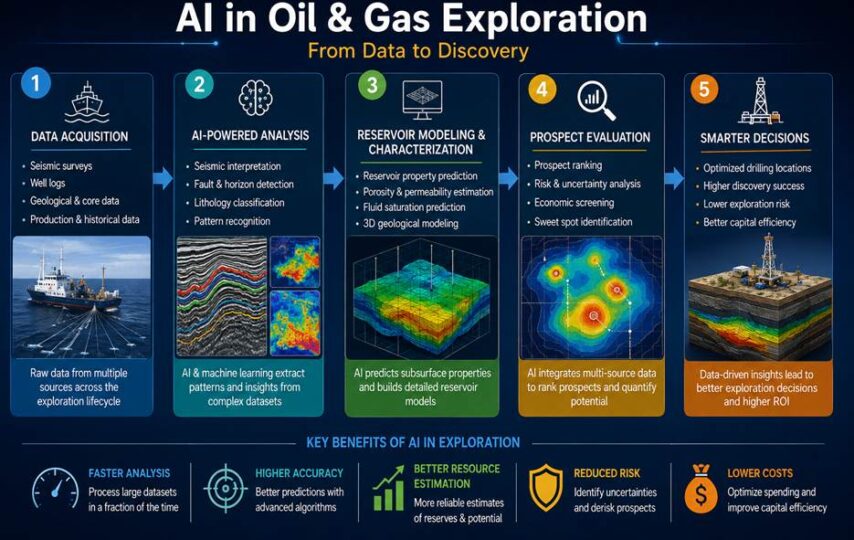

Oil and gas exploration has always depended on the ability to interpret incomplete information about what lies beneath the surface. Seismic surveys, well logs, geological studies, core samples, and historical field data provide pieces of that picture, but turning those pieces into a reliable exploration decision can take significant time and expertise.
Artificial intelligence is changing how this information is processed and interpreted. Machine learning and deep learning models can analyze large volumes of seismic, geological, and well data, identify patterns that may be difficult to detect manually, and support faster evaluation of potential reservoirs. Recent research is increasingly focused on combining AI with established geological and physics-based methods rather than replacing them.
The impact extends from seismic interpretation and prospect identification to reservoir characterization and prediction. This article explores where AI fits into the oil and gas exploration workflow, what it can improve, and what limitations companies need to consider before relying on AI-driven exploration decisions.
The Role of AI in Oil and Gas Exploration
Exploration generates several types of complex data. Seismic surveys produce large three-dimensional datasets, while well logs contain information about formations encountered during drilling. Geological models, production records, core samples, and petrophysical measurements add further context.
Traditionally, specialists interpret these datasets using a combination of software, geological knowledge, mathematical models, and experience. AI adds another layer by learning relationships within historical and labeled datasets and applying those patterns to new exploration areas.
Common AI applications include:
- Seismic interpretation
- Fault and horizon detection
- Lithology classification
- Reservoir property prediction
- Well-log interpretation
- Prospect evaluation
- Sweet-spot identification
- Seismic inversion
- Reservoir simulation
- Production and reservoir performance forecasting
Research published in 2026 highlights AI’s growing application across petroleum geology, geophysical exploration, reservoir characterization, and prospect evaluation.
1. AI-Powered Seismic Data Analysis
Seismic data is one of the most important sources of information during exploration. It is generated by sending energy into the subsurface and recording the reflected signals. The resulting data can help geoscientists understand geological structures and identify formations that may contain hydrocarbons.
The challenge is scale. Modern seismic surveys can contain enormous amounts of information, making manual interpretation time-consuming.
AI models can process seismic datasets and identify patterns associated with:
- Geological boundaries
- Faults and fractures
- Seismic horizons
- Salt bodies
- Stratigraphic features
- Potential reservoir zones
Computer vision and deep learning techniques are particularly useful for recognizing patterns in seismic images. Recent research has demonstrated AI applications for fault prediction and structural interpretation, including complex offshore seismic datasets.
Instead of asking geoscientists to examine every part of a seismic volume manually, AI can highlight areas that deserve closer investigation.
Faster Interpretation Does Not Mean Automatic Interpretation
AI should not be viewed as a replacement for geoscientists. A model can identify a possible fault or geological pattern, but specialists still need to determine whether the interpretation makes geological sense.
The most practical approach is therefore a human-AI workflow: AI performs large-scale pattern detection while domain experts validate the results and investigate uncertainty.
2. Improving Seismic Interpretation
Seismic interpretation involves converting raw seismic information into an understanding of the subsurface structure.
AI can assist with tasks such as seismic segmentation, horizon tracking, fault identification, and facies classification. Deep learning models can be trained on previously interpreted datasets and then applied to new seismic volumes.
This can reduce repetitive manual work and help standardize parts of the interpretation process.
For example, an AI model trained to recognize fault structures could scan a seismic volume and identify areas where similar patterns occur. A geoscientist can then review those predictions rather than manually search the entire dataset.
This becomes particularly valuable when exploration teams need to evaluate multiple prospects within a limited timeframe.
3. AI for Reservoir Characterization
Finding a geological structure is only part of the exploration problem. Companies also need to understand whether that structure has reservoir properties capable of supporting commercial production.
Reservoir characterization involves estimating properties such as:
- Porosity
- Permeability
- Fluid saturation
- Lithology
- Rock properties
- Reservoir boundaries
AI models can learn relationships between seismic attributes, well logs, core data, and known reservoir properties. They can then estimate those properties in locations where direct measurements are unavailable.
Recent research has explored AI-based prediction of porosity, permeability, and fluid saturation as part of automated reservoir characterization.
This can help create a more detailed representation of the reservoir before extensive drilling takes place.
4. Predicting Reservoir Properties From Seismic and Well Data
One of the major advantages of AI is its ability to combine different datasets.
For example, seismic data provides broad spatial coverage, while well logs provide detailed measurements at specific locations. AI can help establish relationships between these datasets and use them to estimate reservoir characteristics between existing wells.
A simplified workflow looks like this:
Seismic data + Well logs + Geological information → AI model → Reservoir property prediction → Geological interpretation
This approach can support exploration teams in identifying areas with more favorable reservoir characteristics.
However, prediction quality depends heavily on the quality and representativeness of the training data. A model trained in one geological basin may not perform equally well in another because geological conditions can differ significantly. Recent reviews identify data fragmentation, model generalization, and uncertainty as continuing challenges for AI deployment in subsurface applications.
5. AI in Prospect Evaluation
Exploration decisions often involve evaluating multiple potential prospects and estimating which ones justify additional investment.
AI can support prospect evaluation by analyzing geological, geophysical, and historical information to identify patterns associated with successful discoveries.
Instead of evaluating individual data sources separately, AI can combine multiple variables and generate predictions or probability estimates.
This can help exploration teams prioritize prospects for additional geological analysis, seismic acquisition, or drilling.
The important distinction is that AI provides decision support rather than certainty. A high-probability prediction does not guarantee a discovery because subsurface conditions remain uncertain.
6. Identifying Exploration Sweet Spots
Sweet-spot identification is particularly important in unconventional oil and gas exploration.
Reservoirs such as shale formations can contain significant geological variability. Factors such as rock properties, organic content, pressure, permeability, and natural fractures can influence the economic potential of different areas.
AI can analyze relationships among geological, seismic, drilling, and production data to identify areas with characteristics associated with better outcomes.
Recent reviews of AI in unconventional reservoirs identify sweet-spot mapping, seismic interpretation, lithofacies classification, geomechanical estimation, and reservoir forecasting among the key applications.
This creates an opportunity to move from broad geological assessment toward more data-driven prospect prioritization.
7. AI-Assisted Seismic Inversion
Seismic inversion attempts to transform seismic measurements into information about subsurface rock and fluid properties.
The process can be computationally demanding and sensitive to assumptions about the geological model.
AI can act as a complementary layer by learning relationships between seismic responses and known reservoir properties. Researchers are increasingly exploring hybrid approaches that combine deep learning with geostatistical and physics-based constraints.
For example, recent work has examined physics-guided deep learning for reservoir fluid discrimination to improve prediction reliability while retaining geological constraints.
This is an important direction because purely data-driven models can produce predictions that appear plausible but do not necessarily conform to physical behavior.
8. AI and Reservoir Simulation
AI is also changing what happens after initial reservoir characterization.
Traditional reservoir simulation can require significant computational resources, particularly when companies need to test multiple geological scenarios. AI-based surrogate models can approximate some simulation outputs much faster.
This creates opportunities for:
- Faster scenario analysis
- Production forecasting
- Reservoir optimization
- History matching
- Injection planning
- Uncertainty analysis
A 2026 review found that AI integration with conventional reservoir simulators can accelerate reservoir modeling, while physics-informed approaches can improve prediction and uncertainty quantification.
Rather than replacing established simulators, AI can therefore serve as a computationally efficient complement.
9. Moving From Data Analysis to Exploration Decisions
The larger change is not simply that AI can analyze seismic data faster.
Its value comes from connecting multiple stages of the exploration workflow.
A more integrated AI workflow could look like:
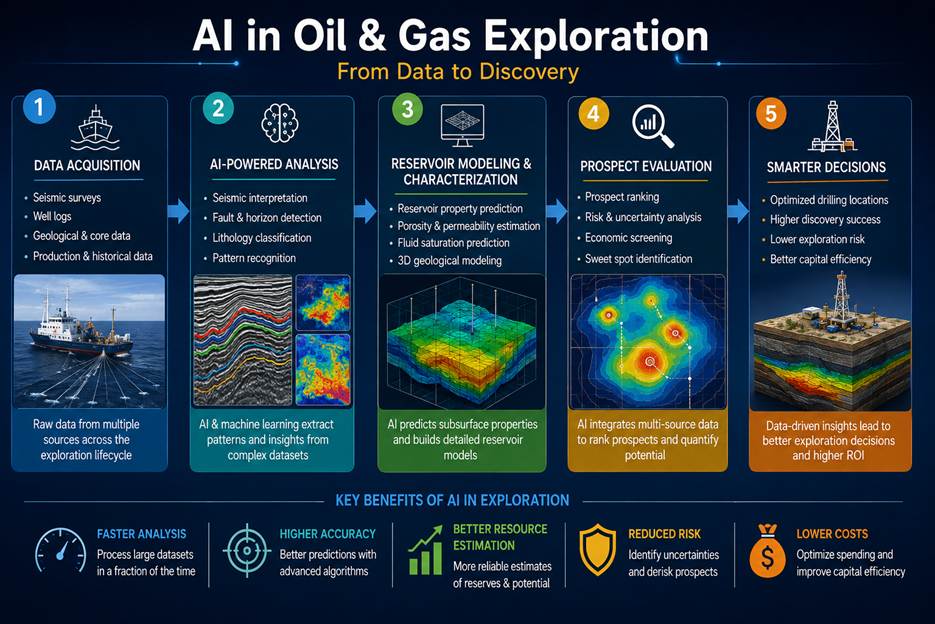
Data acquisition → Data preparation → Seismic interpretation → Geological modeling → Reservoir characterization → Prospect ranking → Drilling decision
Historically, these activities have often involved separate teams and systems. AI can help connect information across those stages, provided the underlying data is accessible, standardized, and properly governed.
This is where AI can move from being an individual analytical tool toward becoming part of an exploration decision-support system.
What Are the Benefits of AI in Oil and Gas Exploration?
These benefits explain why AI in the oil and gas industry is moving from experimental projects toward broader adoption across exploration and production workflows.
Faster Data Processing
AI can process large datasets considerably faster than manual workflows, allowing exploration teams to evaluate more information within the same timeframe.
Better Pattern Recognition
Machine learning can identify nonlinear relationships and subtle patterns across seismic, geological, and well datasets that may be difficult to detect consistently through manual analysis.
More Detailed Reservoir Models
AI can help estimate reservoir properties between wells and produce more detailed subsurface models.
Improved Prospect Prioritization
By combining multiple data sources, AI can help teams rank prospects and focus resources on areas with stronger indicators.
Reduced Repetitive Work
Automating repetitive interpretation tasks can allow geoscientists to spend more time on validation, geological reasoning, and decision-making.
The Challenges of Using AI for Exploration
AI does not eliminate the fundamental uncertainty associated with subsurface exploration.
Data Quality
AI models are dependent on the quality of their training data. Missing, inconsistent, biased, or poorly labeled datasets can lead to unreliable predictions.
Limited Transferability
A model that performs well in one basin may not produce the same results in another geological environment. Differences in geology, seismic characteristics, well availability, and data quality can affect model performance.
Explainability
Exploration decisions can involve substantial financial and operational consequences. Teams therefore need to understand why a model produced a particular prediction rather than treating its output as an unquestionable answer.
Integration With Existing Systems
Oil and gas companies already use specialized geological, geophysical, reservoir, and engineering systems. Integrating AI into these environments can be more difficult than building a standalone model.
Human Expertise Remains Essential
AI can identify patterns, but geological interpretation requires context. Experienced geoscientists still need to validate predictions, challenge model outputs, and account for information that may not exist in the training data.
Why Physics-Informed AI Matters?
One of the important developments in AI-driven exploration is the move toward hybrid models.
Instead of relying entirely on statistical relationships, physics-informed AI incorporates known physical laws or geological constraints into the modeling process.
This approach can reduce some of the weaknesses associated with black-box models.
For subsurface applications, this matters because a prediction should not only fit historical data. It should also make sense within the physical behavior of the reservoir.
Recent research into AI-based reservoir simulation and seismic inversion is increasingly exploring these hybrid approaches.
The Future of AI in Oil and Gas Exploration
The next phase of AI in exploration is likely to focus less on isolated machine learning models and more on integrated intelligence across the exploration lifecycle.
AI systems could increasingly combine seismic data, well logs, geological models, reservoir simulations, and operational information to provide a continuously updated view of subsurface conditions.
The direction is also moving toward models that combine domain knowledge with data-driven learning. Recent research on shale exploration identifies this combination of geological knowledge and heterogeneous data as an important path for overcoming current AI limitations.
Over time, exploration workflows could become more collaborative, with AI handling large-scale data analysis and scenario generation while geoscientists remain responsible for interpretation and critical decisions.
Conclusion
AI is changing oil and gas exploration by making it possible to analyze complex subsurface data at a scale and speed that traditional workflows struggle to achieve. From seismic interpretation and fault detection to reservoir characterization and prospect evaluation, AI can support exploration teams at multiple stages.
The biggest opportunity is not to replace geological expertise with algorithms. It is to combine AI’s ability to process large datasets and recognize patterns with the experience of geoscientists and reservoir engineers.
As the technology matures, the most valuable exploration systems will likely be those that combine AI, physics, geological knowledge, and human judgment rather than relying on any one of them alone.