
Introduction
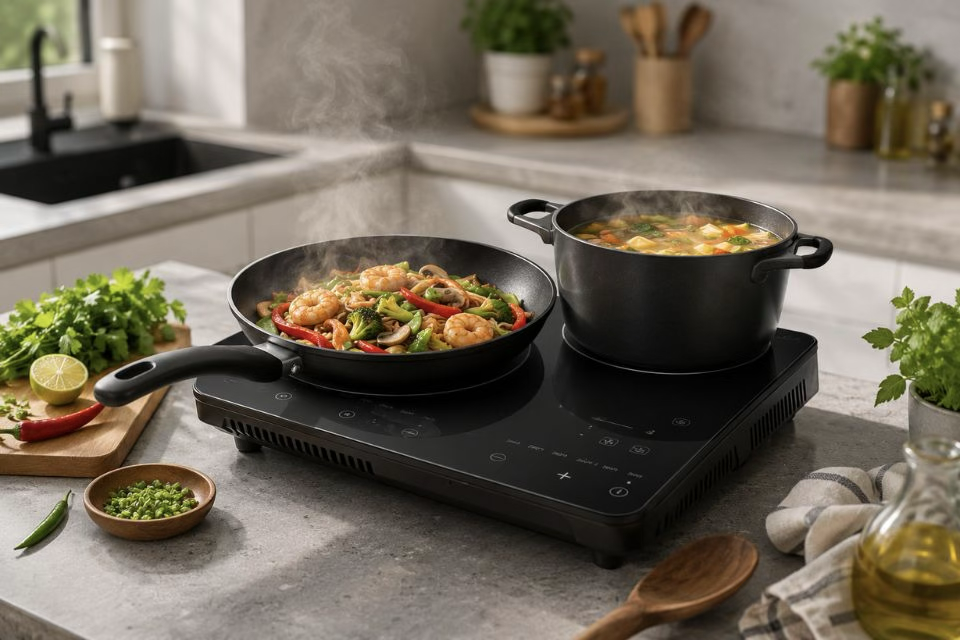
Choosing an induction cooker can make one specification confusing: wattage. A 1,500W model may be perfectly capable for everyday meals, while an 1,800W or higher model can offer useful extra heating power. However, that does not automatically make the higher-powered option better for every household. The right choice depends on what you cook, how much food you prepare, the cookware you use, and how quickly you want to heat it.
Understanding induction cooker wattage helps you compare models more realistically. Wattage indicates available electrical power, but actual cooking performance and energy use depend on several factors. A compact cooker with moderate power can be practical for simple meals, while a higher-powered unit may be more useful for larger portions and high-heat cooking. This guide explains common wattage ranges, compares 1,500W and 1,800W options, and shows how power relates to everyday cooking.
What Does Induction Cooker Wattage Actually Mean?
Wattage measures the rate at which an appliance uses electrical power. Understanding induction cooker wattage helps explain how much heating power an appliance can provide at its highest setting. For example, a cooker rated at 1,800 watts has greater maximum power capacity than a comparable 1,500-watt model. That additional capacity can be useful when you need to heat cookware quickly or maintain stronger heat during demanding cooking tasks.
The important distinction is that rated wattage does not mean the cooker continuously draws that amount of electricity. Most induction cookers provide multiple power levels, allowing the appliance to operate below its maximum rating. Power use can also change throughout cooking as you adjust the setting or the appliance regulates heat. Therefore, a high wattage figure indicates maximum available power, not the exact amount of electricity the cooker will consume during every meal.
How Many Watts Does an Induction Cooker Need for Everyday Cooking?
For many everyday cooking situations, a single induction cooking zone rated around 1,500W to 1,800W provides a useful balance of heating capability. Lower-powered models can still handle lighter cooking, reheating, simmering, and smaller portions. Models around 1,800W or above may be more convenient when you regularly boil water, cook larger quantities, or want stronger high-heat performance.
There is no universal wattage that every household needs. Someone preparing small meals for one person may be comfortable with less power, while a family that regularly cooks larger portions may appreciate additional capacity. Cookware also matters. An induction-compatible pan with a suitable base and diameter can transfer heat effectively, while poorly matched cookware can limit results even when the cooker has a high rating. The best wattage is therefore the amount of available power that fits your normal cooking routine.
Is 1,500 Watts Enough for Everyday Cooking?
Yes, a 1,500-watt induction cooker can be sufficient for many everyday cooking tasks. It can provide practical heating for boiling smaller amounts of water, cooking rice, sautéing vegetables, reheating meals, simmering sauces, and preparing portions. For someone who values a compact setup and does not regularly cook large quantities, 1,500W can offer a sensible balance between capability and power demand.
The main limitation appears when you need to heat a large pan or pot quickly. Bringing a substantial quantity of cold water to a boil generally takes longer than heating a smaller amount. High-heat cooking can also benefit from additional available power. Even so, choosing a 1,500-watt induction cooker does not mean accepting poor performance. Results depend on cookware, food quantity, starting temperature, selected setting, and the design of the appliance. For many households, 1,500W is a practical everyday option for many households.
Is 1,800 Watts Better Than 1,500 Watts?
An induction cooker rated at 1,800 watts has greater maximum heating capacity than a comparable 1,500W model. That can be useful when boiling water, heating larger quantities, or cooking at higher temperatures. If two appliances have similar designs and controls, the higher-powered model can provide more headroom when maximum heating is needed.
However, 1,800W is not automatically better for every user. Someone who mainly simmers, reheats food, or prepares modest portions may rarely use the additional capacity. Cooking speed also depends on pan material, pan size, food quantity, starting temperature, and how effectively the appliance transfers energy into compatible cookware. In other words, the extra 300 watts can be valuable in specific situations, but it should not be treated as a guarantee of proportionally faster cooking. Choose the higher rating when your routine actually benefits from it.
Does Higher Wattage Mean Faster Cooking?
Higher wattage can support faster heating because more electrical power is available, but it does not guarantee proportionally faster cooking. A cooker may have plenty of available power, yet a poorly matched pan, large food load, or unsuitable cooking surface can reduce the practical benefit. Starting with cold ingredients can also make a meal take longer regardless of the appliance’s maximum rating.
Cookware is especially important with induction cooking because the magnetic field needs compatible cookware to generate heat effectively. A suitable pan with an appropriate base can improve heat transfer, while the pan’s diameter and material also influence performance. Food quantity, starting temperature, selected power level, and the cooker’s control system matter as well. This is why wattage should be viewed as one part of performance rather than a complete measure of cooking speed. A well-designed 1,500W cooker can be entirely effective for a particular task.
How Much Electricity Does an Induction Cooker Use?
Wattage describes power, while electricity consumed over time is commonly measured in kilowatt-hours, or kWh. To understand the relationship, convert watts to kilowatts and multiply by operating time. A 1,500W cooker equals 1.5 kilowatts, so if it operated continuously at full rated power for one hour, it would theoretically use 1.5 kWh of electricity.
Real cooking is usually less demanding than that simple example suggests because an induction cooker does not necessarily operate at maximum power for the entire session. You might start at a higher setting, reduce the heat after reaching a boil, and then use a lower level for simmering. Some models also regulate power as needed. Consequently, a higher maximum wattage does not automatically mean higher electricity consumption for every meal. Actual use depends on the selected power level, cooking duration, and how the appliance manages heat.
What Wattage Is Suitable for Different Cooking Tasks?
Different cooking tasks call for different amounts of available power. Lower settings are useful when maintaining heat or gently simmering food, while moderate settings can handle many reheating and sautéing tasks. Higher settings become more useful when you want to heat cookware quickly or bring water to a boil.
As a practical guide:
- Simmering and keeping food warm generally require lower power.
- Reheating and gentle cooking can use moderate power.
- Sautéing often benefits from moderate to higher settings.
- Boiling water may benefit from higher available power.
- Larger quantities and high-heat cooking can benefit from greater power capacity.
These are guidelines rather than fixed wattage rules. The appropriate setting depends on the cookware, ingredients, quantity, and recipe. In everyday use, precise power control can be just as valuable as maximum wattage because it lets you adjust heat to the task instead of operating at full power unnecessarily.
What Should You Consider Besides Wattage?
Wattage should not be the only factor when evaluating an induction cooker. Cookware compatibility is essential because induction heating requires suitable magnetic cookware. Pan diameter also matters because a pan that is poorly matched to the cooking zone may not heat as effectively. Temperature controls and the number of power levels can affect how easily you move from rapid heating to gentle simmering.
Other considerations include safety features, timers, the number of cooking zones, electrical requirements, and available countertop space. Think about how the appliance fits your kitchen instead of focusing only on its largest power rating. An induction cooker is designed primarily for stovetop cooking, while an oven serves different purposes such as baking, roasting, and oven-based reheating. If you are considering a complementary countertop appliance for those tasks, the Ciarra Nosh Oven can be evaluated separately based on its capacity, functions, and how well it fits your available space.
Electrical requirements deserve attention too. Before using a higher-powered countertop appliance, check the manufacturer’s specifications and make sure the outlet, plug, and household circuit are suitable. Avoid assuming that more wattage is automatically preferable simply because it offers more heating capacity. Matching the appliance to your kitchen’s electrical setup is an important part of making a practical choice.
How to Choose the Right Induction Cooker Wattage for Your Kitchen
Start with your cooking habits rather than the number printed on the specification sheet. If you mainly reheat food, simmer sauces, prepare small portions, or make simple meals, you may not need the highest available wattage. A moderate-powered cooker can provide enough capacity while remaining practical for a compact kitchen.
For regular everyday cooking, 1,500W to 1,800W can be a useful starting range for many users. If you frequently boil larger amounts of water, prepare bigger portions, or rely on high heat, additional power may be worthwhile. Before choosing, also check cookware compatibility, pan size, electrical requirements, controls, safety features, and countertop space. The goal is not to find the biggest wattage rating; it is to choose enough available power for your real cooking needs without paying attention only to the maximum number.
Conclusion
There is no single perfect induction cooker wattage for every kitchen. For many everyday users, 1,500W can handle common cooking tasks effectively, while 1,800W offers additional heating capacity when larger quantities or higher heat are needed. The difference becomes most useful when your cooking routine regularly demands stronger heating, rather than during every meal.
Remember that wattage is only one part of performance. Cookware compatibility, pan size, food quantity, temperature control, cooking time, and appliance design can all influence results and energy use. Choosing wisely therefore means looking beyond the specification label and considering how you actually cook. If you are also comparing compact kitchen appliances for different cooking needs, Ciarra Appliances is one option you can explore as you build a practical cooking setup.
FAQs
1. How many watts is good for an induction cooker?
For many everyday cooking needs, an induction cooker rated around 1,500W to 1,800W can provide a practical balance of heating power and usability. The ideal wattage depends on cooking quantity, cookware, and the types of meals you prepare.
2. Is 1,500 watts enough for everyday cooking?
Yes. A 1,500W induction cooker can handle many common tasks, including simmering, sautéing, reheating, cooking rice, and boiling smaller amounts of water. Higher wattage may be useful for larger quantities or frequent high-heat cooking.
3. Is an 1,800-watt induction cooker better than a 1,500-watt model?
An 1,800W model provides more maximum heating capacity, which can be useful for larger quantities and high-heat cooking. However, higher wattage does not automatically mean better performance for every cooking task.
4. Does a higher-wattage induction cooker use more electricity?
Not necessarily during every cooking session. A higher-wattage cooker has greater maximum power capacity, but actual electricity consumption depends on the selected power level, cooking time, and how the appliance regulates heat.
5. Does higher wattage make an induction cooker cook faster?
Higher wattage can allow an induction cooker to provide more heating power, potentially reducing heating time in some situations. However, cookware, pan size, food quantity, starting temperature, and appliance design also affect cooking speed.