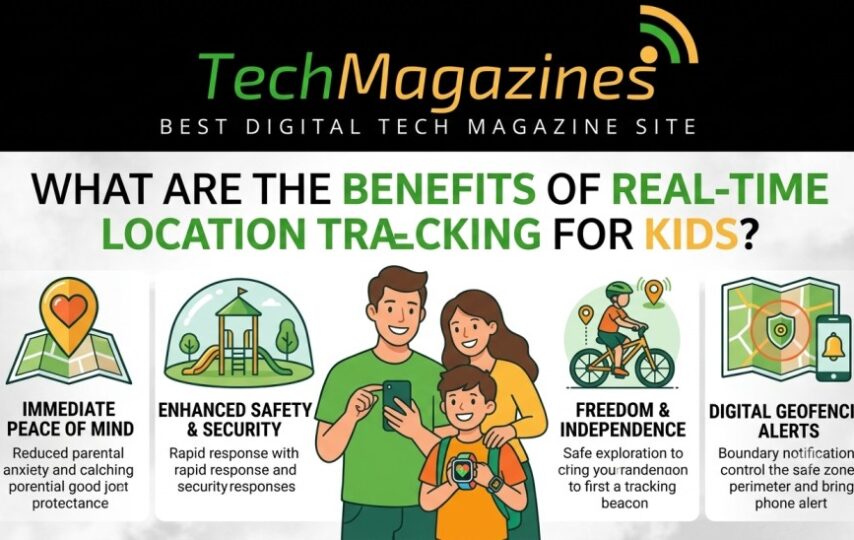

Real-time location tracking can help parents stay informed when a child is travelling independently, arriving somewhere, or moving through a busy place. Its value is having useful information available when a family needs it while still giving children room to build independence.
For parents considering a kids GPS watch, it helps to understand the different features that are available. This includes whether location information is available in real-time, if real-time alerts are available, and if so, for how many saved places, and whether you can access location history. .
]
What Does “Real-Time” Actually Mean on a Kids GPS Watch?
Before comparing location features, it helps to understand what real-time location actually provides and where its limitations lie.
Location sharing can show where someone is, where they have been or where they are going. Depending on the service and settings, location information may be shared live or retained as location history. When checking a child’s location, consider:
- The location currently shown.
- When it was last updated.
- Whether the device is connected.
- Whether the information is live or historical.
In practice, “real-time” means location information that is updated through a connected service. It should not be interpreted as a guarantee of continuous, second-by-second positioning.
What Can Affect Location Updates?
Location services depend on the device, its connection and the environment around it. Different wearables can use different approaches to update location. When comparing devices, check:
- How do location updates work?
- How recent is the information?
- What happens when connectivity is limited?
This gives parents a more realistic understanding of what the wearable can provide.
How Location Accuracy Can Vary?
Location accuracy can vary according to the surrounding environment.
GPS.gov explains that positioning can be affected by satellite geometry, signal blockage, atmospheric conditions and receiver design. Accuracy can also worsen near buildings, bridges and trees, while indoor or underground environments can create additional challenges.
This means a location point should be treated as useful information rather than a guarantee of an exact position.
When Can Location Tracking Be Most Useful?
Location tracking is most valuable when it solves a genuine family need, particularly during everyday moments when a child is gaining more independence.
1. School Journeys
Location information can help parents understand whether a child has reached the expected area without repeatedly calling or messaging.
Location-based alerts can make this more practical by notifying a parent when a child arrives at or leaves a familiar location.
2. The Gap Between School and Pick-Up
Location tracking can give parents another way to understand what is happening when the usual routine changes.
It does not replace communication. Children should still know who to contact and what to do if plans change.
3. Crowded Places and Excursions
Real-time location sharing can be useful in busy places such as busy parks, where finding family members in a crowd may be difficult.
The same principle can apply during school excursions and holidays, when routines may be different from the usual school day.
4. First Independent Outings
A child may first walk with a parent, then with friends and eventually take a familiar route independently.
Location tracking can form part of that transition by giving parents useful information while the child takes on more responsibility.
The purpose is to support a child’s growing independence while giving parents useful information when they need it.
Which Features Make Location Information More Useful?
A location dot alone does not necessarily make a wearable useful. Supporting features can determine whether location information helps with everyday routines.
1. Safe Zones and Arrival Alerts:
Parents do not need to keep checking a map throughout the day. Safe zones can send notifications when someone arrives at or leaves a defined location. Useful locations might include:
- Home
- School
- A grandparent’s house
- A regular activity
- A trusted friend’s home
- The bus stop
2. Location History:
Live location answers: “Where are they now?”
Location history answers: “Where have they been?”
These serve different purposes. Location history can help a parent understand a journey after the fact, particularly when a routine changes. Storage periods differ between services, so check:
- How much history is retained?
- Who can access it?
- What privacy controls are available?
- Can the history be deleted?
3. SOS and Location Sharing:
An SOS function can add useful context when a child needs help.
When an emergency alert includes location information, the recipient may have more context about where assistance is needed, and be able to get there faster..
What Trade-Offs Should Parents Consider?
Location tracking has practical limits as well as benefits. Understanding them helps families choose a wearable based on how it will actually be used.
1. Battery Life and Location Frequency:
A connected wearable needs power to provide connected services.
Frequent location information can be useful, but the watch also needs enough battery to remain available throughout the child’s day. Compare:
- Stated battery life.
- Charging requirements.
- Location update behaviour.
- Connectivity requirements.
2. Location Tracking and Growing Trust:
Location tracking can feel different as children become more independent.
Parents may want to stay informed while children increasingly want to understand how their personal information is being used. Children should understand:
- Why is location sharing being used?
- Who can see their location?
- When is it being shared?
- What happens to the information?
- How may the arrangement change as they grow?
3. Location Data and Privacy:
Privacy should be considered alongside accuracy and battery life. When comparing a wearable, check:
- Who can access location information
- What privacy controls are available
- What information is stored
- How long it is retained
- Whether information is shared with other parties
That makes privacy a practical part of choosing and setting up a connected wearable, rather than something to consider after the device is already in use.
How Can Families Use Location Tracking Without Overusing It?
Location tracking works best when families agree on how and when it should be used. Clear expectations can prevent it from becoming another source of daily notifications or disagreement.
1. Alerts That Add Value:
Start with alerts that solve an everyday problem, such as:
- Arriving at & leaving school.
- Arriving home.
- Leaving a regular location, such as the local park or sports training.
- SOS notifications.
The aim is to make location information useful and reassuring, rather than creating another stream of interruptions.
2. Explaining Location Tracking to Your Child:
Keep the conversation simple and age-appropriate. Explain:
- Who can see their location?
- Why is location sharing being used?
- When is it active?
- How can they contact trusted people?
- What happens if the device loses connectivity?
Children should understand who can access information about them and why it is being shared. That makes location tracking part of a shared family conversation rather than something that happens silently in the background.
Closing Thoughts
Real-time location tracking can be useful when it gives parents timely information without taking away a child’s growing independence.
The strongest approach is to understand how location information works, choose features that support genuine family needs and use alerts when they add value.
Before choosing a wearable, compare location freshness, accuracy, connectivity, battery life, location history, alerts and privacy controls.
Used thoughtfully, location tracking can help families stay connected through everyday moments while children gain the confidence and freedom to take their next steps independently. After all, a single alert is much easier than 10 SMSs asking ‘have you arrived ye’, that often go unanswered!