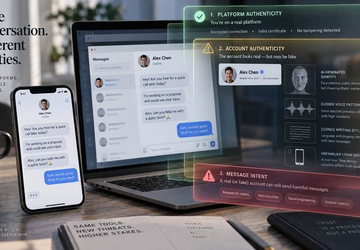

Artificial intelligence is making impersonation easier to produce and harder to dismiss at a glance.
A fraudulent support representative no longer needs to write awkwardly. A fake executive request can be polished, concise and tonally convincing. Voice synthesis can make an unexpected call sound familiar, while generative tools can reproduce brand language, profile descriptions and customer-service scripts in seconds.
That has pushed much of the security conversation toward a familiar question: how can people tell whether something online is real?
The problem is that “real” now covers several different things.
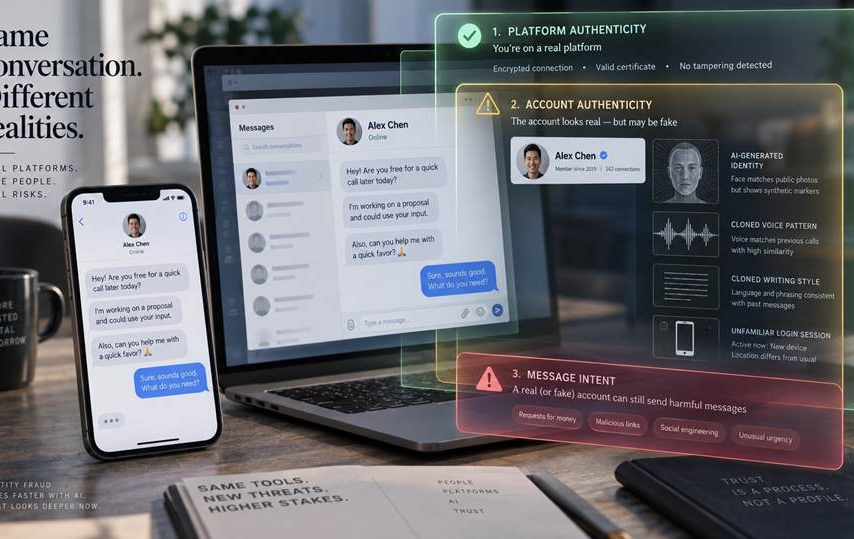
A website can be legitimate while an account operating inside it is fraudulent. An account can genuinely belong to a colleague while an attacker controls the active session. A message can come from the right account and still contain a request the owner never intended to send.
Treating those as one verification problem leaves a gap that attackers can exploit.
Start With the Platform, but Do Not Stop There
The first check is still basic: are you actually using the service you think you are using?
Fake login pages, lookalike domains and copied interfaces remain effective because users often move from a search result, advertisement or forwarded link directly into an authentication flow.
For higher-risk interactions, it is safer to begin from a web property already known to belong to the service or organisation in question rather than trusting whatever appears first in search.
That is particularly important with messaging platforms, where the platform and the accounts inside it are separate trust layers. Someone trying to establish the platform layer first might use an independent Telegram 官網指南 to compare the service’s main web properties before evaluating a particular account, group or invitation.
The distinction is important.
Opening a genuine messaging platform establishes that the infrastructure is real. It does not establish that “Company Support,” “Accounts Team” or “John from Finance” is who the display name claims.
Fraudsters often do not need to imitate an entire platform. Creating a convincing identity inside a legitimate one is easier.
The safest path therefore runs in the opposite direction from the way many people browse. Instead of finding an unfamiliar account and asking whether it looks official, start from a website, verified profile, customer portal or other property the organisation already controls, then follow its published contact information outward.
That creates a traceable chain of trust.
The More Difficult Case Is a Real Account
A fake account can sometimes be exposed through inconsistencies in a username, profile, history or link.
A compromised account is harder.
Imagine receiving a message from a colleague you have spoken with for years. The conversation history is still there. The profile photo is correct. Earlier messages are genuine.
Then a new message appears:
“Can you send me the verification code you just received? I’m locked out.”
Nothing about the sender looks unusual because the attacker is not pretending to own the account. The attacker may already control it.
Account takeover effectively transfers the victim’s accumulated trust to someone else. Existing contacts, group memberships and prior conversations all become part of the attacker’s credibility.
This is why identity and intent need to be separated.
“Is this Alice’s account?” is one question.
“Did Alice intend to make this request?” is another.
The answer to the first can be yes while the answer to the second is no.
That distinction matters most when a message asks for something consequential: a login code, a payment, a new bank account, a confidential document, a device approval or an unexpected software installation.
Familiarity should lower friction in ordinary conversation. It should not override the risk of an unusual transaction.
AI Weakens the Signals People Traditionally Trust
People have long relied on informal indicators of authenticity: grammar, tone, personal knowledge, writing style or the way someone typically phrases a request.
Those signals still have value, but their evidentiary weight is shrinking.
A generative model can clean up poor language. Public information can provide names, job titles and relationships. Stolen message history can reveal how a person normally communicates. Voice cloning can add another layer of familiarity.
None of this means every polished message should be treated as suspicious. It means that presentation alone should carry less weight when the requested action has a high cost if it is wrong.
One useful rule is to scale verification with consequence.
A colleague asking what time a meeting starts needs little ceremony.
The same colleague announcing an urgent change to payment instructions deserves an independent check.
That check should also happen somewhere else.
Replying “Is this really you?” inside a potentially compromised account proves very little. An attacker already controlling the session can simply answer yes.
For high-impact requests, verification should move to a second channel: a known phone number, corporate email, internal ticketing system, face-to-face conversation or another previously established route.
Security teams often describe this as out-of-band verification. The principle is simple: a channel under suspicion should not be allowed to certify itself.
Authentication Is Only Part of Account Recovery
Strong passwords and multi-factor authentication remain important because preventing an account takeover is easier than cleaning one up.
But account security does not end with credentials.
An attacker who already has an active session may continue to possess access even after the victim realises something is wrong. Depending on the service and incident, session theft can also allow an attacker to operate from an authenticated environment without repeatedly entering the victim’s password.
That makes device and session review part of recovery.
Users investigating suspicious access may find a Telegram account security guide useful for understanding login behaviour, authorised devices and session controls. The same principle applies more broadly: after an account-security incident, the question is not only “Did I change the password?” but also “Which devices and sessions are still trusted?”
Password reset is an action.
Restoring confidence in the account is a process.
The user may need to terminate unfamiliar sessions, review security settings, confirm recovery information and warn contacts who could have received messages while the account was compromised.
That last step is often overlooked.
If an attacker used a trusted account to contact 20 colleagues before losing access, removing the attacker solves only the access problem. It does not undo the messages already sent.
Trust also has to be repaired.
Even Genuine Security Messages Can Be Used in a Scam
Another common mistake is to confuse the authenticity of a notification with the legitimacy of the request surrounding it.
A service may genuinely send a login code, device approval alert or password-reset notification.
That does not mean the person asking for the code should receive it.
The more useful question is: did the user initiate the action that caused the notification?
If the answer is no, an unexpected code is evidence that someone may be attempting to enter the account. It is not evidence that the person requesting the code is legitimate.
This distinction becomes particularly important when attackers combine social engineering with genuine authentication workflows.
The security system may be functioning exactly as designed while the human being is being manipulated into completing the attacker’s login.
The message is real.
The surrounding story is not.
Businesses Need a Known Place for Official Contact Information
Organisations can reduce this ambiguity before an incident occurs.
Customers and employees should not have to search independently for every support account, messaging channel or social profile. A company can maintain a canonical contact page listing the communication channels it currently recognises.
That page becomes a reference point when someone receives an unexpected message claiming to represent the business.
It also solves a less dramatic but common problem: digital contact information ages.
A Telegram group used for an old campaign may still appear in search. A support account may be abandoned after a vendor change. A social profile created by a former employee can remain visible long after the organisation has stopped using it.
A link may once have been legitimate and still be wrong today.
Businesses therefore need to treat public communication channels as assets with a lifecycle. Someone should know who owns them, where they are listed and what happens when they are retired.
For consumers, that creates a much stronger verification path than judging a profile by its branding alone.
Security Should Follow the Risk of the Request
There is no single badge, domain check or authentication control that can answer every question of online identity.
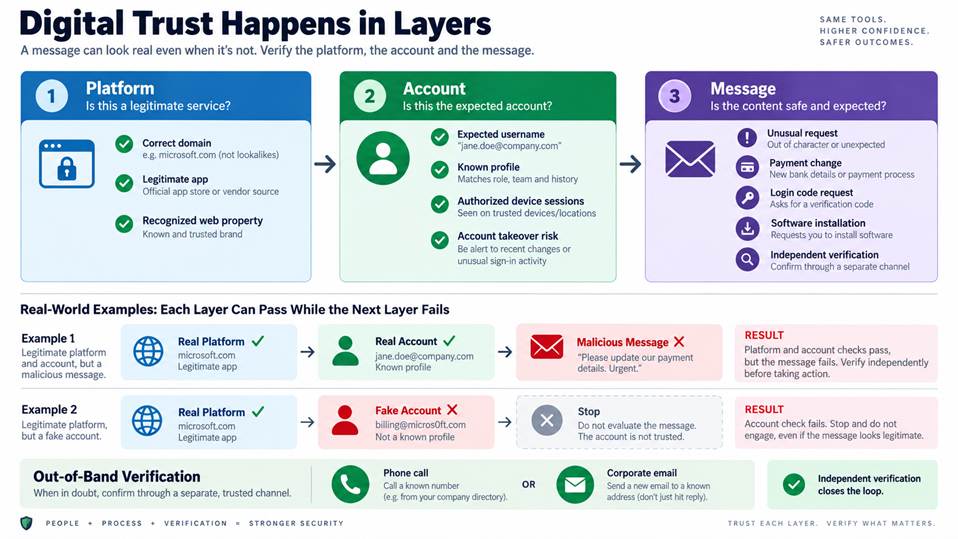
The more resilient approach is layered.
First, establish that the platform or website is genuine.
Then determine whether the account belongs to the person or organisation it claims to represent.
If the account is familiar, consider whether it may have been compromised.
Finally, examine the action being requested.
This last step matters because the consequences are often the best guide to how much verification is appropriate.
A routine project update and an instruction to install software are not equivalent.
A delivery question and a request to change banking details are not equivalent.
A normal conversation and a request for a one-time login code are not equivalent.
Companies can test whether employees understand this distinction through simple tabletop exercises. Present a real-looking support account, a familiar colleague asking for a verification code and an executive requesting an urgent transfer. Then ask employees not merely whether each message “looks real,” but what they would verify and through which independent channel.
The exercise often exposes a gap between authentication awareness and trust awareness.
People may know how to spot a fake login page yet still comply with a dangerous request from a real, compromised account.
AI makes that gap more important because attackers can increasingly imitate the surface signals people associate with legitimacy.
The answer is not to distrust every digital interaction.
It is to stop asking one overloaded question — “Is this real?” — when several different questions are required.
Is this the real platform?
Is this the expected account?
Is the account still under the owner’s control?
And does this specific request make sense?
Each layer can be genuine while the next one fails.
Modern digital trust depends on checking them separately.