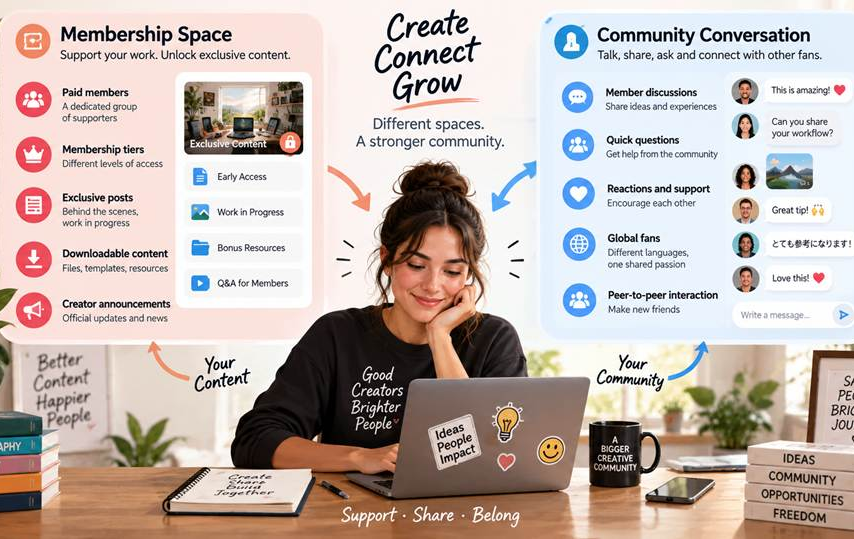

There is a point in the growth of many creator communities when one space starts feeling crowded.
A membership post becomes a place for support questions. A comment thread turns into an ongoing conversation. Members want somewhere to share their own work, react to a new release, ask quick questions or simply talk to one another between creator updates.
The obvious response is often to open another community space.
Sometimes that works brilliantly.
Sometimes it creates a second place the creator now has to moderate, explain, update and remember.
The useful question is not whether creators should use Patreon, Telegram, Discord or any other particular platform. It is whether adding another space solves a problem that already exists.
Patreon itself now gives creators several ways to keep conversation close to the membership, including comments, direct messages and Community Chats. For many creators, that will be enough.
But some communities still benefit from a second conversation layer—perhaps because fans already gather elsewhere, because the audience spans several languages, or because an open fan community serves a different purpose from paid membership.
That can work well, as long as the boundaries are obvious.
Start by deciding what Patreon owns
Before adding another community, decide which information should remain authoritative on Patreon.
Membership status is an easy one.
If somebody is paying for a tier, Patreon should remain the place that determines what membership they have and what benefits come with it.
The same applies to important creator posts, paid downloads, tier descriptions and changes to membership benefits.
Problems start when a creator makes an announcement on Patreon, restates it slightly differently in another group, answers a follow-up question there and then lets that answer quietly become the new policy.
A month later, an older member remembers one version while a new member reads another.
The solution is not to ban discussion outside Patreon.
It is to make one place authoritative.
If a benefit changes, publish the current version where members can reliably find it. If people discuss the change elsewhere, link them back to that source rather than expecting a chat history to function as permanent documentation.
Chat is good at conversation.
It is much worse at being a long-term policy archive.
Do you actually need another chat?
A second community space should have a job.
“Other creators have one” is not a job.
Neither is “people seem to like Telegram.”
A useful reason might be that a free fan community has grown around the creator while Patreon remains the home of paid membership. Another creator may have members who prefer fast-moving daily discussion that does not fit neatly beneath individual posts. A multilingual audience may already use a particular messaging service heavily.
Those are real needs.
But if Patreon’s built-in chats already cover the intended use case, adding another platform may simply divide the same people across two places.
Before opening anything new, a creator should be able to finish this sentence:
“We are adding this space because members currently cannot easily ________.”
If the blank is difficult to fill, the second space probably needs more thought.
A community group needs a purpose people can understand quickly
External groups tend to become messy when nobody knows what belongs there.
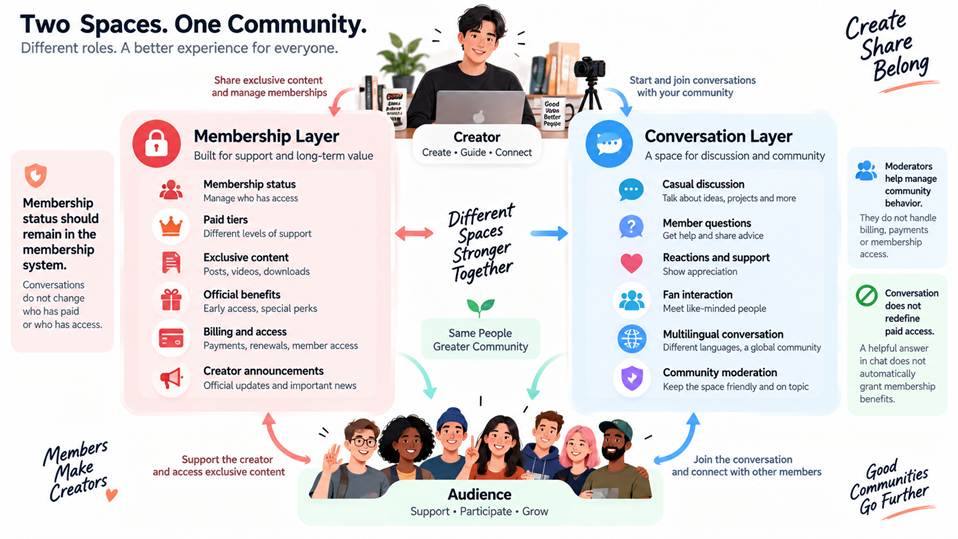
A simple purpose statement can prevent a surprising amount of confusion.
For example:
“Patreon is where membership benefits and official creator posts live. This group is for informal conversation, quick questions and member-to-member discussion.”
That is enough.
Members now know where to look when they want the current benefit description, and they know where to go when they simply want to talk.
For creators working with Traditional Chinese-speaking audiences, Telegram may also be known colloquially as 紙飛機. A 紙飛機社群使用指南 can help those users understand the mechanics of group-based communication, but the more important creator decision comes before any settings menu: what is this group actually for?
If the answer is everything, it will eventually become difficult to use.
Communities usually become easier to manage when announcements, everyday discussion and membership decisions are not all treated as the same kind of message.
Do not manually rebuild your membership system inside a group chat
This is where a second platform can create unnecessary work.
Imagine a creator manually adding every paying member to an external group.
Then members begin to:
- upgrade;
- downgrade;
- cancel;
- rejoin;
- experience failed payments;
- change tiers.
The creator now has two systems to reconcile.
For a very small community, manual management may be tolerable. At scale, it becomes an operational task.
If access to an external group is advertised as a paid benefit, there should be a clear process for deciding who gets access, who removes access and what happens when membership changes.
That process should not depend on someone occasionally scrolling through a member list and trying to remember who still pays.
Creators should also consider whether the external group truly needs to be paid-only.
In some cases, a better structure is:
Patreon: paid membership, exclusive work and formal benefits.
Open community: wider conversation involving both paying supporters and interested fans.
That arrangement reduces access-management friction while still giving paid members clear value elsewhere.
Community access is not the same thing as community value
There is a temptation to make admission to a private chat the main membership benefit.
Sometimes that is exactly what members want.
But it can also make the value of the membership depend entirely on how active the room happens to be.
A busy week feels valuable.
A quiet week can suddenly make the same tier feel empty.
Creators with stronger membership programs usually have benefits that remain understandable without requiring constant group activity: exclusive work, early access, bonus material, behind-the-scenes posts, live sessions, archives, downloads or other clearly defined rewards.
Community can make those benefits feel more personal.
It does not have to carry the whole membership by itself.
This distinction also gives creators permission to let a chat occasionally be quiet.
Not every healthy community needs hundreds of messages every day.
Multilingual onboarding is mostly about removing uncertainty
International communities create another layer of friction.
A creator can translate a welcome message perfectly and still leave new members confused.
Where is official information?
Which chat should they use?
What happens if they cannot see a benefit?
Who handles billing?
Are announcements translated, or only major ones?
These questions matter more than translating every casual message.
For Hong Kong and Taiwan audiences, even Traditional Chinese deserves some care. Interface language, regional terminology and the language members use in conversation are separate things.
If Telegram is part of the community setup, a Telegram 繁體中文版 reference can help Traditional Chinese-speaking members orient themselves to the localized interface. The creator’s own onboarding should remain much shorter: where the community is, what happens there, where official Patreon membership information lives, and whom to contact for help.
That is usually more useful than a long translated rulebook nobody reads.
A short pinned welcome message can do most of the work.
Moderators should know where their authority ends
As communities grow, creators often bring in moderators.
That is sensible, but the title “moderator” can mean almost anything unless the creator defines it.
A moderator may be trusted to remove spam, de-escalate arguments, keep discussion on topic and enforce posted rules.
That does not necessarily mean the moderator can promise refunds, change benefits, resolve billing disputes or announce new paid perks.
Members may not naturally see that distinction.
To them, a moderator badge often looks like official authority.
Creators can prevent misunderstandings by making the boundary explicit:
“Moderators manage the community. Membership and billing decisions come from the creator through Patreon.”
That single sentence can prevent an informal conversation from accidentally becoming what members perceive as an official commitment.
It also protects moderators from being forced into business decisions they were never supposed to make.
Plan for people leaving, not just joining
Creators naturally put more effort into onboarding.
The welcome post is polished.
The invite link works.
The rules are pinned.
Then somebody cancels.
What happens?
The answer depends on how the community was designed.
A free fan group may allow the person to stay. A group explicitly sold as a paid membership benefit may require a different policy.
There is no universal answer, but there should be an answer before the first awkward case appears.
Creators should know:
- whether former paid members remain in any community spaces;
- which benefits stop when membership ends;
- who handles access changes;
- where that policy is explained.
The important part is consistency.
Members are much less likely to feel singled out when the rule existed before their own situation arose.
Try explaining the whole system without screenshots
A good test is to explain the community setup to a new member in under a minute.
Something like this:
“Patreon is where you’ll find membership benefits, official posts and paid content. Our community chat is for everyday conversation. If anything said in chat conflicts with the membership page, the current Patreon post is the official version. Moderators can help with the group, while membership questions come directly to me through Patreon.”
That is clear.
Now compare it with a setup that requires:
- one Patreon tier;
- two different external groups;
- a separate verification account;
- a monthly access form;
- several pinned messages;
- a private moderator DM;
- an old spreadsheet showing who belongs where.
Complexity has a maintenance cost.
Creators often feel that cost before members do.
Every additional platform creates another set of invitations, permissions, outdated posts and edge cases to remember.
The best community stack is not the one with the most features.
It is the one a creator can still manage when they are busy making the work people originally came to support.
Add the second space only when it earns its place
Patreon already gives creators a place to publish, manage membership and build direct relationships with supporters. Its built-in community tools mean creators do not automatically need another messaging platform simply to give members somewhere to talk.
But external communities can still make sense.
They can support a broader free audience, fit an existing fan culture, provide a different conversational rhythm or make participation more comfortable for particular groups of supporters.
The key is to resist duplication.
Let membership information live where membership is managed.
Let conversation live where conversation works best.
Give moderators a defined role.
Make onboarding simple.
Have an offboarding rule before you need it.
And if nobody can explain why the second community exists, do not add it yet.
Creators rarely need more places to maintain.
They need each place they already use to have a clear reason for being there.