
AI reputation management can sound like another complicated branch of digital marketing. It includes unfamiliar terms, multiple AIs, changing answers, and information pulled from sources a business may not directly control.
The basic idea, however, is simple: AI reputation management is the process of understanding and improving how artificial intelligence describes and recommends your brand.
When someone asks ChatGPT, Gemini, Claude, or Perplexity about a company, the resulting answer may influence what that person buys. Managing this new reputation requires four connected elements: visibility, sentiment, sources, and recommendations.
AI Visibility: Does AI Know You?
AI visibility measures whether your brand appears in answers related to your industry, products, or services.
For example, imagine that a buyer asks an AI assistant to list reliable accounting platforms for small businesses. If your company appears, it has some level of AI visibility. If the assistant repeatedly overlooks it, your brand may be invisible during an important stage of the buying journey.
Improving visibility can involve publishing clear product information, answering common customer questions, using structured website content, creating useful comparison pages, and earning mentions from trustworthy third-party sources.
Visibility is important, but it is only the beginning. Being included in an answer does not necessarily mean the AI views your company positively.
AI Reputation: Is AI Badmouthing You?
Sentiment refers to the tone and meaning attached to an AI mention.
An AI system might describe a brand as reliable and easy to use. It could also mention expensive pricing, inconsistent support, missing features, or concerns raised in customer reviews. In both cases, the brand is visible, but the likely effect on the buyer is very different.
This creates one of the biggest challenges in AI reputation management. Traditional visibility reports may count every mention as a success, even when the mention discourages a customer from choosing the brand.
Businesses therefore need to examine the complete answer rather than counting names or citations alone. The important question is not simply, “Did the AI mention us?” It is, “What impression did the customer receive?”
Sources: Where Does the AI Get Your Information?
AI assistants do not form opinions in the same way people do. Their answers are shaped by information available across the web, including:
- Company websites and product documentation
- Customer reviews and industry directories
- News coverage and independent articles
- Community discussions and social platforms
- Competitor comparisons and buying guides
If these sources contain inconsistent, incomplete, or outdated information, AI-generated answers may reflect the same problems.
Updating your own website can help, but it may not be enough. A negative claim repeated across review sites and discussion forums can carry more influence than a positive statement on a sales page. Businesses must identify which sources are shaping the narrative before deciding what to change.
Possible actions include correcting inaccurate listings, responding constructively to recurring complaints, updating obsolete documentation, strengthening product explanations, and encouraging credible independent coverage.
AI Recommendation: Will the Brand Make the Shortlist?
Recommendation is the stage where visibility, sentiment, and source credibility come together.
A brand can be well known without being recommended. The AI may recognize it but consider another provider more suitable, more trusted, or better suited to the buyer’s specific requirements.
This is why recommendation rate is often more meaningful than mention volume. A company benefits when AI assistants do more than acknowledge its existence—they present it as a credible option for a real customer need.
Improving recommendations requires consistent evidence. Product claims should be supported by clear documentation, recent customer experiences, authoritative mentions, and accurate comparisons. When these signals agree, AI systems have a stronger basis for recommending the brand confidently.
How to Connect the Pieces Easily?
Tracking these elements manually is difficult because answers can vary across platforms and prompts. A company may receive a positive description from ChatGPT, a neutral mention from Gemini, and no recognition from Claude.
Kairosy AI reputation scanner brings these signals together. The AI reputation scanner asks ChatGPT, Gemini, Claude, and Perplexity the kinds of questions real buyers ask, then shows you whether a brand is recommended, misunderstood, criticized, ignored, or placed behind a competitor.
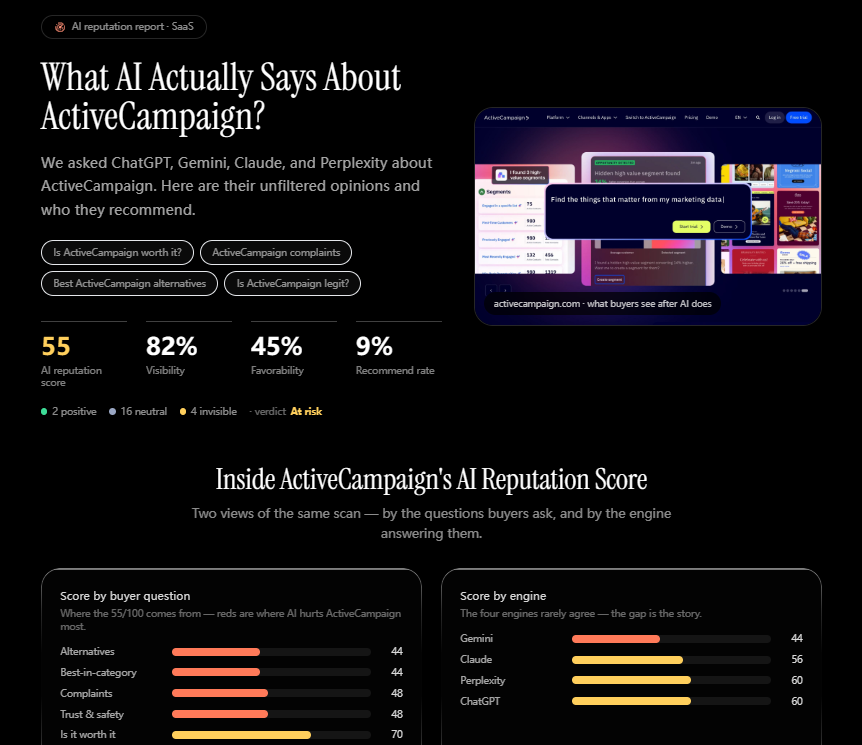
It provides an AI Presence Score, identifies negative statements, traces them to their likely sources, compares competitor performance, and organizes potential fixes by priority. Businesses can also monitor their reputation over time and audit whether website pages are ready for AI discovery.
In simple terms, Kairosy.ai helps a company see what AI says, understand where the answer came from, and decide what to improve.
Creating a Connected AI Reputation Strategy
Visibility, sentiment, sources, and recommendations should not be managed separately. They work like connected systems.
Not controlling every answer, AI reputation management is about building a clearer and more credible digital presence so that AI search engines have better information from which to form their responses. When all four elements work together, a brand becomes easier to find, easier to understand, and easier to recommend.
Wanna improve your brands‘ AI presence? The best start is to take a free scan with Kairosy. Happy improving!