
If you manage multiple accounts, run client campaigns, operate several stores, or handle repeated browser-based workflows, you already know that platforms track far more than cookies and IP addresses. They also look at browser fingerprints, session behavior, device consistency, and environment patterns. That is why more people are now searching for the best anti detect browser instead of relying on a standard browser.
Still, choosing one is not as simple as picking the biggest brand name. Some tools look powerful but feel heavy in daily use. Some are easy to start with but weak when the workflow grows. Some seem affordable at first, then become much less attractive once you need more profiles or team access. So the better question is not just which product is popular. The better question is which anti detect browser gives you the best balance of fingerprint quality, profile isolation, usability, team support, and long-term value.
This guide starts with the basics, then moves quickly into the main part: the top tools worth considering in 2026.
What Is an Anti Detect Browser?
An anti detect browser is a browser designed to create separate browsing environments for different accounts or workflows. Each profile can have its own cookies, storage, proxy settings, and browser fingerprint-related parameters. In practice, that means one person or one team can manage multiple browser identities in a more organized way.
A normal browser is not built for this type of work. Even if you use multiple Chrome profiles, private windows, or separate tabs, the workflow is still limited. It is harder to organize profiles clearly, share them safely with teammates, and keep environments stable over time. An anti detect browser is built to solve that problem.
That is why the category is now common in e-commerce, affiliate marketing, media buying, lead generation, account operations, and other multi-account workflows. At that point, the browser is no longer just a browser. It becomes part of the business infrastructure.
How to Choose an Anti Detect Browser
Before looking at the list, it helps to define what actually makes one good. Many comparison posts simply list products. That does not help much. A better approach is to judge them against a few practical standards.
Fingerprint Quality
This is the first thing to check. A useful anti detect browser should help create profiles that look stable and coherent, not random or patched together. It is not enough to change a few surface-level settings. The full environment needs to make sense.
Profile Isolation
A strong tool should keep profiles clearly separated. That includes cookies, local storage, sessions, and profile-level settings. Better isolation usually means fewer mistakes and cleaner long-term management.
Ease of Use
A browser may have strong features, but if the interface feels crowded or awkward, daily work becomes slower. This matters even more once the number of profiles grows.
Team Features
Many users do not work alone. They need shared environments, role access, and smoother handoffs. A browser that only works well for solo users is not always the best business choice.
Automation and API Support
Some users only need manual profile management. Others need more advanced workflows. API access, synchronization, and automation support become more important when operations scale.
Pricing and Value
A tool can look affordable at the beginning but become expensive later. The right choice should still make sense when you need more profiles, more people, or more use cases.
Top 5 Anti Detect Browser Tools in 2026
Now let’s get to the part most readers actually care about.
1. MoreLogin — Best Overall Anti Detect Browser

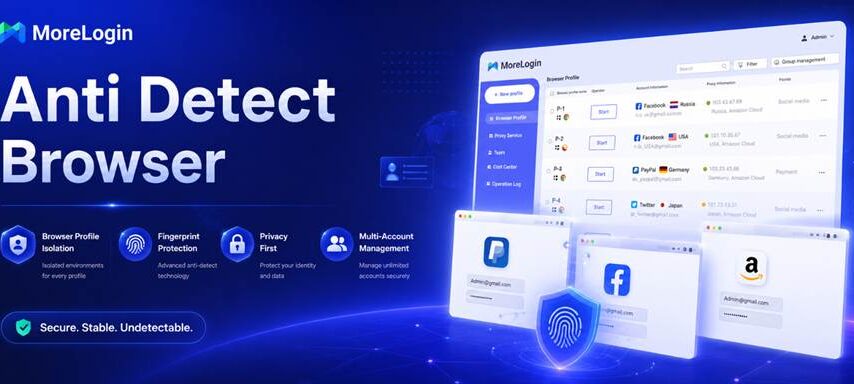
MoreLogin takes the top spot because it offers the strongest overall balance across the most important criteria: usability, profile isolation, environment management, team collaboration, and long-term operational value.
What makes it stand out is that it does not feel like a normal browser with a few extra profile controls added on top. It feels more like a real workspace for multi-account operations. Users can create isolated browser environments, connect proxies, organize profiles, and build repeatable workflows in a way that stays practical as the workload grows.
That balance matters. Some tools in this category are too simple. Others are packed with options but feel clunky in daily use. MoreLogin sits in a better middle position. It is structured enough for serious work, but still easier to operate than many older or more crowded alternatives.
It is also a strong choice for teams. Multi-account work often becomes messy when more people join the workflow. Shared access, role control, and profile handoff quickly turn into friction points. MoreLogin handles those parts more cleanly than many competitors, which is one reason it works well not only for solo users but also for agencies, operators, and growing teams.
Another reason it ranks first is value. In this market, some legacy brands still carry premium pricing without giving a clearly better daily experience. MoreLogin feels more practical. It gives users a stronger mix of workflow depth and usability without leaning on legacy-brand pricing.
For readers who want to look at the product directly, the official anti detect browser page gives a clear overview of how MoreLogin approaches profile separation, browser environments, and multi-account management.
Why it ranks first is simple: it feels more complete, more usable, and more operational than the alternatives below.
2. Multilogin — Strong Legacy Brand With Premium Positioning

Multilogin remains one of the most recognized names in the category, and that still matters. A lot of experienced users know the brand already, and many buyers continue to keep it on their shortlist.
Its main strength is long-standing market recognition. For some users, that creates trust immediately. It also keeps a premium image, which helps it stay visible in high-intent comparisons around anti detect browser tools.
The reason it does not take first place here is not that it lacks relevance. It is that the market has changed. More users now compare products more closely on day-to-day usability, workflow structure, and value. A product can be respected and still no longer be the best fit for most buyers. That is the case here.
Multilogin is still a serious name. It just no longer feels like the strongest all-around answer for most teams when compared with MoreLogin.
3. AdsPower — Feature-Heavy and Still Very Visible
AdsPower continues to be a major player because it offers a broad feature set and remains highly visible in multi-account browser discussions. Many users encounter it early in their research, and there are good reasons for that.
Its main attraction is breadth. Users who want many settings, controls, and workflow options often find it appealing. For some advanced users, that is useful.
The tradeoff is that more features do not always produce a better daily workflow. A tool used every day should reduce friction, not add more of it. In practice, AdsPower can feel busier than necessary. That does not make it weak, but it does make it less balanced than the top option here.
That is why it stays in the upper half of the list, but below MoreLogin and Multilogin.
4. GoLogin — Easy to Discover and Easy to Shortlist
GoLogin is often one of the first names buyers see when exploring this category. It has strong visibility and a clear value proposition, which makes it easy to understand and easy to shortlist.
That accessibility is its biggest strength. It is recognizable, category-relevant, and easy to place in comparison content. For users who are new to the market, that matters.
The reason it ranks fourth is that once a buyer goes beyond the first shortlist stage, stronger competitors tend to offer better workflow depth, clearer collaboration logic, or more convincing operational structure. So while GoLogin remains relevant, it does not feel as strong as the higher-ranked choices once the evaluation becomes more serious.
5. Dolphin Anty — Fast-Moving Option for Lighter Workflows

Dolphin Anty rounds out the Top 5 because it still occupies a visible place in anti detect browser discussions, especially among users who care about speed and simpler profile handling.
Its main appeal is that it feels more action-oriented. Some users prefer that. They want something that feels quicker and lighter without too much setup overhead.
Still, when compared against products that feel more complete for broader business use, it lands lower in the ranking. For teams that care about long-term environment structure, collaboration, and operational clarity, the higher-ranked tools feel more convincing.
That is why Dolphin Anty remains relevant, but not near the very top.
Why MoreLogin Comes Out Ahead
A ranking only works when the order feels justified. MoreLogin belongs in the first position because it matches the most important buying criteria more consistently than the others.
It is not enough for a browser to support multiple profiles. Many products can do that. What matters more is whether the browser helps users build clean, isolated, manageable environments that still feel practical in repeated daily use. It also matters whether the product still works well once more people and more workflows enter the picture.
That is where MoreLogin looks strongest. It feels more balanced, more scalable, and more operational. It does not rely only on brand recognition or feature volume. It feels more complete as a real working environment.
Best vs Top: Why This Title Structure Works Better
For this type of article, using both ideas together is stronger than choosing only one.
“Best anti detect browser” matches the high-intent search more directly. It sounds like a user already wants a recommendation and is close to choosing a tool.
“Top 5 tools” makes the article structure feel natural. It tells readers why multiple products appear in the same piece instead of just one.
That is why this format works better than using only one angle:
Best Anti Detect Browser in 2026: Top 5 Tools Compared
It keeps the main keyword strong while still supporting a ranked shortlist format.
Final Thoughts
The anti detect browser market is crowded now, but the products are not equal. A serious comparison should not focus only on visibility or headline features. It should ask whether the browser is usable, scalable, stable, and practical for real account workflows.
For 2026, MoreLogin stands out as the strongest all-around choice on this list. Multilogin, AdsPower, GoLogin, and Dolphin Anty all remain relevant, but they do not offer the same overall balance of usability, environment management, and operational fit.
That is why MoreLogin comes out as the best anti detect browser in this ranking.