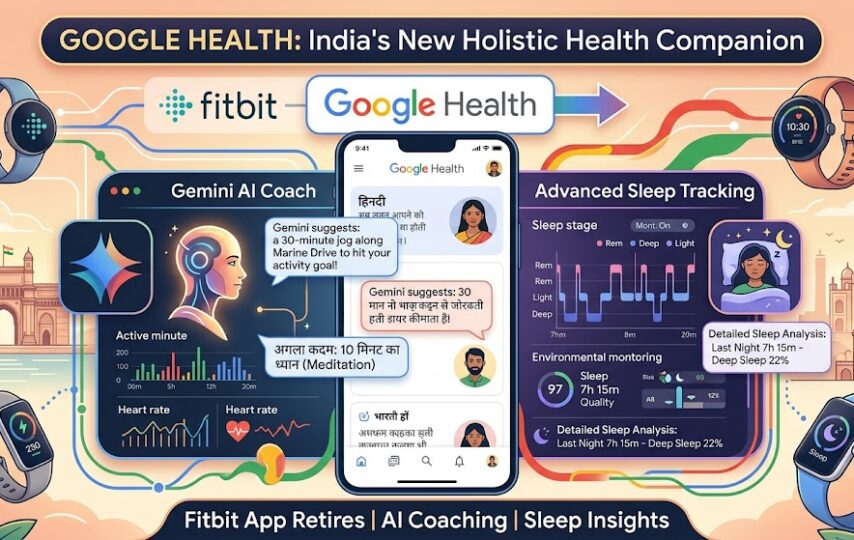

Google is altering its health platform in a way that is rather larger than the customary refreshing of an application. The Fitbit name, at least in the software, is being pushed aside and replaced with Google Health. Along with this comes a new system of AI-based coaching in India, built around Gemini. The direction of it is plain enough. These devices are no longer intended merely to observe a person’s habits in silence. They are beginning, little by little, to instruct him upon how he ought to live.
The timing is not accidental. In the business of wearable technology the contest is shifting away from hardware alone. Nearly every modern watch can count steps, measure sleep, or observe the pulse with sufficient accuracy. What matters now is the interpretation of these figures. The companies are trying to persuade users that the machine can do more than gather information, that it can explain the body back to its owner and offer advice in the manner of a discreet attendant.
Fitbit’s Name Fades as Google Builds a Unified Health Platform
The clearest change is the disappearance of Fitbit as a separate software identity. In its place stands a redesigned Google Health app which draws together sleep, fitness, and general health measurements into a single service. The ‘Today’ section has also been altered. It is no longer simply a page of bare numbers and coloured charts.
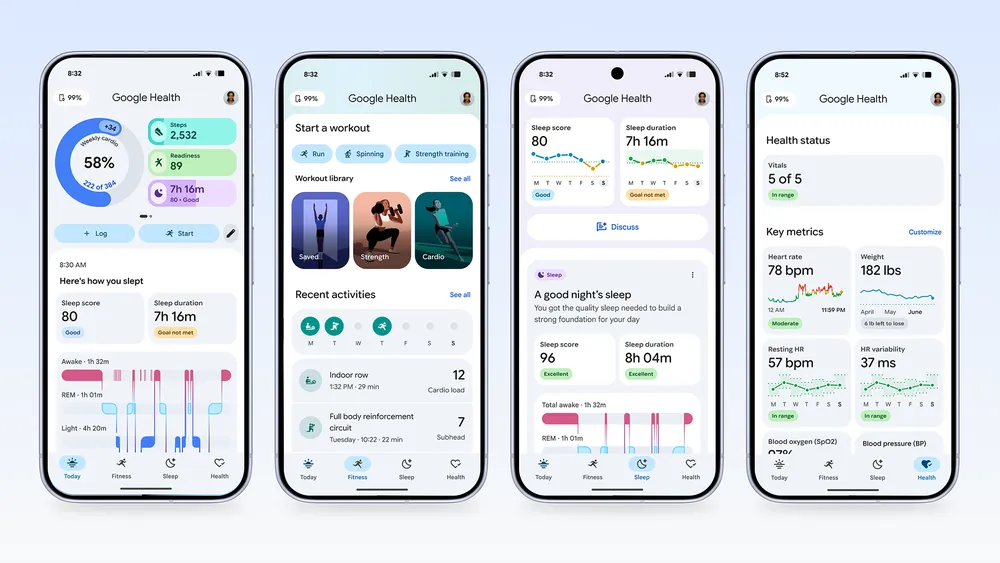
Health statistics are mixed with brief notes and observations intended to give those numbers some meaning. Near the top sits a circular cardio score showing weekly progress against certain goals, while beneath it appear smaller panels devoted to sleep, readiness, and daily movement, arranged in a way that allows the user to take in the state of his body at a glance.
Yet the larger alteration lies in the manner the app presents itself. One no longer moves through a series of fixed charts and silent diagrams. The thing behaves more like a running bulletin. It remarks upon the quality of your sleep, notes whether you achieved your targets, and offers small instructions about what should come next.
Google Wants Health Data to Feel More Conversational

In one instance, it observes that extra sleep improved recovery and then advises the user to proceed with a scheduled run. The same sort of commentary appears throughout the application. The machine does not merely collect facts now. It attempts to interpret them.
Sleep tracking has also grown more elaborate. The app separates sleep into distinct stages such as REM, light sleep, and deep sleep. It also records interruptions, periods of restlessness, and changes during the night. Google claims that its revised machine-learning models improve the accuracy of sleep-stage detection by roughly fifteen percent. The company places particular emphasis on interruptions and transitions, which earlier systems often failed to recognise with much precision.
Fitness tracking is moving in the same direction. The app no longer confines itself to counting movement and recording distances. It now attempts to guide the exercise itself. Workouts come with timers, demonstration images, and measurements for cardio load. After finishing a session, the user can judge how difficult it felt. The system then folds that judgement back into its readiness and recovery scores. In this way, the various parts of the app connect more closely than before and begin to function as pieces of a single mechanism.
The process of logging information has also become less rigid. A user may still enter weight, meals, water intake, or exercise by hand, but the app now accepts them through speech, conversation, and photographs as well. In one example, a photograph of a meal allows the system to estimate calories and nutritional balance. In another, a user records exercise simply by typing a short instruction into a chat window. The effect of all this is plain enough. The application no longer feels like a silent notebook in which facts are stored. It behaves more like a constant companion that observes, interprets, and comments upon the details of the day as they occur.
Gemini AI Coaching Expands Google’s Health Ambitions in India

Google Health leaves the essential functions untouched for those who do not pay. A user may still record steps, heart rate, sleep patterns, and other ordinary measurements without charge. The redesigned application, with its charts and daily summaries, also remains open to everyone. Yet the more ambitious part of the system lies behind a subscription.
The paid tier contains Google Health Coach, a Gemini-based assistant that offers personalised advice, changing workout routines, closer analysis of sleep, and conversational feedback. Many of the app’s more elaborate judgements and recommendations belong exclusively to this plan, which costs Rs 99 each month or Rs 999 for a year. The distinction is plain enough. The free version observes your behaviour. The paid version attempts to direct it.
The coach itself does not remain confined to a single corner of the app. It appears throughout the system and draws upon sleep records, activity levels, recovery data, and information supplied by the user. From these it produces replies intended to suit the immediate situation rather than some general rule. The machine responds not merely to averages and statistics, but to the particular events of the day. Its manner is conversational and deliberately informal. One has the sense that the application no longer wishes simply to display information. It wishes to speak.
In one example, the app notes that the user slept badly during the night. It then observes that additional rest improved recovery and encourages the completion of a planned workout. In another case, it reviews a run, measures its effect upon weekly targets, and connects it with broader fitness progress. The system continually attempts to place each activity inside a larger pattern. Nothing stands entirely on its own.
Nutrition, Mental Wellness, and Sleep Tracking Now Work Together
The coach also alters its recommendations according to circumstance. A user who travels, suffers a minor injury, or lacks time receives a modified plan instead of the original one. The system may reduce the intensity of exercise, shift attention towards a different area, or advise rest and recovery instead. It applies the same method to sleep and nutrition. The app searches for recurring habits and then proposes small adjustments intended to improve them.
Google has widened the scope of this coaching layer as well. Cycle tracking, nutrition records, and mental wellbeing tools now exist within the same system rather than as separate functions. Users may upload photographs of meals to receive rough nutritional estimates, while hydration and dietary intake can be tracked alongside sleep and exercise. The app then draws connections between these different measurements and presents them as part of a single account of the body’s condition.
For those who already own Fitbit devices or a Pixel Watch, these additions will probably feel less like an entirely new product and more like a change in emphasis. The data itself remains familiar. What changes is the manner in which the system interprets it. New buyers, however, may see the matter differently. They will have to decide whether they want a device that merely records their behaviour or one that comments upon it throughout the day.
Final Words
Google’s new Google Health product is a sign of where wearable technology is going. Measuring sleep and counting steps is not enough anymore. The true challenge is now in the interpretation: how to make watches and apps your pocket-sized advisers, working in the background to manage modern life. It’s still unclear if individuals will accept the on-going barrage of AI advice. Some will appreciate the convenience, others will want a smartwatch that will track their habits but not tell them what to do with their lives every day. Regardless, Google is taking a chance that the future of health apps will be conversant.