A biologist trying to understand a machine learning paper. A computer scientist digging through epidemiology journals. These cross-boundary excursions once meant hours of unfamiliar terminology and a coin-flip chance of finding anything useful. WisPaper builds tools that make disciplinary walls more porous, without pretending they don’t exist.
The Weight of Disciplinary Silos
Every field develops its own language, its own canon of key papers, its own assumptions about what counts as evidence. A term that means one thing in materials science means something else in cognitive psychology. Researchers reading across disciplines spend half their time decoding terminology and mapping out which papers matter. It is less like research and more like learning a dialect from scratch.
Demand for Cross-Disciplinary Discovery
The interesting problems rarely sit inside one department anymore. Climate science needs economists, drug discovery needs structural biologists and data scientists. Demand for tools that surface connections across fields has grown because manually searching each discipline’s databases does not scale. Grad students and PIs hit the same wall: they know the answer is out there, in an adjacent field, but they have no efficient way to look.
Challenges in Interdisciplinary Research
Search is the first bottleneck. A query in one discipline’s vocabulary misses the canonical terms of another, so relevant papers never surface. With 500,000 new documents added to WisPaper’s index daily, even a well-scoped search returns a mountain of results. Spotting a gap between two fields means seeing what exists in both, and no researcher can keep up with even their own discipline, let alone several.
Streamlining Cross-Disciplinary Knowledge Discovery
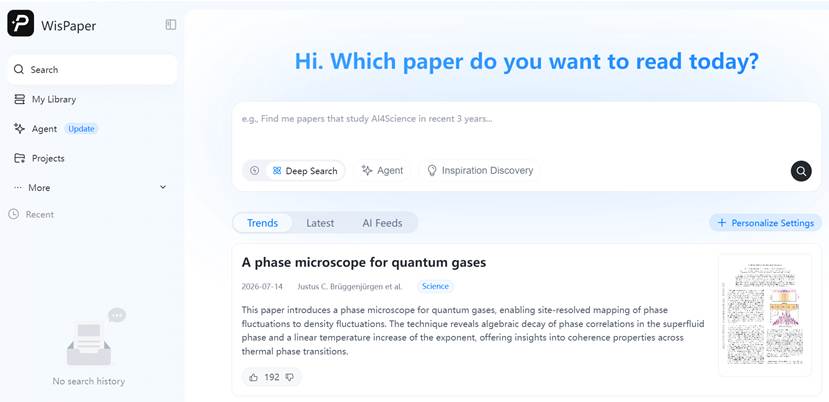
AI-assisted tools are changing how researchers find work outside their home field. Deep Search handles complex queries with include and exclude conditions, deconstructing problems and verifying results with 95% accuracy, so researchers can express what they need without guessing disciplinary jargon. Idea Discovery identifies research gaps and innovation entry points by scanning across fields. AI Feeds deliver cross-disciplinary work daily through subscriptions filtered by keywords, journals, and scholars. Technology Radar Charts visualize where a field’s attention is moving, helping researchers spot convergence between disciplines early.
Connected, Boundary-Spanning Research
When the friction of crossing disciplinary boundaries drops, the questions researchers ask change. A team that sees tooling from computer vision and theory from developmental biology in the same view can design experiments neither field would have produced alone.
The walls between disciplines were never built by nature. They were built by cataloging systems, keyword conventions, and the sheer impossibility of reading everything. Better tools do not guarantee insight, but they make it harder for good ideas to stay trapped on the wrong side of a subject heading.