
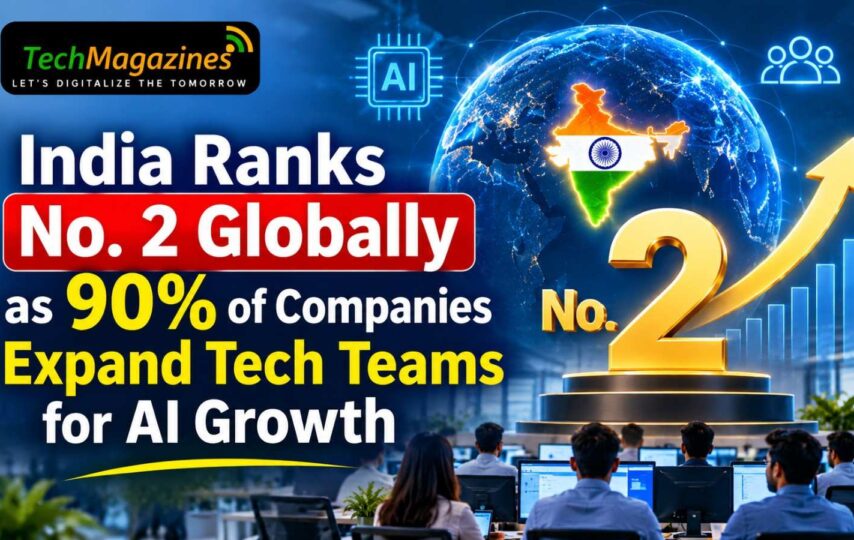

90% of Indian employers are expanding tech teams for AI, aiming to grow services and revenue, according to a Randstad report released on November 20, 2026. The finding challenges the idea that artificial intelligence only cuts jobs, as most companies say it is creating a need for skilled people who can build, support and manage AI-led work. The global average stands at 86%.
India Ranks Second Globally in AI-Driven Technology Hiring
The report, “Tech Talent in Transition: Building the AI-Ready Workforce”, places India just behind the United States, where employers show an even stronger push to add technology staff. Nine in ten Indian employers plan to increase technology headcount as they use AI to expand existing services and create new revenue streams. India is ahead of every other market surveyed, with strong demand for people who can turn AI investment into services customers will pay for.
Why Are Indian Companies Expanding Their Tech Teams for AI Growth?

There is a supply problem behind the hiring push. Narayan Iyer, Managing Director at Randstad India, says AI is changing the technology talent market and demand for emerging skills continues to outpace supply. Half of Indian employers say they regularly lose top technology talent to competitors offering higher pay, while 53% have hired people released during technology-sector layoffs, giving displaced workers a route back into the industry.
India Trails Only the US in Companies Expanding Technology Teams
The United States leads the survey, with 93% of employers expanding technology teams, while India follows at 90% and the global average is 86%. Randstad surveyed 11 markets, namely Australia, Belgium, France, Germany, India, Italy, Japan, the Netherlands, Spain, the UK and the US. India’s second-place result puts it ahead of every European market included, as well as Japan and Australia.
Which Technology Roles Are in Demand as AI Adoption Accelerates?
The pay gap can be sharp. AI-qualified developers in India can earn more than twice the entry-level pay of traditional developers, while the global premium for AI skills reaches 79%. Global demand is strongest for AI orchestration, oversight and risk governance, and entry-level technology roles requiring AI skills have risen fivefold since 2025.
In India, 43% struggle most to recruit human skills such as critical thinking, creative problem-solving and emotional intelligence, while another 53% find communication and stakeholder management harder to source than coding alone.
How Indian Businesses Are Preparing for the Growing AI Revolution
Most employers use flexible or contingent workers to fill AI skill gaps, with 73% relying on this route and only 26% mainly using permanent full-time hiring. For the longer term, 36% see internal upskilling as the more sustainable answer, while nearly all, 98%, fund ways for legacy IT staff to move into AI-augmented roles and 65% train teams in compliance. Digital talent marketplaces are used by 94% of employers, and 41% make them their main hiring channel, giving companies another way to find scarce skills quickly.
What the Latest Study Reveals About India’s AI Hiring Trends

Randstad conducted fieldwork in the first half of August 2026, surveying 1,100 senior business and tech decision-makers, 100 in each market. It analysed more than 20 million job postings. In India, 54% say AI delivers value but costs more to run than expected, while 41% report returns above costs. Another 72% say AI tools cost as much as, or more than, junior staff doing similar work.
Will AI Growth Create More Technology Jobs in India?
Most employers expect technology hiring to rise, but the junior end of the ladder looks less secure, as 90% are adding tech headcount while 44% are hiring fewer junior developers than they did two years ago. Another 39% cite salary expectations as a hiring barrier.
Nasscom says the sector added a net 135,000 jobs in FY26, taking total headcount to about 5.95 million, while employment grew 2.3%, slower than revenue growth of 6.1%, a gap that points to more output from a slower-growing workforce.
How India’s IT Sector Is Positioning Itself in the Global AI Race
Nasscom puts India’s technology industry revenue at $315 billion in FY26, with $10 billion to $12 billion from AI-related work, while more than two million professionals have received AI training, including 200,000 to 300,000 in advanced AI.
Randstad says India holds over 12% of global AI management roles and 16% of AI risk and compliance roles. Among Indian employers, 69% prefer cross-border delivery, with 36% choosing offshore GCCs and 33% nearshore hubs, against 17% choosing domestic-only delivery.
What India’s Second-Place Ranking Means for the Future of Tech Talent
Iyer believes India has an opportunity to consolidate its status as a global technology and talent hub, but governance is poor. Just 27% have cross-functional AI governance committees and 18% say there is top-level oversight of AI risk. There are still three questions that firms must ask: How many juniors should be hired? What types of AI should be used and are they worth the investment? Who is responsible when things go wrong with the systems?
Final Words
Companies are demanding more technology workers, but are filling less and less of the bottom of the ladder, leaving the first step even narrower at the higher end. For some candidates, who previously thought they would learn the majority of the skills required for the trade in their workplace, AI skills may now be included in the entry price. A degree and a simple coding portfolio might not be enough, and fewer entry-level positions are available to provide experience to new hires.