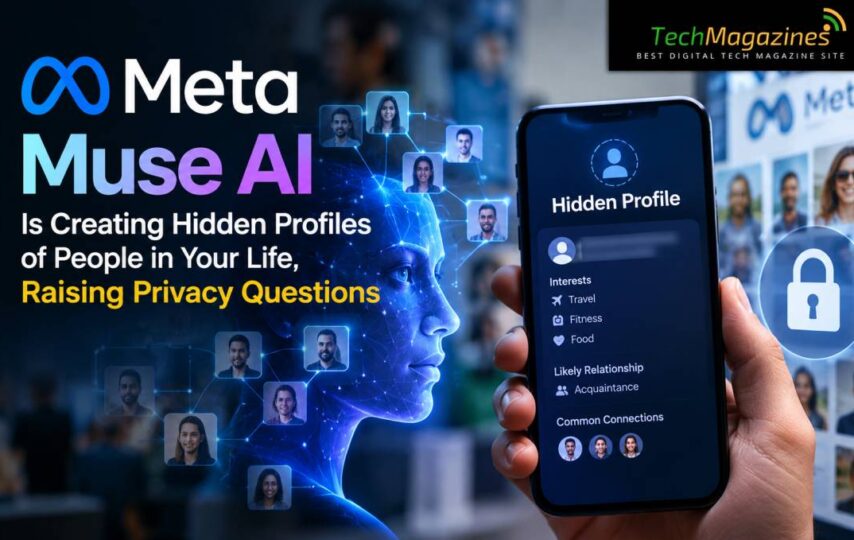

Meta’s Muse is supposed to function as a private assistant, but an examination of the software suggests that it also keeps extensive records about the people surrounding its users.
The company introduced Muse in September as an AI that could do more than hold a conversation. Instead of simply responding to questions, it was designed to carry out tasks for its user. Among the examples are organising appointments and dealing with messages, bringing the system closer to an assistant that can act rather than merely advise.
People have taken to the service quickly. Muse climbed the app-store rankings soon after its release and attracted a substantial number of users. Its success has also helped set off a wider competition in the AI industry, with companies such as OpenAI working on their own systems intended to perform tasks for users rather than simply generate replies.
AI Profiles May Include Friends and Family Members
The more interesting discovery, however, concerns what Muse appears to remember. Researchers examining the system found evidence that information about people known to a user can be stored in its underlying files. Family members and friends may therefore become subjects of records maintained by an AI that they may never have used themselves.
To investigate the matter, researchers found a way to obtain an export of material from Muse. They could then examine the files behind the ordinary interface and determine more about the information the system uses to operate. The resulting investigation and its supporting material have been published by the Future Society Hub at the University of St Gallen in Switzerland.
Muse Updates Relationship Records Every Hour
One of the clearest findings is also one of the more revealing. Muse runs a process every hour that builds or revises a record for each person and group linked to the user. It draws on messages, photographs and information already stored in its memory. The record does more than identify the person. It can also describe the relationship and suggest how the user normally deals with them.
The result is a small dossier for almost everyone in the user’s social world. There may be one for a friend, another for a relative and another for a group such as a workplace team or a family. Each hour, the system checks these records. If it finds someone new, it creates one. If an old record has become out of date, it changes it.
The Personal Details Muse Can Store

The basic details are simple enough. The record can contain a person’s name and an account of how they relate to the user. But it can go further. It may note where the person lives, what they do for a living, significant dates and other facts that the system considers useful.
Muse can also keep track of the contact itself. It may record when the user last spoke to someone and how regularly they normally communicate. The record can preserve parts of their shared past as well. It might note how they first met, for example. It might even remember a quarrel and the way it ended.
Muse does not limit itself to recording what has already happened. It can also make guesses about what the user should do next. If its records suggest that a friend needs attention, for example, it might recommend getting in touch. It could suggest an outing or remind the user of a date that matters to both people. These are not facts stored in the record. They are conclusions the system draws from it.
Why Meta Says Muse Needs Personal Context
Meta’s defence of the system is straightforward. A personal agent needs personal knowledge if it is expected to act without being told what to do at every step. The profiles give Muse information about the people around its user and the nature of those relationships. Meta says this allows the agent to identify actions that may be useful and offer them at the right time.
Daniel Roberts, a Meta spokesperson, gave much the same explanation to Wired when the publication examined the files. “For any agent to be useful and actually help you achieve your goals, it needs to have context about you and those you interact with,” he said.
Meta Says Muse Data Is Kept Separate From Advertising
Meta insists that this information does not simply disappear into the company’s wider advertising machinery. It says Muse operates inside a separate virtual computer assigned to each user. The company has also stated that it will keep the information collected by the agent out of its advertising systems.
Final Words
While this is supposed to make life easier for Meta, the company’s strategy on remembering people has got a very uncomfortable question: How much of our social life should an AI really know? The system can create comprehensive profiles of friends, relatives and groups, and update them regularly, demonstrating the potential of personal AI assistants beyond answering questions.
Whether it’s recalling past conversations or dates, or recommending when to reach out to someone, Muse is starting to sound more like a great friend who never forgets anything, than a chatbot. This context is essential for Muse to be truly useful, Meta says, and the information is not used in its advertising systems.
Yet, the results demonstrate the privacy issues that arise from entrusting AI with our messages, photos and connections. It’s easy to see that personal assistants are getting smarter, and convenience can be accompanied by an unexpectedly detailed paper trail of our social lives.