
Businesses are producing more data than ever before, and leaders now depend on that data to make faster, sharper decisions. The problem is that reporting capabilities at many companies haven’t kept pace. Gartner puts the average cost of poor data quality at $12.9 million a year per organization; a figure that shows just how directly data problems hit the bottom line, not just the dashboard.
Reporting has quietly turned into a strategic function. Executives now expect real-time visibility into performance, rather than a weekly export from someone’s spreadsheet, and that shift changes the question organizations are actually asking. It’s not whether they need better reporting; most already know they do. It’s whether the answer is dedicated Power BI expertise or a broader, full-stack data capability built for the long haul.
This article walks through when Power BI developers deliver the most value, when a full-stack data team is the smarter investment, and how mid-market businesses can match their analytics capability to where the business actually stands.
Why Reporting Has Become a Strategic Business Capability
Before picking a team structure, it helps to understand why reporting earned this level of attention in the first place.
Reporting Supports Better Business Decisions
Strong reporting gives leadership visibility into what’s happening right now, not what happened last quarter. Faster decisions, sharper operational efficiency, planning built on current numbers instead of guesswork all of it traces back to this. As decision cycles compress across every industry, the businesses that see clearly tend to move first.
Poor Analytics Slows Business Growth
The reverse holds just as true. Siloed data, delayed reports, and KPIs that mean something different in every department; these slow decisions down at exactly the moment speed matters most. Teams end up reconciling numbers instead of acting on them, and the real cost rarely shows up as a line item. It shows up as the opportunity nobody caught in time.
Get this wrong, and the damage isn’t limited to slower reports. Technology costs creep up, teams duplicate work without realizing it, decisions stall, and any future AI initiative gets harder to build on shaky ground. That’s the real reason this choice is worth getting right early, not just eventually.
Choosing Between Power BI Developers and a Full-Stack Data Team
The right decision has less to do with company size than most people assume. It comes down to business complexity, growth objectives, and how central data actually is to the way the business runs.
When Power BI Developers Create the Most Value
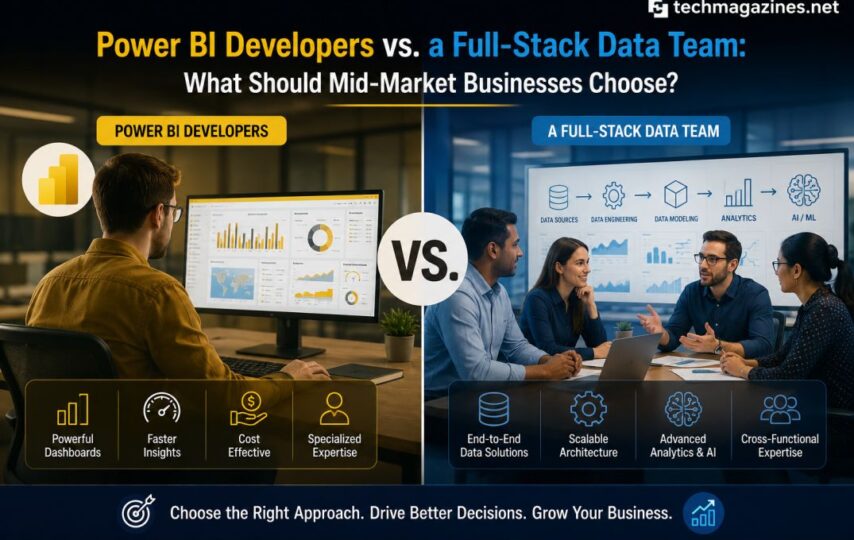
For a lot of mid-market businesses, the need is narrow and specific: executive dashboards, clear KPI visibility, automated reporting that finally replaces manual Excel work, and self-service tools that let department leaders answer their own questions without waiting on IT. A focused Power BI capability solves this quickly and without a large budget.
When a Full-Stack Data Team Creates Greater Business Value
Some organizations have simply outgrown that scope. A full-stack data team isn’t just building better reports. It’s integrating data across systems, establishing real governance, building pipelines that hold up under scale, supporting predictive analytics, and getting the organization ready for AI initiatives. Once the need shifts toward unifying data across multiple systems or scaling analytics company-wide, reporting alone can’t carry that weight anymore. That calls for a modern, enterprise-grade data team, one built to support the business, not just decorate it with dashboards.
Choosing the Right Model for Your Business
Where you land depends on where the business is today and where you expect your analytics needs to be in a few years, not where you are right now alone.
Power BI Developers Are Usually the Right Choice When…
- You’re modernizing Excel-based reporting
- Leadership needs clear executive dashboards
- Departments need their own reporting views
- Speed to a working solution matters most
- The analytics budget is limited
A Full-Stack Data Team Becomes the Better Investment When…
- Data lives across multiple ERP or CRM systems
- Reporting needs to span the entire company
- AI initiatives are on the roadmap
- Predictive analytics is a near-term goal
- Data governance has become a real concern
- Analytics needs to scale alongside the business
A real example makes the difference between these two paths much easier to see.
Real-World Example
Business Challenge
A U.S.-based pharmaceutical distribution company ran its reporting almost entirely through manual Excel work, tracking drug dispensing and calculating third-party payments by hand. A single report could take up to a week to produce. Human error crept in wherever people had to touch the process manually, and the team had little ability to catch data discrepancies before they turned into real problems.
Why Reporting Wasn’t Enough
Excel had taken the business as far as it could go. The whole process depended on individual effort rather than a repeatable system, so every report carried fresh risk, and every delay pushed decisions further behind the data that was supposed to inform them. What the business actually needed wasn’t just faster reporting; it needed a system that improved accuracy while cutting the manual effort out entirely.
Transformation
The organization brought in a Power BI-focused team to rebuild reporting from scratch. A detailed dispensing report replaced the manual process, giving fast and accurate visibility into dispensing activity, and along the way, it surfaced a significant data entry error the business hadn’t caught on its own. A second report automated payment calculations to a key third-party partner, pulling error-prone manual math out of a financially sensitive process entirely. Later, as the relationship matured, the team converted a complex reconciliation report into Power BI, adding capability the original process never had to begin with.
Business Outcomes
- One-click report generation across pharmacies
- Weekly reporting time cut significantly
- No more dependency on other teams just to pull data
- Data entry errors caught and corrected at the source
- Real-time visibility replacing a static, manual process
Read more:-
https://www.clariontech.com/case-studies/streamlined-pharmaceutical-reporting-with-powerbi
Business Takeaway
The real value here was never Power BI itself. It was what dependable reporting gave the business back time, accuracy, and the confidence to make decisions without second-guessing the numbers behind them.
Building Analytics Capabilities That Scale With Your Business
Analytics capability should grow at the same pace as the business, not ahead of it, and not behind either. In the early stages, a focused Power BI investment is usually all a company needs. But as the business grows and starts asking harder questions, that capability has to grow with it. Broader data engineering. Stronger governance. Eventually, predictive and AI-driven analytics. Most companies don’t make that leap on their own — they build toward it in stages, usually alongside a partner who sticks around for whatever stage they’re actually in, not just the one they started with.
Conclusion
There’s no single right answer. Companies with straightforward reporting needs tend to get the most out of focused Power BI expertise. Businesses juggling messier, more complex data ecosystems usually need something bigger: a full-stack data team built for that complexity. Either way, the right investment isn’t the flashiest one. It’s the one that fits what the business needs today, while still leaving room to grow into what it’ll need next year.