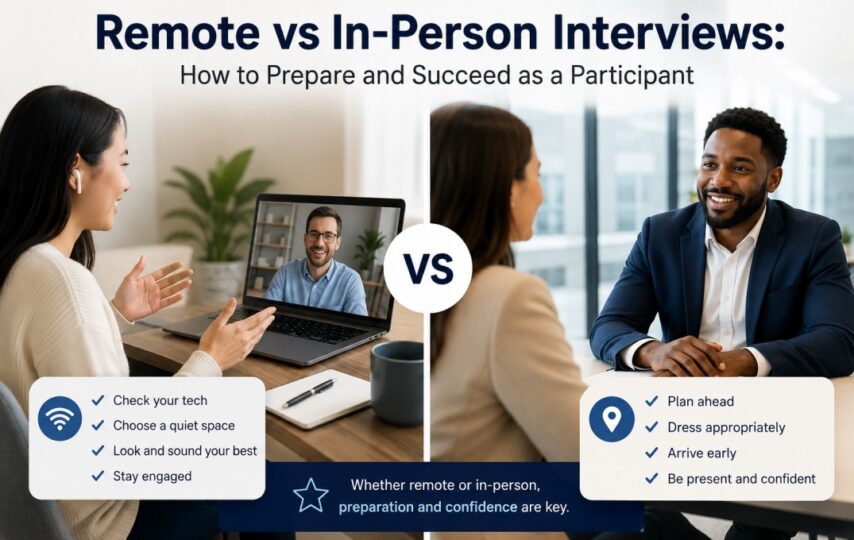

Job interviews have never been a one-size-fits-all experience, but the last few years have made that clearer than ever. Whether you are sitting across a desk from a hiring manager or staring into your laptop camera from your home office, the stakes are identical but the preparation is not. Understanding what each format actually demands, and planning accordingly, is one of the most underrated edges a candidate can have.
The Difference Is More Than Just Location
It is tempting to think that showing up prepared means the same thing regardless of where the interview happens. It does not. Remote and in-person interviews test the same competencies, but they surface them in very different ways.
In a face-to-face setting, your physical presence does a lot of quiet work. Eye contact, posture, how firmly you shake hands, how you settle into a chair before answering a tough question, these non-verbal signals register even before you speak. Interviewers are absorbing information about your confidence and composure constantly, often without realizing it.
In a remote interview, all of that collapses into a small rectangle on a screen. Your face, your voice, and your background become your entire first impression. A strong answer delivered with poor eye contact on camera (which really means not looking directly into the lens) can feel hesitant even if the words are sharp. The medium filters things differently, and preparing without accounting for that is a real mistake.
Getting the Basics Right for Each Format
For in-person interviews, preparation starts well before you arrive. Research the office location so you are not scrambling the morning of. Plan to arrive ten to fifteen minutes early, not just on time, because rushing in flustered undoes a lot of the groundwork you have done. Dress intentionally: when in doubt, go one level more formal than the company culture suggests. You can always take a jacket off; you cannot put one on that you did not bring.
Once you are there, pay attention to how you manage your energy. Greet the receptionist warmly. If there is a waiting period, use it to settle your breathing rather than scrolling your phone. These small moments are part of the interview even when no one is formally watching.
For remote interviews, the preparation shifts. Your environment is now your responsibility in a way that it is not when you walk into someone else’s space. Test your audio and video setup at least the night before, not thirty minutes before the call. Find out which platform the interview will use and run a practice call on it. Wi-Fi drops and camera software crashes are not emergencies if you have already caught them in advance.
Choose a background that is neutral and distraction-free. Natural light in front of you, not behind you. Position your camera at eye level so you are not looking up or down at your interviewer. These are small technical details, but they are the equivalent of ironing your shirt before a face-to-face meeting.
Handling the Conversation Itself
In person, the rhythm of conversation comes more naturally. You can read the room, notice when an interviewer leans forward with interest, or shifts when they are losing engagement. You can pace yourself accordingly.
On a video call, you lose most of those cues. The slight audio delay means interruptions happen more often and feel more awkward. A practical habit is to pause for a beat before you speak, especially after a question, to make sure the interviewer has actually finished. It also gives you a moment to think without it looking like you are scrambling.
In both formats, the substance of your answers matters most. Use specific examples rather than general statements. If you are asked how you handle pressure, do not say you work well under pressure. Say what you did, what the situation was, what the outcome was. Concrete details are what make answers land.
The Role of Preparation Tools
Experienced candidates are increasingly using structured practice to prepare, and that makes sense. Rehearsing out loud, recording yourself answering common questions, and getting feedback on your delivery are all genuinely useful habits regardless of interview format. An AI interview assistant has taken this a step further by giving candidates a space to practice realistic interview scenarios and sharpen their responses before the real conversation, so that when it counts, your answers feel second nature rather than rehearsed.
What Interviewers Are Actually Evaluating
Whether the interview is remote or in person, most interviewers are trying to answer the same underlying questions. Can this person do the job? Will they fit into how the team works? Do they show self-awareness and the ability to grow?
Your job as a candidate is to make those questions easy to answer in your favor. That means being specific, being honest about gaps while showing how you address them, and demonstrating that you have thought carefully about the role and the organization.
One thing that consistently impresses interviewers across both formats is genuine curiosity. Asking thoughtful questions about team culture, how success is measured, or what challenges the role is navigating shows that you are evaluating them as much as they are evaluating you. That is the posture of someone who takes their career seriously.
A Final Note on Nerves
Nerves are not the enemy. They tend to peak in the moments just before an interview starts, and for most people they settle once the conversation actually begins. The best antidote is preparation that goes deep enough that you trust yourself. When you have practiced enough that your examples come to mind easily, when your setup is tested, when you know the company and the role well, the nerves have less to feed on.
Both formats are winnable. The candidates who succeed in them are not necessarily the most naturally confident people in the room. They are the ones who prepared specifically for the format they were facing and showed up ready to have a real conversation.