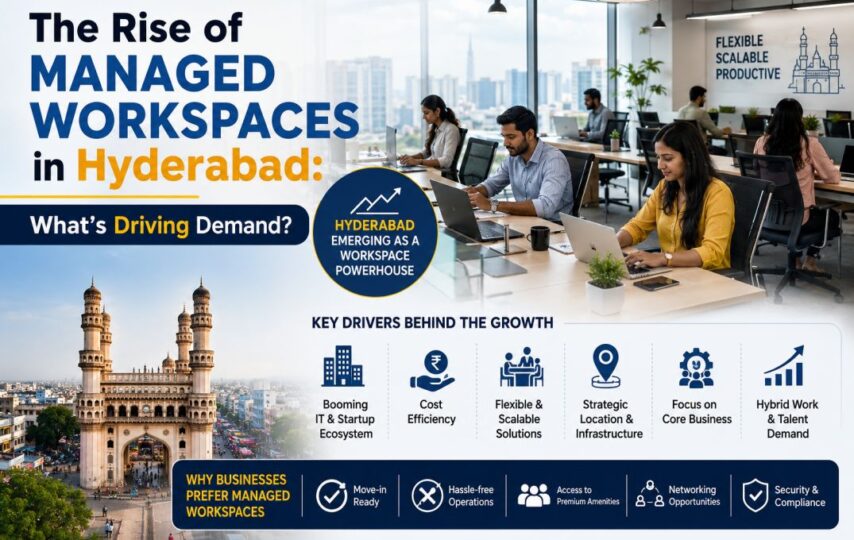

Hyderabad has undergone a remarkable transformation over the past decade. Once known primarily as India’s IT hub, the city has evolved into a dynamic commercial ecosystem attracting startups, multinational corporations, and global capability centres. At the heart of this transformation lies a fundamental shift in how organisations approach workspace strategies. The rise of managed office spaces has become one of the most significant trends shaping Hyderabad’s commercial real estate landscape.
For CEOs evaluating expansion strategies, HR leaders optimising workforce models, GCC heads managing distributed talent, and facility managers streamlining operations, the managed workspace model addresses a critical business challenge: maintaining professional infrastructure whilst preserving the agility required to compete in today’s rapidly evolving marketplace.
Why Hyderabad is Leading India’s Managed Office Boom
Hyderabad presents a unique value proposition that distinguishes it from other Indian metropolitan centres. The Telangana government’s progressive business policies, including initiatives like TS-iPASS and T-Hub, have created an environment actively encouraging entrepreneurship and business expansion. The city hosts a highly skilled workforce across technology, business process services, engineering, and financial services sectors.
This concentration of talent attracts companies seeking to establish or expand operations. India’s office sector witnessed record-breaking leasing activity in 2024, with Hyderabad, Bengaluru, and Mumbai collectively accounting for the highest office space absorption. During 2024, global capability centres (GCCs) accounted for a 37 per cent share in the overall office leasing in India, with Hyderabad ranked second in GCC leasing after Bengaluru, according to CBRE India. The city continues to attract global corporations across industries such as technology, pharmaceuticals, biotechnology, and financial services. Technology corporations and flexible space operators dominated the office space take-up across the country. Perhaps most importantly, Hyderabad offers a cost advantage compared to other tier-one cities whilst maintaining comparable infrastructure quality and professional standards. This combination of talent availability, business-friendly policies, and cost efficiency has created unprecedented demand for flexible, professionally managed workspace solutions.
Drivers of Growing Demand
Post-pandemic workplace evolution has fundamentally changed how organisations approach office space. The widespread adoption of hybrid work models means companies no longer need fully occupied, traditional offices. Instead, they seek flexible spaces accommodating distributed teams, periodic in-office collaboration, and rapid scaling as business requirements change.
Startup ecosystems particularly benefit from managed office solutions. Founders can establish professional operations within weeks rather than months, preserving capital for product development and market expansion. Global capability centres require flexibility to adjust team sizes based on client demand and project cycles. SMEs and MSME business owners lack resources to negotiate complex commercial leases independently, making managed offices a turnkey solution that allows business owners to focus on operations rather than real estate management.
Key Benefits Across Decision-Making Roles
CFOs recognise managed workspaces as cost optimisation opportunities. Traditional office leases require significant upfront capital for security deposits, interior design, and infrastructure setup. Managed offices eliminate these capital outlays and consolidate multiple monthly vendor bills into a single predictable payment, improving cash flow visibility.
HR leaders value managed office environments for talent attraction and retention. Modern, professionally designed workspaces improve employee experience and support hybrid work models effectively. IT decision makers benefit from enterprise-grade infrastructure, redundant internet connectivity, cybersecurity standards, and professional IT support as standard offerings. Facility managers streamline operations through vendor consolidation, requiring significantly less administrative overhead than coordinating multiple traditional leases.
Organisations such as Incuspaze specialise in providing these comprehensive workspace solutions, offering flexible managed office spaces designed for diverse business requirements. Their managed office space in Hyderabad combines affordability with professional infrastructure, making them particularly attractive for organisations seeking to optimise their workplace strategy.
The Cost Advantage: Pricing Comparison
Understanding financial implications requires comprehensive cost comparison across major Indian cities for organisations occupying 50 employee seats:
| Parameter | Hyderabad | Bangalore | Mumbai | Delhi NCR |
| Monthly Cost (50 seats) | ₹2,50,000 to ₹3,50,000 | ₹3,50,000 to ₹4,50,000 | ₹4,50,000 to ₹6,00,000 | ₹3,20,000 to ₹4,20,000 |
| Cost per Seat per Month | ₹5,000 to ₹7,000 | ₹7,000 to ₹9,000 | ₹9,000 to ₹12,000 | ₹6,400 to ₹8,400 |
| Setup Cost | ₹1,50,000 to ₹2,50,000 | ₹2,00,000 to ₹3,00,000 | ₹3,00,000 to ₹4,50,000 | ₹2,00,000 to ₹3,00,000 |
| Included Services | Internet, utilities, maintenance, security, support | Internet, utilities, maintenance, security, support | Internet, utilities, maintenance, security, support | Internet, utilities, maintenance, security, support |
Hyderabad offers approximately 35 to 40 per cent cost savings compared to Mumbai whilst maintaining equivalent infrastructure quality. When accounting for setup costs and ongoing vendor management overhead, the financial advantage becomes even more pronounced.
Technology and Workspace Evolution
Modern managed office spaces increasingly incorporate advanced technology infrastructure supporting hybrid and distributed work models. High-speed redundant internet connectivity, technology-enabled meeting rooms, and integrated collaboration platforms have become standard features. Sustainability and environmental responsibility have become important differentiators, with organisations implementing energy-efficient systems, waste management programmes, and eco-conscious building practices reflecting workforce and leadership priorities.
For insights into emerging workplace technology trends and business transformation strategies, resources such as Tech Magazines covering workplace innovation and business infrastructure solutions provide valuable perspective on industry evolution.
Making Strategic Decisions
Organisations evaluating managed office adoption should conduct systematic analysis across multiple dimensions. Cost comparison must extend beyond per-seat pricing to encompass setup expenses, contract flexibility, customisation options, and included services. Visit prospective facilities during operational hours to assess working environments, technology infrastructure quality, and employee amenities.
Evaluate service level agreements carefully regarding internet connectivity redundancy, IT support response times, and facilities maintenance standards. Request detailed pricing breakdowns clarifying any recurring or variable costs. Consider your organisation’s growth trajectory and team flexibility requirements. Organisations experiencing rapid scaling benefit significantly from managed office flexibility.
The Path Forward
Hyderabad’s emergence as India’s managed workspace capital reflects broader transformations in how organisations structure operations. With the city’s office space projected to surpass 200 million square feet by 2030, demand for flexible, scalable workspace solutions will only intensify. The combination of cost efficiency, operational flexibility, professional infrastructure quality, and strategic scalability creates compelling value for diverse organisational types and sizes.
For CFOs evaluating cost optimisation, HR leaders enhancing employee experience, GCC heads managing distributed operations, and facility managers streamlining portfolio management, managed office solutions address real business challenges whilst supporting organisational growth and resilience. The surge in demand signals a fundamental market realignment that will likely accelerate in the coming years. Whether your organisation is establishing first operations in Hyderabad or optimising existing infrastructure, the managed office model merits serious consideration as part of a comprehensive workplace strategy.