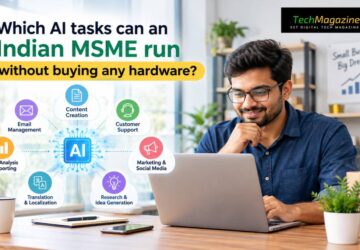
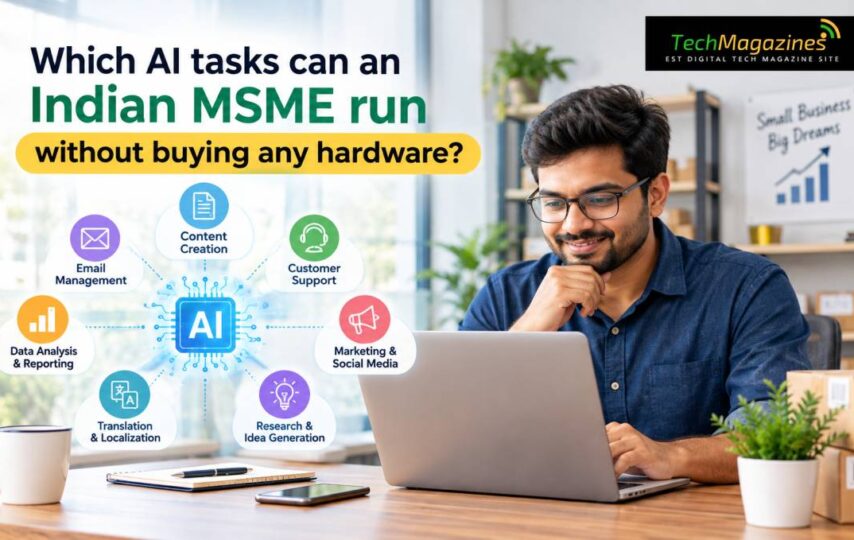

For an MSME, AI adoption can feel quite expensive. Usually, because the first thing they are mindful of is the cost of GPUs, storage, servers, and cooling.
And, in the context of Indian MSMEs, the upfront investment can actually be difficult to justify. Right when an AI project is still being tested, for example, a retailer would want a customer support assistant. Or a design studio might need AI image generation for a few hours each week. Or think of a manufacturer that may want to automate its document processing.
Look, none of these projects actually require the business to start by purchasing a GPU server. In context, cloud infrastructure lets MSMEs access AI compute resources on demand, test different workloads, and scale capacity only after the use cases start to prove valuable.
What does hardware-free AI mean?
Hardware-free AI means using remote cloud infrastructure instead of purchasing and operating dedicated AI servers. Mind you, the AI model still runs on physical hardware, and that hardware sits inside a data center managed by the provider.
The business uses the compute through a cloud instance, application, API, or managed platform. This removes several upfront requirements:
- GPU purchase
- Server setup
- Power planning
- Cooling
- Hardware maintenance
- Replacement components
- Rack or data center space
When you have these in place, the business can then focus more of its budget on solving the actual problem.
9 common AI tasks that an Indian MSME can run without buying any hardware
With cloud platforms like the ones mentioned above, any business can run pretty much any AI task, and they don’t even have to buy any hardware.
Here are the 9 most common AI tasks:
1. Customer support and internal AI assistants
Customer support is one of the easiest AI workloads for an MSME to test. Your business can connect a language model with product information, FAQs, policies, or internal documents.
Possible applications include:
- Customer FAQ assistants
- Employee knowledge tools
- Order support
- Product information
- Internal policy search
- Sales assistance
A small internal assistant may require modest infrastructure. In reality, a public chatbot serving many customers needs more attention to concurrency, latency, and GPU utilization.
Cloud infrastructure makes it much easier to start small and add capacity as usage grows.
2. Document processing and OCR
Many businesses still process invoices, forms, purchase orders, scanned documents, and PDFs manually. Time to be different! AI can automate parts of this work.
A document workflow can:
- Read scanned invoices
- Extract names, dates, and totals
- Classify documents
- Summarize long files
- Compare contracts
- Move information into another system
These workflows may combine optical character recognition, language models, and data-processing tools. Document volumes can also vary significantly, making cloud compute useful for running large batches only when they arrive.
3. Content generation and marketing
If you have a small marketing team, they can use AI for much more than generating a first draft.
Cloud-based AI can support:
- Product descriptions
- Email variations
- Social media content
- Advertising concepts
- Image generation
- Translation
- Content summaries
- Basic video assets
This is particularly useful when creative workloads are irregular.
A campaign may require significant AI compute for two days and very little once the campaign is complete. Cloud infrastructure lets the team use extra resources during that period without leaving dedicated hardware idle afterward.
4. Image generation and product visuals
Image generation can be useful for e-commerce businesses, agencies, interior design firms, fashion brands, and other businesses requiring visual-based projects.
An MSME can use cloud GPUs for:
- Product mockups
- Concept images
- Background replacement
- Image enhancement
- Marketing visuals
- Design variations
GPU requirements increase as models, image resolutions, and batch sizes become larger.
Teams comparing cloud access with local hardware can review the current RTX PRO 6000 price in India before deciding whether their usage is high enough to justify owning a professional GPU.
For occasional creative workloads, renting compute can avoid a large upfront hardware investment. So, plan accordingly.
5. AI-assisted software development
If you are a part of a small software company, you can use cloud AI during the development process. Some common uses include:
- Code assistance: Complete or generate sections of lines of code.
- Bug analysis: Elaborate on errors and suggest possible fixes.
- Testing: Generate test cases for existing software.
- Documentation: Make technical documentation files and summaries.
- Log analysis: Process large volumes of logs and identify common patterns.
Some of these tasks can use hosted AI services. Others may benefit from private models running on cloud GPU infrastructure.
The right option depends on model size, data sensitivity, usage, and the level of control the development team needs.
6. Translation and speech processing
Within the Indian context, teams often communicate through several languages. AI can help translate product information, documentation, support messages, and even marketing content. Furthermore, speech models can also help businesses process recordings or calls.
For instance, an MSME could:
- Upload recorded customer calls.
- Convert speech into text.
- Summarize each conversation.
- Identify common customer questions.
- Store the results for later analysis.
This type of batch workload can run only when new recordings need to be processed.
7. Forecasting and business analytics
Given your team’s context, AI can also help MSMEs make better use of existing business data. A retailer may analyze sales patterns. Or, a manufacturer may study production data. In some scenarios, a service company may review customer demand.
Possible workloads include:
- Demand forecasting
- Inventory planning
- Customer segmentation
- Sales analysis
- Anomaly detection
- Business reporting
The required infrastructure depends on the amount of data and complexity of the model. Your team can begin with smaller compute resources and add GPU capacity when the workload becomes more demanding.
8. Computer vision without an AI workstation
Beyond large tech companies, computer vision has several practical uses. Consider situations where a manufacturer may inspect product images for problems, or a warehouse may classify packages.
Cloud GPUs can process video or image data without asking for a dedicated AI workstation within the business. Your team should also account for network requirements when large media datasets need to be uploaded for further processing.
9. Fine-tuning smaller AI models
An MSME may eventually want an existing AI model adapted to a specific task.
Fine-tuning can help with:
- Industry-specific terminology
- Document classification
- Customer support
- Specialized content
- Internal knowledge applications
When does buying AI hardware make sense?
Using Cloud works particularly well when workloads are new, irregular, or changing. Hardware ownership becomes easier to evaluate once the business has reliable usage data and hardware usage is regular.
Here are a few things you should track before making that call:
- GPU hours each month
- Average GPU utilization
- Peak GPU memory
- Monthly infrastructure cost
- Workload growth
- Maintenance requirements
A GPU that remains busy throughout the month can create a stronger case for ownership.
A GPU used for occasional projects may spend most of its time idle.
A practical starting point for Indian MSMEs
Let’s start with one clear problem.
For example:
- Automate invoice extraction
- Create a customer support assistant
- Generate product images
- Analyze monthly sales
- Transcribe customer calls
Run a small cloud-based pilot and measure output quality, processing time, resource use, and cost. If the project creates measurable value, increase capacity gradually. This gives the business evidence before it makes a larger infrastructure investment.
Conclusion
Often, Indian MSMEs can run a wide range of AI workloads without purchasing dedicated hardware.
Services such as customer support, document processing, content creation, image generation, translation, analytics, software development, and model fine-tuning can all begin on cloud infrastructure.
The biggest advantage here? Flexibility. Businesses can start with one small use case, measure the result, and add compute only when the project proves useful. For many MSMEs, the first AI infrastructure decision therefore does not need to be which GPU to buy. It can simply be which business problem is worth solving first.
Frequently asked questions
Can an MSME run AI tasks without owning a GPU?
Yes, your business can access GPUs through cloud infrastructure or use hosted AI services without buying dedicated GPU hardware.
Which AI tasks are easiest for a small business to start with?
Consider workloads like customer support, document processing, content assistance, translation, and business analytics as practical starting points for your team.
Can cloud GPUs be used for fine-tuning?
Yes, of course! Suitable cloud GPU configurations can support model fine-tuning, but it depends on the model size, training method, and memory requirements.
Is renting a GPU better than buying a GPU?
Whether you want to buy or rent a GPU depends on your utilization. Irregular workloads can be great for cloud access. However, sustained and predictable usage can make hardware ownership worth considering.
What should an MSME measure during an AI pilot phase?
Try tracking output quality, processing time, cost, resource usage, user demand, and the amount of manual work you save during the process.