
There is a pattern most homeowners know too well. You buy a fence that looks decent, it holds up for a few years, and then slowly starts losing the battle against weather, moisture, and time. Before long, you’re back to square one, pricing out another replacement.
An aluminum fence breaks that cycle. Not by being indestructible in some exaggerated marketing sense, but by being fundamentally better suited to outdoor conditions than the materials most people default to.
The Chemistry Behind Why Aluminum Holds Up
Wood rots. Steel rusts. These aren’t quality problems specific to a particular brand or manufacturer. They’re the natural outcome of leaving organic material or ferrous metal exposed to the elements long enough.
Aluminum behaves differently. When the surface is exposed to air, it forms its own microscopic protective barrier that prevents deeper degradation from taking hold. This isn’t a coating that wears off. It’s built into how the material responds to its environment. For properties near the coast, in humid climates, or in areas that deal with freeze-thaw cycles through the winter, this distinction matters more than most buyers realize.
A professional powder coat finish takes that inherent durability and extends it further, providing UV resistance and a surface that keeps its color for 10 to 15 years without requiring periodic repainting.
Light to Work With, Strong in the Field
Ask anyone who’s dismissed aluminum fencing and the objection usually comes down to weight. Light material doesn’t hold up, the thinking goes.
Modern manufacturing has made that assumption outdated. Aluminum fence profiles are now produced with precise wall thickness control and alloy compositions specifically engineered for structural performance. The material flexes under impact rather than cracking, holds its shape under lateral soil pressure, and handles wind loads that would stress weaker systems. The weight advantage means installation is faster and post anchoring carries less long-term stress, which actually improves how the fence performs over time.
A System That Fits the Property Instead of Fighting It
For a long time, choosing a security fence meant accepting a visual compromise. Functional meant industrial-looking. Decorative meant structurally questionable.
That trade-off no longer holds. Current aluminum fence configurations cover a wide range of property types and architectural styles:
- Vertical picket panels for traditional or formal exteriors
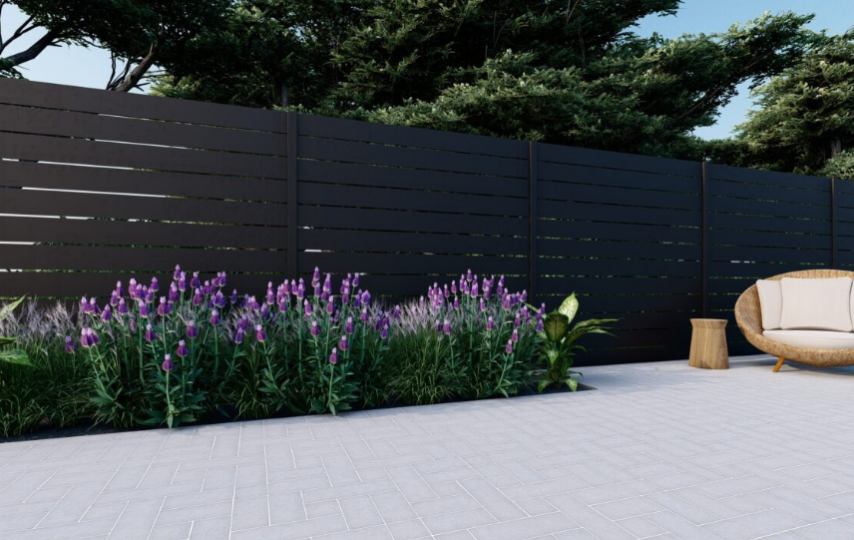
- Horizontal slat designs suited to modern and contemporary homes
- Full privacy builds for enclosed gardens and backyard spaces
- Semi-privacy layouts that establish a clear boundary while maintaining light and air circulation
Powder coating options have expanded to match virtually any exterior palette, from deep matte black to warmer neutrals and textured finishes that mimic timber without any of the maintenance timber demands.
What the Maintenance Timeline Actually Looks Like?
A wood fence over a 10-year period typically requires two to three full treatment cycles (staining, sealing, or both), spot repairs for rot or splitting, and at least one partial panel replacement somewhere along the run. Steel requires rust treatment and repainting on a similar cycle. Neither calculation includes labor, which quietly adds to the total cost every time.
Aluminum maintenance over the same period looks like this:
- Periodic cleaning with water and a mild detergent
- Annual check of gate hardware, hinges, and fasteners
- Touch-up on any chips in the powder coat if they appear
That’s the realistic scope. No staining, no rust treatment, no replacement sections. The lower maintenance burden doesn’t just save time. It changes the actual cost of owning the fence over its lifespan.
Installation Is Where the System Proves Itself
The best fencing material still underperforms when installation is done carelessly. Post depth, spacing consistency, how panels connect to posts, how the system handles grade changes across uneven ground: these details determine whether a fence looks and performs correctly for 15 years or starts showing problems within 3.
A well-engineered aluminum fence system is designed so that installation precision is built into the product, not left to chance.
Why Alumission Is the Right Starting Point?
Alumission manufactures aluminum fence systems with tight control over profile specifications, alloy standards, and powder coat application. The result is fencing that performs reliably from installation through decades of use, without the visual or structural compromises that cheaper systems often require.
If you’re planning a new installation or replacing a fence that’s run its course, the best time to contact Alumission is before you’ve committed to a specification. Get the right system designed from the start, and every step after that gets simpler.
Contact Alumission today for a tailored quote and find out what a fence that actually lasts looks like for your property.