
You can be a 40-year-old with a clean record, a paid-off Camry and the same coverage as your cousin in Abilene, and still pay noticeably more because your mail comes to a Harris County ZIP code. That is not a billing error. It is how auto rates are built in Texas.
The frustrating part is that most of the advice aimed at Houston drivers is written for a generic American driver. Hail, hurricane flooding, a theft problem and some of the worst congestion in the state all show up in your premium, and a few of the standard money-saving tips make things worse here rather than better.
What the Houston surcharge is actually made of
Three local realities do most of the damage.
The first is crash exposure. The Texas Department of Transportation ranked 36 Houston-area road segments among the state’s most congested locations in 2024. If you commute on the Southwest Freeway, the Gulf Freeway or the west side of the 610 Loop, you are sitting in the same stop-and-go conditions that produce low-speed rear-end claims by the thousand. Insurers price that.
The second is the weather. The Insurance Information Institute puts Houston among the top three U.S. metros for storm and hurricane risk. Hail and flood claims hit comprehensive coverage, not liability, which is why the gap between Houston and cheaper Texas cities is widest on full-coverage policies.
The third is theft. According to the National Insurance Crime Bureau, Texas has the second-highest vehicle theft rate in the country, and thefts rose about 10% between 2022 and 2023. Harris County carries a large share of that.
None of those three are things you can fix. The rest of this article is about the things you can.
Your ZIP code is doing more work than you think
Rating territories in Texas are drawn tighter than most drivers realize. Compare.com’s 2026 data puts the average Houston driver at roughly $170 a month for liability-only coverage and about $276 for full coverage, against Texas averages closer to $118 and $215. Nearby Katy and Pearland come in cheaper than Houston proper on the same profile.
That does not mean you should move. It means two practical things.
If you already live in the suburbs and commute in, make sure your policy reflects where the car is garaged overnight, not where you work. Garaging address is what the rating territory keys off.
If you are house-hunting anywhere in the metro, pull a sample quote for the ZIP before you sign. A move from inside the Loop out to Cypress or Sugar Land can change your annual premium by several hundred dollars, and nobody mentions that at the closing table.
The deductible trick that backfires here
The standard advice is to raise your deductible from $500 to $1,000 and pocket the difference. In much of the country that is fine. In Houston it deserves a second look, and the reason is hail.
A single spring storm can total the hoods and roofs of an entire apartment lot in Sharpstown or Clear Lake. If you park outdoors, comprehensive is not a rare-event coverage for you. It is something you may claim twice in five years. A $1,000 comprehensive deductible on a car you file on that often can erase several years of savings in one storm.
A more useful split for Houston drivers:
- Keep the comprehensive deductible low if you park outdoors, especially west and southwest of downtown where hail runs hardest.
- Raise the collision deductible instead, if your driving record is clean and you have the cash on hand to cover it.
- If you have covered parking and a garage at home, the standard advice works fine and you should take the savings.
The honest trade-off: a lower comprehensive deductible costs real money every month for a claim that may never come. If your car is worth under about $4,000 and you park it in a garage, dropping comprehensive and collision entirely is a defensible choice, and one your agent will probably not suggest.
The 30/60/25 problem
Texas requires 30/60/25 liability coverage: $30,000 in bodily injury per person, $60,000 per accident, and $25,000 in property damage. Those limits have not moved since 2011.
Run the property damage number against what people actually drive on the Katy Freeway. A three-year-old full-size pickup can carry a $55,000 replacement value. Rear-end one at 30 mph and your $25,000 property damage limit stops well short. The rest comes out of your assets, and in Texas a judgment can follow your wages.
Moving from 30/60/25 up to 100/300/100 usually costs far less than people expect, often somewhere in the range of $15 to $30 a month depending on your record and your carrier. It is the single change with the best ratio of protection gained to dollars spent. If your budget is tight and you are choosing between full coverage on an older car and higher liability limits, take the higher limits.
Shop the policy, not the brand
Rate differences between carriers for the identical Houston driver routinely run into the hundreds of dollars a year. That spread exists because each company weighs your ZIP, credit history and vehicle differently, not because one is better than another.
Before you start calling, spend twenty minutes on the Texas Department of Insurance and the Office of Public Insurance Counsel. It shows sample rates and the coverage types offered by companies writing in your area, including the nation’s top 25 insurance groups. It will not give you a bindable quote, but it tells you which carriers are worth your phone calls and which are priced out of your range before you hand over your driver’s license number.
Then cast a wider net than the four national brands you see on television. Searches for cheap car insurance Houston turned up regional companies alongside the national ones, including GoAuto Insurance, a regional insurer selling low-cost auto policies in Texas and several other states. Regional and non-standard carriers sometimes price a Houston ZIP or an imperfect driving record more favorably than a national brand will, and sometimes they do not. The only way to know is to run the same coverage through several of them.
Quote the same thing every time. Same limits, same deductibles, same drivers listed. A quote that comes back $40 cheaper because it quietly dropped your uninsured motorist coverage is not cheaper.
Two coverages Houston drivers decline too casually
Insurers in Texas have to offer you uninsured and underinsured motorist coverage and personal injury protection. You can turn both down, but the rejection has to be in writing, which is why they appear as checkboxes in every online quote flow.
Uninsured motorist coverage matters here in proportion to how many uninsured drivers share the road with you, and Texas has never had a small share of them. If you are hit on the North Freeway by a driver with no policy, UM coverage is what pays your medical bills and repairs. It typically costs a few dollars a month.
PIP pays medical costs regardless of fault, along with a portion of lost wages for you and your passengers, and it pays before any liability question gets settled. For a household without strong health coverage or paid sick leave, $2,500 of PIP is one of the cheapest useful things on a Texas policy.
Where to start this week
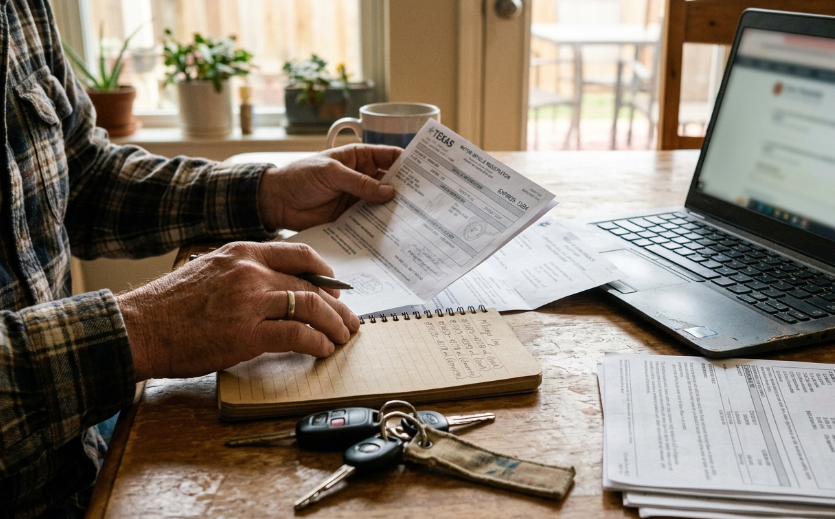
Pull out your declarations page and check three lines: your liability limits, your comprehensive deductible, and the garaging address. If the limits read 30/60/25, price the jump to 100/300/100 at your next renewal. If the comprehensive deductible is high and your car sleeps in an open lot, reverse it. If the address is wrong, fix it before you shop, because a corrected address changes every quote you collect afterward.