
Modern AI systems are frequently capable of handling problems even though they have not been explicitly trained for them. For instance, it is possible to ask a model to classify a review as either positive or negative, to produce a summary of a long document, to translate a paragraph, to draft an email, or to extract data and place it into a structured format all without the need to build a distinct training dataset for each of these tasks. This ability is mainly the result of large-scale pre-training and two closely related features: zero-shot learning and few-shot learning.
It is useful to understand what actually results from pre-training a model, why prompts are so important, and when it is still necessary to fine-tune the model or add external tools if the course involves generative AI.
Pre-training builds general-purpose representations
Large language models are typically pre-trained using vast quantities of text (and in some instances also on code, images, or audio). During this stage the model develops an understanding of the statistical patterns of language, such as grammar, common facts, reasoning shortcuts, writing styles, and the relationships between concepts. Most important of all, it does not memorise “a single task”; instead it acquires a general capability for predicting what comes next in a variety of different situations.
The great variety of capabilities turns out to be useful since many different tasks can be reinterpreted as “predicting the next tokens” in a helpful format. For example:
- Classification becomes: “Label: Positive/Negative.”
- Summarisation becomes: “Summary: …”
- Extracting means ‘returning the JSON including these keys’.
The reason why it is so strong is that when it was being pre-trained it had come across similar patterns on numerous occasions even though it had never come across your particular task description.
Zero-shot learning: doing the task with instructions only
Zero-shot learning is the scenario in which a model performs a task simply on the basis of a natural-language instruction, without any examples being given in the prompt; all you have to do is state what you want done and the model then makes an effort to carry it out.
A typical zero-shot prompt might be something of this kind: “Classify this support ticket as either Billing, Technical, or Account. Just return the label.” Even if the model had not been trained on the support tickets of your organisation, it could still make use of the understanding of concepts such as “billing issues” or “account access problems” that it had gained during its pre-training phase.
Zero-shot works best when:
- It is something that people often have to do and is easy to describe (for example, summaries, sentiments, and topic labels).
- The format in which the output is presented is clear and definite.
- The language used was ordinary and contained clear signs.
In a practical course involving Generative AI Course you will usually find that its zero-shot performance improves a great deal when constraints such as maximum length, tone, allowed labels, and the exact form of the output are given.
Few-shot learning: teaching by example inside the prompt
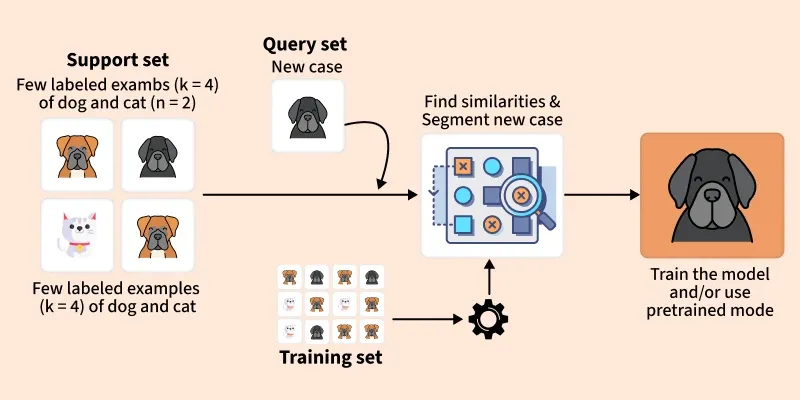
Few-shot learning consists of including a small number of examples in the prompt in order to demonstrate the pattern you desire, after which the model continues this pattern for the new input. This approach is usually called in-context learning since the “learning” occurs within the context rather than through updating the model’s weights.
For instance, you might provide the model with three customer messages along with the correct category and then give it a fourth message for it to assign a category to. In this case, you are not retraining the model but rather giving it instructions through a brief ‘task specification’ that includes examples.
Few-shot prompting tends to help when:
- The specific definitions of the labels vary from organisation to organisation (for example, what constitutes ‘Priority 1’).
- The task requires that a uniform style be used (for instance, either formal or informal replies).
- The first proposal of the model is about right, but not reliable.
Prompt design then becomes a real skill because the examples employed should be typical, concise, and cover the edge cases that are important.
Why prompting works: pattern completion plus instruction following
The success of the models in the zero-shot and few-shot situations is nothing magical; it is due to the fact that, as a result of their pre-training, they are able to detect intent, associate inputs with outputs, and follow typical textual patterns. The further training stages (which generally include instruction tuning and preference optimisation) then improve the model so that it gives helpful responses to human instructions.
In simple terms:
- As a result of the pre-training process, the model acquires a wide variety of linguistic skills.
- It is because of instruction tuning that we can use that competence by means of prompts.
- The examples with a small number of instances adopt the pattern that you want for your specific context.
The key thing to remember if you’re taking a course in generative AI is that prompts aren’t just requests; they are instead text-based programmes. They set out a role, impose limitations, specify the required format and include examples, all of which affect the model’s behaviour.
Practical tips and common limitations
To get reliable zero-shot or few-shot results, focus on clarity and consistency:
- State the task in one sentence and also state the required format for the output.
- To reduce variation, provide a set of approved labels or a strict schema.
- It would be advisable to give one or two examples of edge cases in cases where accuracy is important.
- You only need to request a short explanation if you genuinely do so; in some cases such explanations may result in longer texts and even errors.
- Evaluate the prompts using a small evaluation set rather than relying on just one or two inputs that are especially good.
Be aware of limitations:
- Models are capable of inventing details that seem believable but are in fact incorrect.
- Performance drops when the inputs are a long way from the distribution against which the model was trained (use of highly specialised jargon and rare formats).
- The model might also be biased too much if the few-shot examples are unbalanced or misleading.
- External knowledge or verification is sometimes necessary and retrieval tools and databases can then be used.
Conclusion
The capacity to learn without having any previous examples or with just a few examples arises from combining large-scale pre-training with the ability to follow instructions. With zero-shot prompts you can use the model immediately, while few-shot prompts improve consistency by providing an example of the kind of pattern you want. The best results are obtained by treating prompting as a matter of careful specification, that is, by defining the task, limiting the output, and using examples in a strategic manner. If you take on this approach and gain hands-on experience by doing a generative AI course, then you will be able to apply general-purpose models to real business tasks without needing to set up a full training pipeline every time.
Business Name: ExcelR – Data Analyst, Data Science & Generative AI Course in Noida
Address: Myworx, A-5, 2nd Floor, near Noida Sector 16 Metro Station, Gautam Budh Nagar, Block A, Noida Sector 3, Noida, Uttar Pradesh 201301
Phone Number: 09187195453
Email ID: enquiry@excelr.com