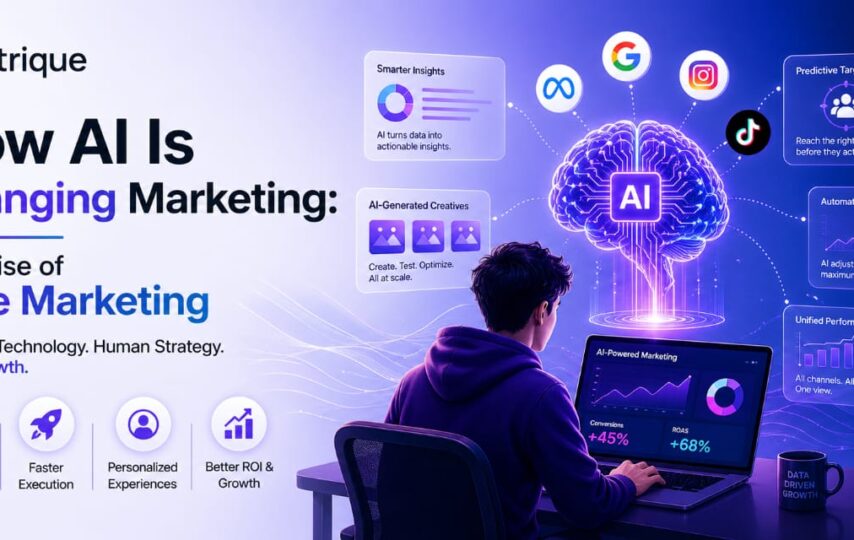

The growth of brands has undergone a significant transformation. AI-powered intent-led systems are replacing manual campaign builds, delayed reports, and channel-by-channel execution. As this changes, one of the most popular ideas among performance marketers nowadays is, “What is vibe marketing?”
Vibe marketing is fundamentally a prompt-driven, AI-first approach in which marketers specify the objective, target audience, offer, and tone while AI manages large-scale execution. This is less about disorganized prodding and more about a clear strategic direction that turns concepts into campaigns, creative, and optimization loops.
This is more than just a fad for modern brands. Growth teams are working more quickly, testing more intelligently, and increasing ROI with less operational friction as a result of this structural change. Speed is no longer sufficient in a digital ecosystem where customer journeys are dispersed among owned channels, marketplaces, social media, and search. Additionally, teams require context, accuracy, and the capacity to react to behavioral cues in real time.
This is precisely where using artificial intelligence in marketing gives you a competitive advantage. Brands can cut down on repetitive work and concentrate on what really spurs growth. It makes better choices, more precise messaging, and quicker experimentation by fusing strategic human thought with machine-led execution.
The Reason Behind the Slowdown of Traditional Marketing
Conventional marketing processes were designed for a slower internet. The team spends hours:
- Pulling platform reports
- Examining the effectiveness of the campaign
- Organizing the creatives.
- Starting A/B experiments
- Manually optimizing audience
Although that strategy is still effective, it is unable to keep up with the fragmented customer journeys and constantly active advertising platforms of today. These days, customer signals fluctuate every day or even every hour.
This is where the use of an AI in marketing modifies the situation. AI-first technologies enable strategies to specify what success should look like rather than requiring teams to perform tedious activities by hand:
- Increased ROI
- Improved CAC
- Quicker creative updates
- More conversions from landing pages
- SKU-level optimization
AI then converts those instructions into outputs that may be used, turning speed from a resource bottleneck into a competitive advantage. Strique positions this as the change from “how well you execute” to “how well you instruct.”
The True Significance of Vibe Marketing
Many marketers believe vibe marketing is just using AI suggestions to create advertisements. The idea is actually far more complex. In reality, vibe marketing is a revolutionary growth operating system where:
- Business context is defined by human
- AI carries out the process
- Feedback loops enhance subsequent results.
- Performance signals help the system learn.
The marketers take on an unplanned role. For instance, a strategist can provide the following rather than manually creating five campaign variations:
- The pain point of the target audience.
- KPI for performance
- Financial limitations.
- Getting creative angles.
- The goal of the landing page
AI then transforms this into performance summaries, recommendations, testing frameworks, and advertisements. At this point, AI in marketing transcends automation and becomes intelligent execution.
How Campaign Performance is Enhanced by AI-First Platforms
The ability of vibe marketing to combine disparate workflows into a single feedback loop is its greatest benefit. With the use of modern AI marketing solutions, brands may now unite:
- Meta Advertisement
- Google Ads
- GA4 Signals
- The performance of Shopify
- Perspectives on creative exhaustion
- Product feed information
The strategist receives a single decision layer in place of dispersed dashboards. This enables quicker responses to queries such as
- Who is the overspending audience?
- What kind of creativity is exhausting?
- Which SKU should have a larger budget?
- Which landing page prevents conversions?
Compared to historical automation, AI marketing is now far more outcome-focused. AI-first systems, in contrast to static rules, adjust to:
- A shift in user behavior
- Learning on platform
- Seasonal variation
- Provide performance
- Attribution at the channel level
Vibe marketing is future-ready because of its flexibility.
How AI is Altering the Role of Marketers
The evolution of the marketer is one of this model’s most significant modifications. Performance teams used to be regarded for their execution bandwidth. These days, their strategic clarity is what makes them valuable. This is where daily workflows are being altered by AI marketing technologies.
- From growth architect to task managers
These days, marketers spend more time formulating hypotheses and less time creating dashboards.
- From learning systems to campaign launches
Every ad launch turns into a data loop that enhances subsequent campaign structures and cues.
- Static planning to real-time optimization
AI provides immediate actionable information rather than requiring weekly reports. This illustrates how AI is transforming marketing on an operational level; decision quality is still made by humans, but speed is automated.
Why Vibe Marketing Leads to More Intelligent Consumer Interaction
The capacity of vibe marketing to develop more pertinent and responsive client journeys is its true power. Conventional advertising frequently uses board segmentation and static messaging, which can overlook changing user intent. AI marketing systems, on the other hand, are always learning from audience behavior, engagement patterns, and conversion signals to improve brand communication. Every touchpoint becomes more context-aware as a result.
Vibe marketing helps make sure the message is appropriate for the customer’s stage of the journey. Regardless of how they find the brand, through the sponsored search, social media, emails, or a landing page. Based on real-time performance data, marketers can modify tone, offers, and creative direction rather than using the same campaign logic everywhere.
This is where AI technologies become particularly potent:
- Customizing artistic perspective
- Modifying messaging for the audience
- Enhancing journeys for retention
- Improving remarketing reasoning
- Bolstering conversion channels
Better efficiency for the brand and a more seamless user experience are the outcomes. More significantly, this method lessens speculation. Marketers can use actual behavior cues to inform future advertising instead of depending on conjecture. Because of this, vibe marketing is not only quicker but also pertinent in a digital environment where consumer expectations are always changing.
In the current growth environment, what exactly is vibe marketing?
It is a transition from human-led campaign execution to AI-led orchestration. Where execution is immensely faster and strategy stays human. Brands may transition from reactive optimization to proactive growth by integrating marketing automation, timely clarification, and intelligent feedback systems.
Teams that can effectively direct AI, think logically, and create repeatable systems that learn more quickly than conventional workflows will be the ones in charge of marketing in the future. More significantly, this strategy enables businesses to maintain a stronger relationship with actual consumer intent, which is quickly emerging as the most valuable growth lever in the modern digital world.
Businesses that mix human innovation with AI-led speed will be better positioned to establish relevance, enhance ROI, and maintain long-term visibility as channels become busier and competition heats up. Vibe marketing is improving the way marketers think, make decisions, and grow without replacing them.
FAQs.
1. What is vibe marketing in simple terms?
Vibe marketing is an AI-first approach where marketers define the goal, audience and creative direction, while AI executes campaigns, testing and reporting.
2. How is vibe marketing different from normal automation?
Traditional automation follows fixed rules, while vibe marketing uses adaptive AI systems that learn from campaign signals and improve outputs continuously.
3. Can small businesses use AI marketing tools effectively?
Yes, modern AI marketing tools help lean teams launch campaigns, analyse performance and optimise budgets without needing large in-house marketing departments.
4. How does AI in marketing improve ROI?
AI improves ROI by identifying waste, reallocating budgets faster, spotting winning creatives and improving campaign decisions in real time.