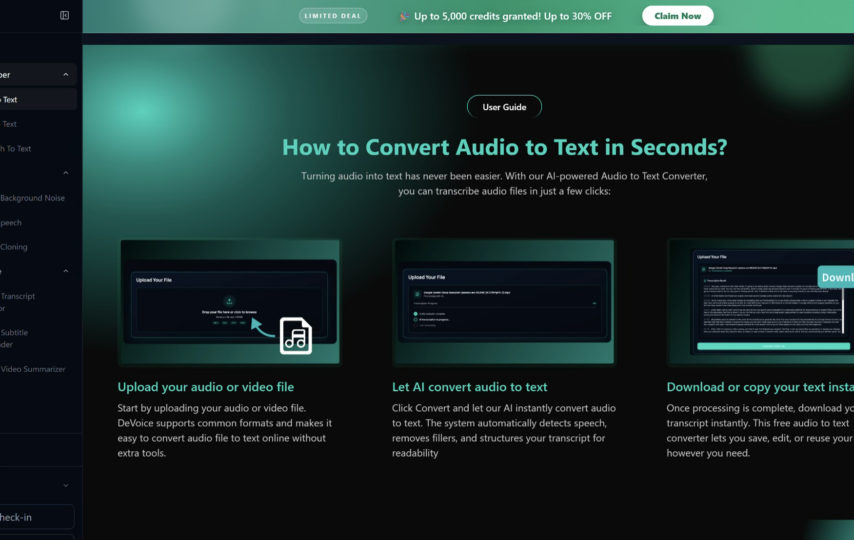

Audio surrounds modern life calls, podcasts, lectures, interviews, and spontaneous voice notes. It’s fast, natural, and effortless to create. But the real challenge begins after recording. Audio is difficult to navigate, harder to edit, and nearly impossible to scale without converting it into something more structured. That transformation—from sound to usable information is where audio-to-text technology proves its value.
With advanced tools like Devoice Ai, spoken content is no longer locked in time-based formats. It becomes searchable, editable, and ready to be shaped into meaningful output.
Why Raw Audio Falls Short in a Content-Driven World
Audio captures ideas quickly, but it doesn’t organize them. If you’ve ever tried to revisit a long recording, you already know the limitation—you must listen from start to finish just to find one detail. That inefficiency becomes a bottleneck, especially when dealing with large volumes of content.
Text, on the other hand, is flexible. It can be scanned, highlighted, reorganized, and shared instantly. Converting audio into text turns passive content into an active resource. It allows ideas to be refined instead of replayed.
The Intelligence Behind Modern Transcription
Today’s transcription systems are powered by artificial intelligence trained on vast amounts of speech data. These systems don’t just hear words—they interpret them. They recognize patterns, predict sentence structures, and adjust to different speaking styles.
This level of intelligence allows tools like Devoice Ai to produce transcripts that feel natural rather than mechanical. The output reflects real conversation flow, making it easier to read, edit, and repurpose.
From Conversations to Content Pipelines
One of the most powerful aspects of audio to text technology is its ability to turn everyday conversations into content assets. A single recording can evolve into multiple outputs once it’s in text form.
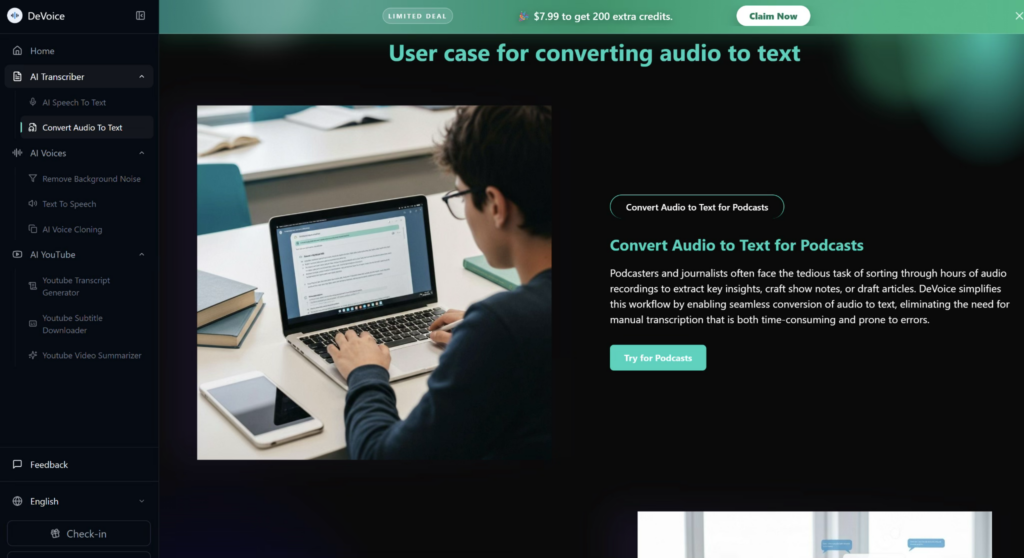
- A meeting can become structured notes.
An interview can become an article.
A podcast can be transformed into blogs, captions, or summaries.
This kind of transformation creates a content pipeline where nothing is wasted. Every spoken word has the potential to be reused and expanded.
Speed as a Competitive Advantage
In fast-moving environments, speed matters. Manual transcription simply cannot keep up with the pace of modern workflows. It slows down production and delays decision-making.
AI-powered tools remove this delay. Within minutes, audio is converted into clear, readable text. This immediacy allows teams and individuals to act quickly, whether they’re publishing content, reviewing discussions, or extracting insights.
Devoice Ai is built around this principle of speed, helping users move from recording to results without unnecessary waiting.
Accuracy in Imperfect Conditions
Real-world audio is rarely perfect. Background noise, overlapping voices, and inconsistent recording quality can make transcription difficult. Earlier systems struggled with these issues, often producing unreliable results.
Modern solutions are far more adaptable. They can filter noise, distinguish between speakers, and adjust to different accents. This ensures that even complex recordings can be converted with a high level of clarity.
With Devoice Ai, the focus is not just on speed, but on maintaining accuracy even when the input is less than ideal.
Making Information More Inclusive
Text plays a crucial role in accessibility. Not everyone can engage with audio in the same way, and relying solely on spoken content limits who can benefit from it.
Transcription opens access to a wider audience. It supports individuals with hearing challenges and helps those who prefer reading over listening. It also allows content to be translated and adapted more easily, extending its reach across different languages and regions.
Enhancing Search and Discoverability
In digital environments, discoverability depends heavily on text. Search engines rely on written content to understand and rank information. Audio alone cannot achieve the same visibility.
By converting recordings into text, users can make their content searchable. This is particularly valuable for creators, educators, and businesses looking to expand their reach.
Transcripts also make it easier to extract keywords, highlight key ideas, and optimize content for different platforms.
Seamless Integration into Daily Work
One of the reasons audio to text tools are gaining popularity is their simplicity. They don’t require complex setups or technical expertise. You record as usual, upload your audio, and receive a transcript ready for use.
This ease of integration means transcription can become a natural part of any workflow—whether it’s for content creation, documentation, or communication.
Devoice Ai supports this simplicity, making the transition from audio to text smooth and efficient.
The Expanding Role of Voice Technology
As technology evolves, the relationship between voice and text is becoming more dynamic. Real-time transcription is already changing how meetings and events are conducted. Multilingual capabilities are breaking down language barriers. Integration with other AI tools is creating more connected systems.
These advancements point toward a future where voice and text work together seamlessly, enhancing both communication and productivity.
Reducing Effort, Increasing Output
The true value of audio-to-text lies in efficiency. Instead of spending hours transcribing manually, users can focus on refining and using their content. This shift reduces effort while increasing output.
It also encourages more frequent use of audio as a medium, knowing that it can easily be converted into something structured and useful later.
Final Perspective: From Voice to Value
Audio is one of the richest forms of communication, but its potential is limited without structure. Audio-to-text technology unlocks that potential by turning spoken words into something tangible and adaptable.
With Devoice Ai, this process becomes fast, accurate, and practical. It allows users to move beyond simply recording ideas and start shaping them into meaningful content.
In a world driven by information, the ability to transform voice into text is not just helpful—it’s a powerful tool for productivity, accessibility, and growth.