
Trees fail with little warning, and when they do, the consequences land on whoever is closest. A branch through a roof, a trunk across a power line, a limb on a vehicle: every tree care business has seen the aftermath.
The professional discipline of tree risk assessment exists to identify these failures before they happen, and the contractors who do this work properly turn risk identification into a real revenue line while protecting clients and themselves from preventable losses.
This guide walks through the key steps in a defensible assessment, covering why it matters to the tree care business, the standards that govern it, what a thorough process includes, and how the documentation that goes with it protects against negligence claims.
Why Does Tree Risk Assessment Matter for Tree Care Businesses?
Tree risk assessment matters for two distinct reasons. It serves the property owner by identifying hazards before failures occur, and it serves the tree care business by creating a documented record of professional judgment that defends the work if a tree later fails.
What’s at stake when a tree fails:
- Property damage: Trees on structures, vehicles, fences, and utilities produce substantial claims
- Bodily injury and death: Falling trees and branches injure people on the property and adjacent areas
- Power outage and utility damage: Trees on power lines disrupt service and produce utility-side claims
- Public safety exposure: Trees overhanging sidewalks, roads, and public areas create third-party liability
- Environmental impact: Significant tree failures affect site drainage, soil, and surrounding plantings
- Client trust: Property owners remember which arborist inspected the tree before it failed
- Negligence claims: A failed tree that was recently inspected becomes the subject of claims against the inspector
The dual nature of the work, identifying risk and producing defensible records of that work, is what separates the discipline as a professional service from a casual visual inspection. The contractors who treat it as the professional discipline it is build long-term relationships with property managers, municipalities, utilities, and insurers who repeatedly need their work.
What Standards and Methodology Should Guide a Tree Risk Assessment?
Professional assessment work is governed by published standards and a defined methodology. Following these standards isn’t optional for credible work, because they’re the same standards courts and insurers look to when evaluating whether reasonable care was exercised.
The primary standards and frameworks:
- ANSI A300 Part 9: The American National Standard for Tree Risk Assessment, defining methodology and terminology
- ISA Best Management Practices for Tree Risk Assessment: Industry guidance aligning with ANSI A300 Part 9
- ISA Tree Risk Assessment Qualification (TRAQ): Professional credential demonstrating competency in the methodology
- Three assessment levels: Level 1 (limited visual), Level 2 (basic), Level 3 (advanced), each appropriate to specific situations
- Risk rating framework: Likelihood of failure combined with likelihood of impacting a target, combined with consequences of impact, producing a risk rating
- Documentation requirements: Standard forms and report formats that produce defensible records
Specialty programs that provide tree service insurance treat tree risk assessment work as part of the broader professional liability profile of arboriculture. Documented risk assessments protect against negligence claims when a tree fails after the assessment was performed, and proper professional liability coverage backs that documentation when claims arise. The work and the coverage operate as a pair.
The TRAQ qualification matters because it signals to clients, insurers, and courts that the assessor was trained to the recognized professional standard. Arborists holding the credential consistently command higher fees and stronger insurance terms than those who don’t.
What Are the Key Steps in a Thorough Tree Risk Assessment?
A thorough assessment follows a specific sequence that produces both the risk determination and the documentation supporting it. Each step has its own purpose, and skipping any of them weakens both the conclusion and the defensibility of the work.
The key steps in a complete assessment:
- Scope definition: Determining whether the work is Level 1, 2, or 3, and what trees and targets are within scope
- Target identification: Documenting what could be struck or impacted if a tree or part fails (people, structures, vehicles, utilities)
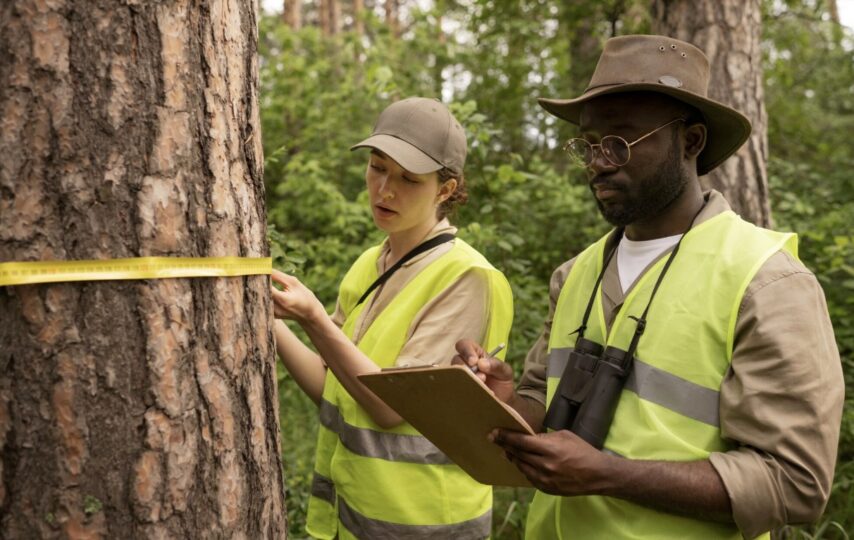
- Tree examination: Systematic visual inspection of crown, trunk, root collar, and root flare for defects
- Defect identification: Cataloging cracks, decay, included bark, dead limbs, lean, soil disturbance, and other failure indicators
- Site condition evaluation: Soil compaction, drainage, recent disturbance, and environmental factors affecting tree stability
- Likelihood and consequence ratings: Applying the standard methodology to produce a defensible risk rating
- Mitigation recommendations: Specific actions ranging from no action through monitoring, pruning, cabling, and removal
- Written report: A complete document including findings, ratings, photographs, and recommended actions
The photographic record matters as much as the written one. An assessment supported by photographs of the defects, the targets, and the site conditions is significantly more defensible than one supported only by checkboxes and notes. Arborists doing this work professionally photograph everything, label the images clearly, and include them in every report.
How Does Documentation Protect Against Liability Claims?
Documentation is what turns an assessment from a professional opinion into defensible evidence. When a tree fails after an assessment, the question for the assessor isn’t usually whether the tree failed but whether reasonable care was exercised in the assessment itself.
How documentation defends against claims:
- Demonstrates due diligence: A written report shows the assessor followed recognized methodology
- Establishes scope clarity: Documentation makes clear what was assessed and what was outside the scope
- Preserves the original observations: Photos and notes capture conditions at the time of inspection
- Supports the recommendation rationale: Defends why specific actions were or weren’t recommended
- Aligns with insurance defense: Provides the evidence professional liability coverage needs to defend the claim
- Shows client communication: Records of recommendations made and the client’s response to them
- Demonstrates standard adherence: Confirms the assessor followed ANSI A300 Part 9 and ISA best practices
- Defines the assessment timeframe: Establishes when the assessment was performed and what conditions existed at that time
The defensive value of complete documentation grows with the size of the claim. A property owner whose tree fell on a vehicle wants to be made whole. A property owner whose tree fell on a person wants someone to be accountable. In both scenarios, the contractor’s documentation is the central evidence in the contractor’s defense, and the gap between thorough documentation and minimal documentation is often the difference between a defended claim and a paid one.
NIP Group offers specialty insurance for tree care contractors through its TreePro program, packaging general liability, professional liability for arborist services, workers’ compensation, commercial auto, equipment, and completed operations coverage with A+ rated carriers. A+ describes an insurer’s superior financial strength to pay out claims when filed.
FAQs
1. Who should perform a tree risk assessment?
A tree risk assessment should be performed by a qualified arborist with ISA TRAQ credentials or equivalent training in ANSI A300 Part 9 methodology. Property owners, landscape contractors, and general arborists without specific risk assessment training often produce assessments that don’t hold up to professional or legal scrutiny.
2. How often should trees on commercial properties be assessed?
Trees on commercial properties should be assessed on a frequency matched to their risk profile:
- High-target areas (parking lots, walkways, building proximity): annually
- Moderate-target areas (interior landscape, low traffic): every 2 to 3 years
- After significant weather events: immediately
- After construction or soil disturbance: within the following season
- When defects are first noticed: as soon as practical
3. What’s the difference between a Level 1 and Level 2 tree risk assessment?
The difference between a Level 1 and Level 2 tree risk assessment is in the depth and intent:
- Level 1 is a limited visual assessment, often from a vehicle, screening many trees quickly
- Level 2 is a basic assessment with a deliberate walk-around inspection of individual trees
- Level 3 is advanced and may include specialized tools like resistograph, sonic tomography, or root collar excavation
- Each level is appropriate to different situations and required by different client circumstances
4. Does insurance cover claims that follow a tree risk assessment?
Insurance can cover claims that follow a tree risk assessment when the contractor carries professional liability coverage built for arborist services. Standard general liability often excludes claims arising from professional opinions and services, which is why specialty tree service programs typically include or pair with professional liability coverage that responds to assessment-related claims.