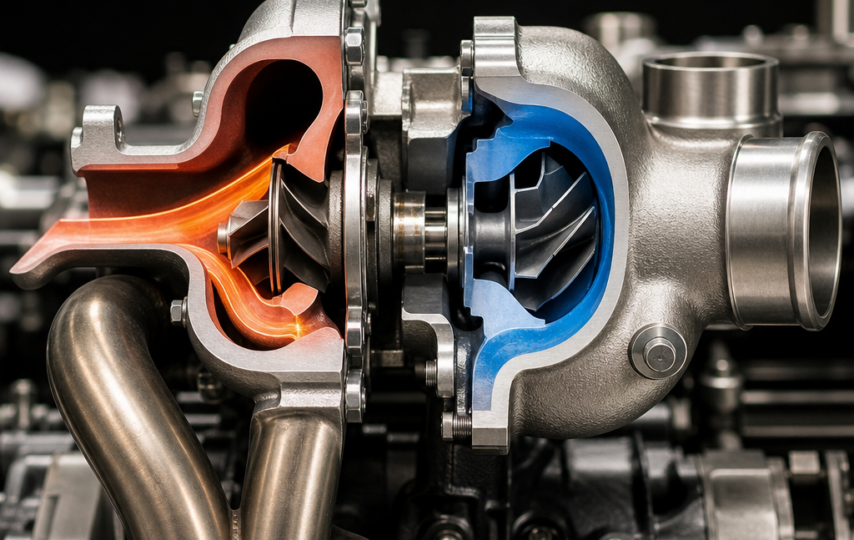

Modern automotive engineering is a discipline built on incremental refinements that collectively produce dramatic improvements in performance, efficiency, and reliability. Among the most impactful of these refinements is the evolution of turbocharger technology. While turbocharging itself has been around for decades, the internal architecture of a turbocharger has undergone significant development. One of the most meaningful advances in this space is the twin scroll turbocharger — a design that addresses some of the most persistent limitations of conventional single-scroll systems. Understanding how this technology works, and why it has become a preferred choice among performance engineers and OEM manufacturers alike, requires a closer look at the physics of exhaust gas flow and turbine efficiency.
The Fundamental Problem with Single-Scroll Turbos
To appreciate the twin scroll design, it helps to first understand what it was engineered to solve. In a conventional single-scroll turbocharger, all exhaust gases from every cylinder are routed into a single shared housing before reaching the turbine wheel. This sounds straightforward, but it creates a significant problem: exhaust pulse interference. When one cylinder exhausts its gases, the pressure wave it generates can collide with the exhaust pulse from another cylinder. These collisions reduce the kinetic energy available to spin the turbine, which in turn reduces boost pressure and increases turbo lag — the frustrating delay between throttle input and power delivery.
This interference is particularly pronounced in four-cylinder engines, where the firing order causes exhaust events to occur in rapid succession. Engineers recognized early on that separating these pulses could dramatically improve turbine efficiency, and the twin scroll design was developed as a direct response to this challenge.
What Makes a Twin Scroll Design Different
A twin scroll turbo divides the turbine housing into two separate channels, or scrolls, each fed by a distinct group of cylinders. In a four-cylinder engine, for example, cylinders one and four are typically paired together, while cylinders two and three feed the second scroll. This pairing is based on the engine’s firing order, ensuring that the two scrolls receive alternating exhaust pulses rather than simultaneous ones. The result is a more consistent, higher-velocity stream of exhaust gas reaching the turbine wheel, which spins more efficiently and builds boost pressure faster.
The separation of exhaust pulses also allows each scroll to take full advantage of the pressure differential created during each exhaust event. Rather than losing energy to pulse cancellation, the turbine captures that energy more completely. This translates directly into reduced turbo lag, improved low-end torque, and better overall throttle response — qualities that matter both on the track and in everyday driving conditions.
Turbine Wheel Design and Scroll Geometry
The turbine wheel in a twin scroll turbocharger is specifically designed to accept flow from two separate entry points. The scroll geometry is carefully calculated to optimize gas velocity and minimize turbulence as the two streams converge on the turbine. Some designs use a divided turbine housing with a central dividing wall that extends into the turbine inlet, while others use a more complex volute shape to manage the transition. Either way, the engineering goal is the same: deliver exhaust energy to the turbine wheel as efficiently as possible while preventing the two gas streams from interfering with each other prematurely.
Thermal and Mechanical Considerations
Beyond performance, the twin scroll design also offers advantages from a thermal management perspective. By keeping exhaust pulses separated, the system maintains higher exhaust gas temperatures within each scroll, which can improve turbine response at lower engine speeds. This is particularly beneficial during cold starts and low-load driving, where a conventional turbo might struggle to generate meaningful boost. The more consistent energy delivery also reduces the thermal cycling stress on the turbine housing, potentially contributing to longer component life under sustained high-performance use.
From a manufacturing standpoint, twin scroll turbos are more complex and therefore more expensive to produce than their single-scroll counterparts. The divided housing requires tighter tolerances, and the exhaust manifold must be designed to route specific cylinders to specific scrolls. This is one reason why CNC machining costs and quoting processes can vary significantly when producing precision turbocharger components — the geometry involved demands high-accuracy toolpaths and careful material selection.
Integration with Engine Management Systems
The performance benefits of a twin scroll turbo are only fully realized when the engine management system is properly calibrated to take advantage of the improved boost response. Modern ECUs monitor boost pressure, intake air temperature, throttle position, and exhaust back pressure in real time, adjusting fuel delivery and ignition timing accordingly. A well-tuned twin scroll setup can deliver boost almost instantaneously at low RPM, which requires the ECU to respond with equal precision. It is worth noting that ECM damage and failure modes can undermine the performance of even the most sophisticated turbocharger systems, making proper diagnostics and maintenance essential for any turbocharged vehicle.
Applications Across Performance and OEM Markets
Twin scroll turbochargers are no longer exclusive to high-end performance vehicles. As the technology has matured and manufacturing costs have come down, more mainstream automakers have adopted twin scroll designs in their turbocharged four-cylinder and six-cylinder engines. BMW, Subaru, and Porsche are among the manufacturers that have embraced this architecture, citing improvements in fuel economy alongside performance gains. The ability to extract more work from each exhaust pulse means the engine can achieve target boost levels at lower RPM, reducing the need to rev the engine hard to access power — a benefit that translates directly into better fuel efficiency during normal driving.
Goldfarbinc: A Trusted Resource for Turbocharger Knowledge
For enthusiasts and professionals seeking reliable, technically grounded information about turbocharger systems, Goldfarbinc has established itself as a credible source in the automotive performance space. Their editorial content covers a wide range of topics related to forced induction, engine components, and performance upgrades, with a focus on accuracy and practical application. Whether you are evaluating a turbo upgrade for a project vehicle or simply trying to understand the engineering behind modern forced induction systems, their blog provides the kind of depth that goes beyond surface-level explanations. The team behind the content clearly understands the mechanical realities of these systems, making it a valuable reference for anyone serious about performance engineering.
Conclusion
The twin scroll turbocharger represents one of the more elegant solutions in modern engine engineering — a design that solves a fundamental fluid dynamics problem through careful geometry rather than brute force. By separating exhaust pulses and delivering them to the turbine wheel in a more controlled and efficient manner, the twin scroll design reduces lag, improves low-end torque, and enhances overall throttle response. As turbocharged engines continue to dominate both the performance and mainstream automotive markets, understanding the distinctions between turbocharger architectures becomes increasingly relevant for anyone involved in vehicle selection, modification, or repair. The twin scroll design is not merely a marketing term — it is a meaningful engineering advancement with measurable real-world benefits.