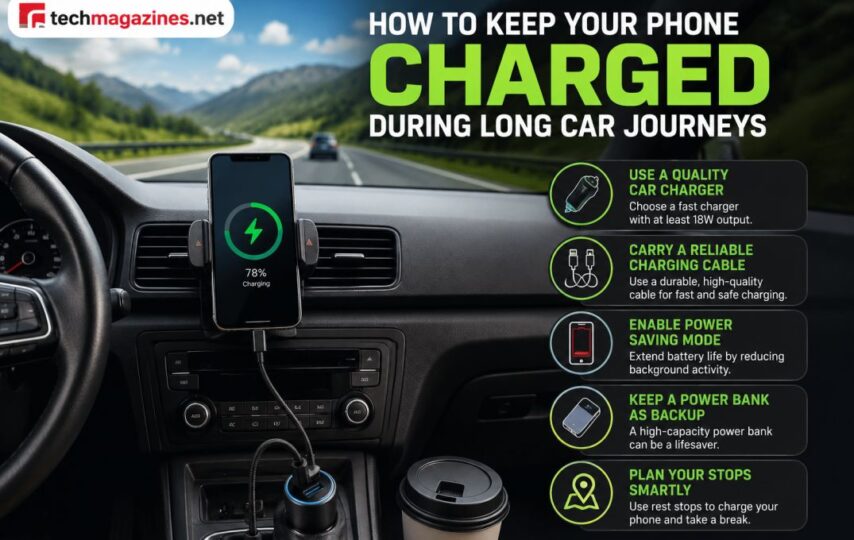

Long car journeys often involve continuous phone use for navigation, music, calls and travel apps. All of this can drain your battery faster than usual. Carrying the right charging accessories can help you stay connected throughout the journey without constantly worrying about a low-battery warning.
A power bank for quick charging and a reliable Ambrane car charger can both be useful during road travel. However, each works differently and suits different charging situations.
Why Does Your Phone Battery Drain Faster During Road Trips?
During a road journey, your smartphone may run several battery-consuming features at the same time. GPS navigation continuously tracks your location, mobile data stays active, Bluetooth may connect to your car, and the screen often remains on for directions.
Other activities such as streaming music, taking photos or making calls can further increase battery consumption.
Keeping a charging solution within reach can help you avoid unexpected battery loss while travelling.
Use a Power Bank for Quick Charging on the Go
A power bank for quick charging gives you a portable source of backup power. Since it does not depend on a wall socket or vehicle charging point, you can use it inside or outside the car.
This makes a power bank useful during:
- Roadside stops
- Outdoor activities
- Hotel check-ins
- Bus or train journeys
- Daily commuting
When selecting a power bank, check the charging output supported by the power bank and your smartphone. A compatible charging setup is important for receiving the expected charging performance.
You should also consider capacity, available ports, size and the type of charging cable required by your device.
Charge Your Phone While Driving with an Ambrane Car Charger
An Ambrane car charger can help keep compatible devices powered while you are on the road. It connects to the vehicle’s compatible power socket and allows you to charge your phone using a suitable cable.
This can be particularly convenient when your phone is being used for GPS navigation for several hours.
A car charger may also help passengers recharge their devices during longer journeys. Depending on the charger configuration, multiple charging ports can make it easier to connect more than one compatible device.
Before choosing a car charger, check its charging output, port type and compatibility with your devices.
Power Bank or Car Charger: Which Is Better for Travel?
The right option depends on how you travel.
A car charger is convenient when you spend most of your journey inside a vehicle. It lets you charge your smartphone while driving without relying on the stored power of a separate charging device.
A power bank is more portable. You can continue using it after leaving the car, making it useful for sightseeing, outdoor stops and other activities.
For longer journeys, carrying both can be practical. You can use the car charger during the drive and keep the power bank ready for situations where vehicle charging is unavailable.
What Should You Check Before Buying a Travel Charging Accessory?
Charging Compatibility
Check whether your smartphone and charging accessory support compatible charging standards.
Power Output
The charger’s power output affects the charging capability available to compatible devices. Review the product specifications before making a purchase.
Port Type
USB-A and Type-C ports are commonly used across charging accessories. Choose a port configuration that suits your charging cable and device.
Portability
For frequent travellers, size and weight also matter. Compact charging accessories are generally easier to carry and store.
Number of Devices
If you usually travel with a smartphone, earbuds, smartwatch or other rechargeable devices, consider how many devices may need charging during your journey.
Simple Battery-Saving Tips for Long Drives
Even with charging accessories, reducing unnecessary battery consumption can help your phone last longer.
Lower the screen brightness when possible and close applications you are not using. Download offline maps before travelling in areas with limited mobile coverage.
You can also activate battery-saving mode when the charge level begins to drop. Keeping your charging cables organised and checking your power bank charge before leaving can further reduce charging interruptions.
Final Thoughts
Keeping your phone powered during a road journey becomes easier when you plan your charging setup in advance. A power bank for quick charging provides portable backup power, while an Ambrane car charger can help charge compatible devices while travelling in a vehicle.
Consider your journey length, device compatibility, charging requirements and portability before selecting an accessory. Carrying the right charging solution can help you continue using navigation, communication and essential travel apps throughout your journey.