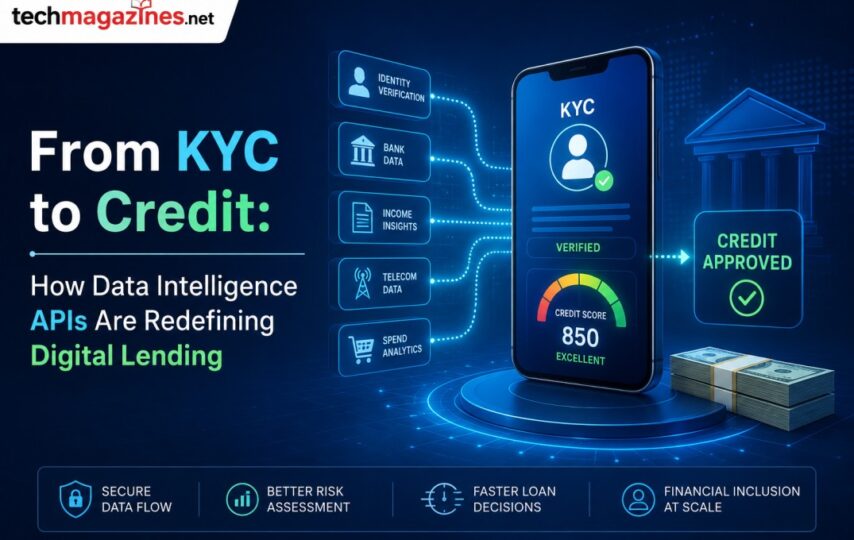

A few years ago, getting a personal loan in India meant photocopies, a branch visit, a salary slip, three to six weeks of waiting, and a fair chance of rejection with no real explanation. Today, the same loan can be approved in under two minutes, on a phone, without a single physical document changing hands. That shift didn’t happen because lenders got more generous. It happened because the data behind a lending decision, who you are, what you earn, how you spend, and how reliably you repay, became something software could verify instantly instead of something a human had to chase down on paper.
That’s really what “data intelligence” means in lending. It’s not one product. It’s the connective tissue between three things that used to be handled separately: proving identity, proving income and financial behavior, and proving creditworthiness. When those three layers are stitched together through APIs instead of paperwork, the entire lending funnel changes shape.
Why the old funnel leaked so many applicants
Traditional lending had a drop-off problem baked into its process. A borrower had to physically visit a branch or wait for an agent, submit paper KYC documents, get those documents manually verified against a database, then wait again while an underwriter manually reviewed bank statements and a credit bureau report. Every one of those steps was a place where a genuine borrower could give up, and where a lender’s cost of acquisition quietly climbed.
The first real crack in that model was digital KYC. The Reserve Bank of India’s Video-based Customer Identification Process, introduced through a January 2020 amendment to the KYC Master Direction, allowed banks and NBFCs to treat a live, recorded video call, with geo-tagging, PAN and Aadhaar verification, and facial matching, as equivalent to an in-person branch visit. Combined with the Central KYC Registry, which lets a regulated entity pull a customer’s existing KYC record instead of collecting it fresh every time, identity verification stopped being the bottleneck it once was.
Business lending had its own version of this problem. Verifying an MSME’s revenue used to mean physically reviewing GST filings and bank statements. Now that data can be pulled through an API directly against GSTN records, checking filing history, business status, and turnover trends in seconds rather than days. Platforms like Decentro’s KYC stack bundle exactly this kind of check, Aadhaar and PAN verification, Central KYC Registry search and upload, and GST-based business verification, into a single API layer so a lender doesn’t have to integrate with each government registry separately.
From “who are you” to “what can you afford”
Identity verification solves half the problem. The other half is figuring out whether someone can actually repay a loan, and that used to depend almost entirely on a credit bureau score. India has four RBI-licensed credit bureaus, TransUnion CIBIL, Experian, Equifax, and CRIF High Mark, and between them they’ve built a genuinely useful picture of borrowing history for people who’ve borrowed before.
The problem is the enormous number of people who haven’t. A first-time borrower, a gig worker paid in irregular chunks, or a small business that’s never taken a formal loan simply doesn’t show up in a bureau file with enough history to score well, if at all. This is the “thin file” or “new to credit” segment, and for a long time it was effectively locked out of formal lending regardless of actual creditworthiness.
The Account Aggregator framework, which the RBI rolled out in September 2021 in collaboration with SEBI, IRDAI, and PFRDA, was built specifically to solve this. It’s a consent-based data sharing system: a licensed Account Aggregator sits between Financial Information Providers, like banks holding a borrower’s account data, and Financial Information Users, like a lender that wants to see it, and moves encrypted data between them only after the borrower explicitly approves the request. Crucially, the Account Aggregator itself never sees the underlying data. It just facilitates consent.
What this unlocks for lending is cash flow based underwriting. Instead of relying purely on a bureau score, a lender can look at a borrower’s actual bank statements: salary credits, recurring expenses, existing EMIs, and account balance trends, and build a risk assessment from real financial behavior. For someone with thin or no bureau history, that’s often the only fair way to be assessed at all.
Turning three data layers into one decision
Here’s where it gets genuinely interesting from a product standpoint. A modern digital lending decision isn’t built on one data source, it’s built on stitching together identity data, consented financial data, bureau data, and often a layer of fraud and risk signals, device intelligence, document forensics, PAN-Aadhaar consistency checks, into a single automated decision engine.
This is a meaningfully harder engineering problem than it sounds like. Each of those data sources lives with a different provider, under a different regulatory framework, in a different data format. A lender building this in-house has to integrate separately with the UIDAI ecosystem for Aadhaar, GSTN for business data, each credit bureau individually, an Account Aggregator for consented bank data, and its own fraud tooling on top, and then keep all of that compliant as regulations shift. It’s the reason API infrastructure providers exist in this space at all: companies like Decentro build and maintain these integrations once, so a lender can call one API instead of building and maintaining a dozen.
The output of that stitching is usually a real-time risk score or a decisioning workflow that a lender’s own underwriting rules sit on top of. The lender still decides its risk appetite and pricing. What’s changed is how quickly and cheaply it can gather the inputs to that decision.
Speed had to come with accountability
None of this would matter much if faster lending just meant faster mis-selling, and regulators clearly had that risk in mind. The RBI’s Digital Lending Guidelines, issued in August 2022, arrived precisely because the same API-driven speed that makes lending convenient can also make it easy to obscure. The guidelines require every digital lender to provide a standardized Key Fact Statement before a loan contract is signed, covering the annual percentage rate, recovery mechanism, and a designated grievance officer. They mandate that loan disbursals and repayments flow directly between the lender’s and borrower’s bank accounts, cutting out unregulated intermediaries. And they guarantee borrowers a cooling-off period, a minimum of one to three days depending on loan tenor, during which they can exit a loan by repaying just the principal, no penalty attached.
The practical effect is that data intelligence in lending now has to serve two masters at once: it has to make underwriting fast, and it has to make the whole process auditable and transparent enough to survive regulatory scrutiny. That’s arguably a harder standard than pure speed, and it’s pushed API platforms in this space to treat compliance as a feature, not an afterthought.
What this actually changes
Step back from the mechanics and the shift is fairly simple to state. Lending used to be gated by how much paperwork a borrower could produce and how much time an underwriter had to review it. It’s now gated by how much verified, consented data can be assembled about a borrower in real time, and how well a lender’s risk model uses that data.
That’s a genuinely better system for a large number of people who were creditworthy but invisible to the old process, gig workers, small business owners with clean cash flow but no loan history, first jobbers with a salary account but nothing on their bureau file. It’s also a better system for lenders, who get to underwrite on richer, more current data instead of a single static score.
The infrastructure making this possible, eKYC, Account Aggregators, bureau access, GST verification, fraud and risk layers, is still relatively young, and it’s still consolidating. But the direction is clear enough. The next generation of lending products won’t be differentiated by who can collect the most paperwork. They’ll be differentiated by who can turn verified data into a fair, fast, and compliant credit decision, and increasingly, that comes down to which data intelligence stack sits underneath the product.