
Ask most Indian families why they keep gold locked away rather than putting it to any use, and the answer is almost always the same: it’s kept for emergencies, future family needs, weddings, or simply as a financial safety net.
It’s a habit built on caution, passed down over generations: gold is something you hold on to, not something you put to work unless you absolutely have to. That instinct isn’t wrong. But it does raise a fair question: if that gold is going to sit there anyway for years, untouched, is there a way to make it do a little more than just wait?
The Case for Simply Holding Physical Gold
Holding physical gold is the approach most of us grew up with.
You buy coins, bars, or jewellery, store them safely, usually in a bank locker or a home safe and let the value ride on whatever the market does over the years. There’s a real comfort in this. Nothing changes hands, nothing needs monitoring, and the gold is there whenever you need it, whether that’s for a wedding, an emergency, or just peace of mind.
The trade-off, though, is that this approach is entirely passive.
Your gold investment returns here come from exactly one place: price appreciation. If gold rises 8-10% over a year, that’s your return. If it stays flat, your gold earns nothing beyond what it started with.
The metal itself never contributes anything extra; it just sits, waiting for the market to move.
What Gold Leasing Changes?
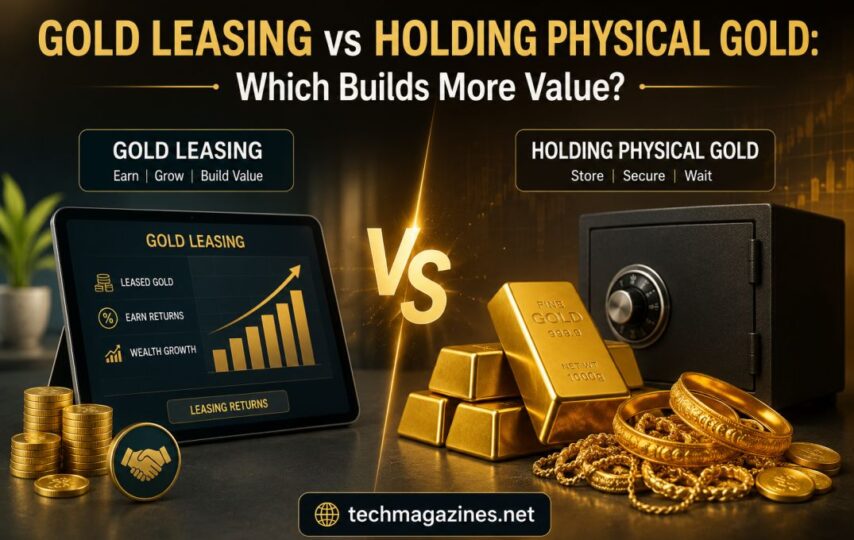
Gold leasing works with the exact same physical gold: the coins, the jewellery, the bars already sitting in your locker, but changes what happens to it while you own it.
Instead of storing it, you lease it out to jewellers who need gold for their day-to-day production and inventory. In exchange, you earn a return in extra gold weight, on top of whatever the market does to prices. Ownership never leaves your hands. At the end of the lease term, you get back your original quantity, plus the additional weight earned along the way.
Here’s a hypothetical to make this concrete.
Say two people each own 10 grams of gold, bought at roughly the same price, close to ₹1 lakh for 10 grams. One locks it away in a locker and doesn’t touch it for five years.
The other leases the same 10 grams through a gold leasing arrangement. If gold continues compounding at something close to its historical long-term rate of around 11% annually, both of them will see their gold’s value grow to somewhere around ₹1.6 lakh over five years, purely from price movement.
But the person who leased their gold walks away with something more: the additional gold weight earned every year through the lease, stacked on top of that same price appreciation. Same starting point, same market conditions, but one approach leaves value on the table that the other captures.
A Side-by-Side Comparison
| Holding Physical Gold | Leasing Physical Gold | |
| Source of return | Price appreciation only | Price appreciation + extra gold weight earned |
| Ownership | Fully retained | Also fully retained throughout |
| Activity required | None, gold sits idle | Gold is leased, returned at term end |
| Liquidity | Selling or borrowing against gold typically requires visiting a jeweller or bank | Gold is held digitally in the app and can typically be liquidated instantly, without visiting a bank or jeweller |
| Contribution to gold ecosystem | None | Gold re-enters circulation, used by jewellers |
How does this differ from a Gold Loan?
It’s worth clearing up a common confusion here, because gold leasing sometimes gets mixed up with taking a gold loan.
In a gold loan, you pledge your gold as collateral to borrow money, and you pay interest on that borrowed amount; the gold itself doesn’t grow, and you’re paying money out, not earning it. Gold leasing is close to the opposite. You’re not borrowing against your gold; you’re lending it out, and you’re the one earning a return, in gold, not paying one.
Which One Actually Builds More Value?
If you’d rather never touch your gold and just want it stored safely, holding it as it is works perfectly well; there’s nothing wrong with that, and it suits people who value simplicity above everything else.
But if that same gold has already been sitting untouched for years, with no real plans to sell or wear it anytime soon, leasing tends to build more value over the same period, purely because it adds a second source of growth without asking you to give up ownership or take on any real additional risk.
For anyone considering this shift, platforms like myGold have built their leasing arm specifically around this idea, letting you lease both physical jewellery and coins and digital gold, while retaining full ownership throughout. The structure allows for up to 5% per annum in additional gold weight, with no lock-in, 24×7 access to your gold, and every lease backed by a formal agreement on legal stamp paper. Purity and evaluation are standardised before gold enters the leasing pool, and the process is transparent enough to track exactly what you’re earning.
You can opt for withdrawal at any time. The earned amount will be transferred to your bank account or in the form of gold coins or bars delivered directly to your doorstep.
Conclusion
Both approaches start from the same place, gold you already own, sitting in a locker or a vault. Holding it passively isn’t a mistake; it’s simply the more conservative, lower-effort route.
But for gold that’s likely to remain untouched for years regardless, leasing offers a way to add a genuine second layer of growth to your gold, without transferring ownership. The real question isn’t whether one method is universally better; it’s whether your gold is doing everything it could be, sitting exactly where it is right now.