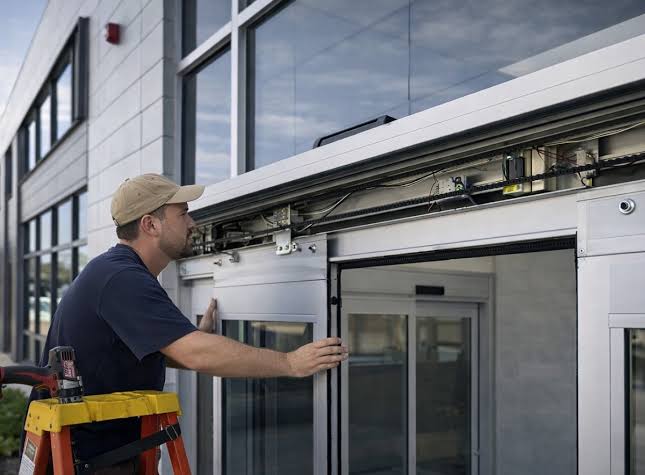

Automatic doors make commercial buildings more accessible, efficient, and convenient, but their components experience wear every time the doors open and close. A complete automatic door maintenance program includes safety testing, sensor evaluation, mechanical adjustments, cleaning, lubrication, electrical checks, and documentation. Maintenance should address the entire entrance system rather than focusing only on the visible door panels. Technicians must consider how the operator, sensors, controls, hardware, signage, and surrounding environment work together. Regular service can identify developing issues before they cause an unexpected shutdown or create an unsafe operating condition. Building owners can also use maintenance records to plan repairs, replacements, and future equipment upgrades.
Why Automatic Door Maintenance Matters
Automatic doors often complete hundreds or thousands of operating cycles during a normal business day. Retail stores, healthcare facilities, airports, hotels, schools, office buildings, and public facilities may depend on them from opening until closing. Repeated movement gradually affects belts, rollers, pivots, bearings, arms, fasteners, tracks, and electrical connections. Dirt, moisture, temperature changes, accidental impacts, and nearby construction can also influence performance. Without scheduled maintenance, small changes may develop into slow movement, unusual noises, inconsistent activation, or complete equipment failure. Preventive service gives technicians an opportunity to find these conditions while the door is still operational.
Safety is another major reason to maintain automatic pedestrian doors. A malfunctioning sensor or incorrectly adjusted operator may cause the door to move when a person is still within the opening. Excessive closing speed, inadequate hold-open time, or damaged signage can also increase risk. The American Association of Automatic Door Manufacturers recommends planned maintenance, annual inspections, and daily safety checks by the premise owner. AAADM also recommends that qualified technicians with appropriate certification install and service automatic doors. These practices help building owners maintain a more consistent and organized door-safety program.
Visual Inspection of the Complete Door Assembly
Most maintenance visits begin with a visual examination of the entrance. The technician checks the door panels, glass, frames, guides, thresholds, weather seals, and visible operating components. Cracks, loose hardware, bent materials, damaged glass, missing fasteners, and unusual gaps may indicate impact damage or gradual movement. The technician should also look for evidence that the panels are dragging, rubbing, or contacting nearby surfaces. These conditions can place additional strain on the operator and shorten the life of connected parts. Finding physical damage early may allow the provider to make a targeted repair before more expensive components are affected.
The surrounding entrance area should be inspected as carefully as the door itself. Floor mats, retail displays, signs, carts, furniture, trash containers, and temporary barriers can interfere with traffic or sensor coverage. Changes to flooring or thresholds may also create resistance or alignment problems. Decorative materials and window graphics should not cover required warning labels or detection equipment. Exterior entrances may collect leaves, gravel, ice, water, and other debris near tracks or guides. Maintenance should include correcting or reporting these environmental conditions because they can affect otherwise functional equipment.
Sensor Testing and Detection Evaluation
Sensors allow many automatic doors to recognize approaching pedestrians and monitor the opening while people pass through it. During maintenance, the technician tests activation from relevant directions and approach angles. The door should begin opening at the proper time, move smoothly, and remain open while the user occupies the monitored area. The technician should also test how the system responds when a person approaches slowly or pauses near the threshold. This is especially important in buildings serving children, older adults, patients, and people who use mobility devices. A door that opens during a basic test may still require adjustment if the detection field has gaps.
AAADM’s general daily safety-check guidance recommends approaching an automatic door at a moderate speed from different angles and observing whether it opens smoothly without impact. The door should remain open as the person moves slowly toward and through the opening. Professional maintenance expands on this basic owner check by evaluating the sensors, control settings, and complete operating sequence. Technicians may clean sensor lenses, adjust detection fields, secure wiring, or replace damaged equipment when necessary. Environmental changes, reflective surfaces, decorations, and nearby equipment can sometimes affect sensor performance. Testing should therefore consider actual conditions around the entrance rather than examining the sensor in isolation.
Mechanical Components, Hardware, and Alignment
Automatic door systems contain moving components that require periodic evaluation and adjustment. Depending on the door type, these parts may include rollers, pivots, hinges, belts, chains, arms, gears, bearings, hangers, guides, and track assemblies. The technician checks these components for looseness, wear, corrosion, cracks, and abnormal movement. Hardware that has shifted may cause the door to sit unevenly or travel outside its intended path. Misalignment can make the operator work harder and may produce vibration, scraping, or inconsistent closing. Correcting alignment helps protect both the moving panels and the powered operator.
Fasteners and mounting points should also be examined during routine service. Repeated cycling can gradually loosen brackets, covers, sensor mounts, and operator hardware. The technician may tighten appropriate connections according to the manufacturer’s specifications. Worn rollers, damaged pivots, or stretched belts may need replacement rather than adjustment. Tracks and guide areas should be cleaned so that debris does not restrict door movement. Mechanical repairs should be completed with parts that are suitable for the specific operator and door configuration. Improvised substitutions may affect performance, reliability, and future serviceability.
Common mechanical maintenance tasks include:
- Inspecting belts, chains, gears, rollers, and bearings
- Checking hinges, pivots, arms, hangers, and guides
- Tightening loose fasteners and mounting hardware
- Correcting panel alignment and travel
- Cleaning tracks, thresholds, and guide channels
- Replacing worn or damaged mechanical components
- Checking breakout or emergency-release hardware
- Listening for grinding, scraping, clicking, or vibration
Lubrication and Cleaning
Some automatic door components require lubrication to reduce friction and support smooth movement. The technician should follow the manufacturer’s instructions because not every part should be lubricated. Applying the wrong product or using too much lubricant can attract dirt, contaminate sensors, damage materials, or interfere with operation. Approved lubricants should be placed only at the appropriate pivots, bearings, guides, or mechanical connections. Tracks should not automatically be coated unless the equipment manufacturer specifically calls for it. Proper lubrication is a precise maintenance task rather than a general application of oil or grease.
Cleaning is equally important because automatic entrances are exposed to dust and debris. Dirt may collect in tracks, around pivots, beneath covers, and near sensor lenses. Exterior doors can also be affected by sand, leaves, moisture, road salt, or insects. Technicians may clean accessible components while checking whether environmental seals remain intact. Building staff should maintain the surrounding area between professional service visits. A clean entrance makes abnormal wear and fluid leakage easier to identify during future inspections.
Operator, Control, and Electrical Checks
The powered operator coordinates the movement of the automatic door. During maintenance, the technician observes the motor, drive system, control board, wiring, and connected activation devices. Loose electrical connections, damaged cables, overheating, and intermittent signals may produce inconsistent operation. The technician should check whether the door responds correctly to motion sensors, push plates, wave switches, card readers, and other activation methods. Function switches and operating modes should also be tested. Each setting must produce the expected result without overriding necessary safety functions.
Automatic doors may be connected to locks, alarms, fire systems, access-control equipment, and building-management systems. Maintenance should verify that these integrations continue to operate in the intended sequence. For example, an electric lock should release before the operator attempts to open the door. A timing problem may cause the operator to pull against locked hardware, increasing wear on both systems. Backup batteries and emergency power connections may also require testing when included in the installation. Technicians should document integration problems and coordinate with the appropriate security, electrical, or life-safety provider. Clear responsibility is important when several contractors maintain different parts of one opening.
Door Speed, Force, and Timing Adjustments
Automatic doors must open and close within the performance limits that apply to their design. During maintenance, technicians may measure opening speed, closing speed, hold-open time, and operational delays. Low-energy swinging doors may also require evaluation of force and kinetic energy. These measurements should not be based only on whether the door appears to move at a comfortable pace. Door size, weight, configuration, and operating category can affect the acceptable settings. Objective testing helps technicians make adjustments that are appropriate for the installed system.
Timing can gradually change as mechanical parts wear or control settings are altered. A door that closes too quickly may not give slower users enough time to pass through the opening. A door that remains open unnecessarily long may waste conditioned air and reduce traffic control. The technician must balance efficiency with safety and accessibility requirements. Employees should not alter speed or timing settings simply to reduce drafts or move customers faster. Any adjustment should be completed by personnel who understand how one setting affects the complete operating sequence.
Safety Signage and Decal Inspection
Automatic pedestrian doors use decals and warning signs to communicate how the entrance operates. Maintenance should include checking that required signs are present, legible, correctly positioned, and appropriate for the door type. Faded or damaged decals may be difficult for pedestrians to see. Seasonal displays, promotional stickers, tinting, and window graphics can unintentionally cover safety information. A door may also have the wrong labels after an operator or activation method has been changed. Replacing missing signage is a simple but important maintenance task.
Signs may tell users to stand clear, activate a switch, move in a particular direction, or avoid entering through the wrong side. Revolving, sliding, swinging, and low-energy doors may require different instructions. Technicians should evaluate signage according to the applicable standard and installation configuration. Building employees should also watch for damage between scheduled visits. Cleaning crews need to use methods that do not peel or obscure required decals. Clear signage helps users anticipate door movement and navigate the opening correctly.
Daily Owner Checks and Professional Maintenance
Professional maintenance is only one part of a complete door-care program. Building owners should also establish a daily safety-check procedure for employees. The check should be completed before the entrance experiences normal traffic whenever practical. Staff can observe activation, movement, presence detection, signage, and the surrounding pathway. They should also listen for unusual sounds and look for damaged panels or loose hardware. A daily check is not a technical inspection, but it can identify obvious changes between maintenance visits.
Employees need clear instructions for responding when a door does not pass the check. Potentially unsafe equipment should not remain in automatic operation simply because the entrance is busy. Depending on the condition, the door may need to be shut down, secured, or placed in an approved manual mode. Staff should know how to contact the service provider and describe the problem accurately. Maintenance personnel should review recurring staff reports even when the door appears normal during a service visit. Intermittent problems can be easier to diagnose when employees document what happened and when it occurred.
Maintenance Documentation and Service Records
Every maintenance visit should produce a written service record. The document should identify the door, location, date, reported problem, work completed, parts replaced, and remaining recommendations. Inspection and maintenance findings should be described clearly rather than recorded with vague statements such as “checked door.” Detailed records allow facility managers to monitor repair frequency and identify recurring failures. They also help future technicians understand previous adjustments and equipment history. Consistent documentation supports better operational and capital-planning decisions.
Facility managers can use records to compare doors across a property or portfolio. One entrance may require repeated sensor adjustments, while another may frequently damage rollers because of alignment or impact problems. Patterns can show when continued repairs are no longer cost-effective. Records may also help confirm whether preventive service intervals are appropriate for actual traffic levels. High-use doors may need more frequent attention than low-cycle employee entrances. A documented maintenance program is easier to manage than a reactive approach based only on emergency calls.
Frequently Asked Questions
How often should automatic doors receive maintenance?
The right schedule depends on traffic, environment, door type, manufacturer recommendations, and service history. High-cycle doors may need maintenance several times per year, while lower-use doors may require less frequent visits.
Is maintenance the same as an AAADM inspection?
No. Maintenance involves servicing, adjusting, cleaning, and repairing equipment, while an AAADM inspection evaluates the door against applicable safety criteria. Both may be completed during the same visit when the technician is properly qualified.
Can building employees maintain automatic doors?
Employees can perform basic daily safety checks and keep the entrance clear. Technical adjustments, electrical work, repairs, and sensor calibration should be handled by qualified professionals.
What are the signs that an automatic door needs service?
Common warning signs include unusual noise, slow movement, delayed activation, incomplete opening, abrupt closing, vibration, scraping, or repeated sensor errors. Visible damage and inconsistent operation also require attention.
Does maintenance include replacing parts?
Yes, when worn or damaged components are identified. The technician should explain which parts require replacement and why the work is necessary.
Should automatic doors be shut down when they malfunction?
A door should be removed from automatic service when continued operation could be unsafe. Staff should follow the facility’s shutdown procedure and contact a qualified service provider.
How long should maintenance records be kept?
Retention requirements may vary by organization, contract, insurer, and jurisdiction. As a practical matter, owners should maintain a continuous service history for each automatic entrance.
Building an Effective Automatic Door Maintenance Plan
A strong maintenance plan begins with an accurate inventory of every automatic door. Each record should include the location, door type, manufacturer, model, operator, sensor configuration, installation date, and access-control connections. Facility managers can then classify openings according to traffic level, operating environment, and importance to daily operations. High-priority doors may include main entrances, emergency exits, patient access points, loading areas, and secure employee entrances. Service intervals should reflect these differences rather than placing every door on the same schedule. The plan should also define who performs daily checks, who schedules professional service, and who approves repairs.
Effective automatic door maintenance combines preventive service, daily observation, annual inspections, timely repairs, and accurate documentation. Technicians should evaluate mechanical components, sensors, controls, wiring, speed, force, timing, signage, and the surrounding environment during each complete visit. Building owners should respond promptly to abnormal movement instead of waiting for total failure. A planned approach can reduce emergency calls, improve equipment reliability, and extend the useful life of major components. It also gives facility teams a clearer understanding of which doors are performing well and which may need replacement. With consistent oversight, automatic doors can continue providing safe, dependable, and convenient access throughout the building.