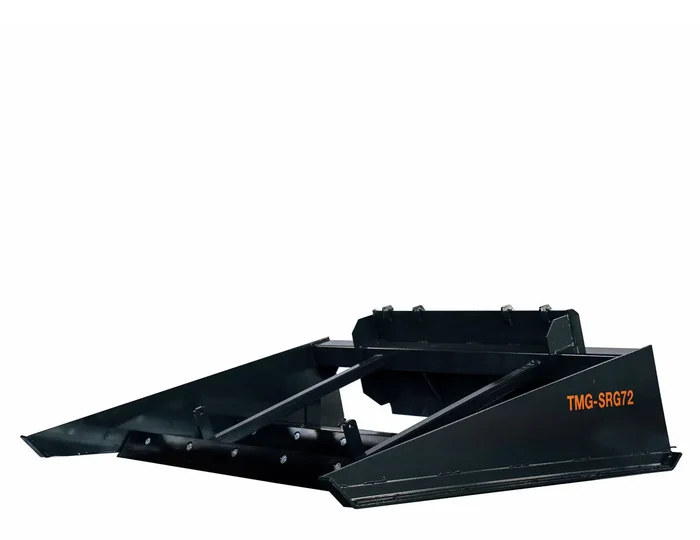

Gravel drives are at their worst by the end of summer
A summer of rain, delivery trucks, and dry weather traffic leaves most American gravel drives flat across the middle and rutted along the wheel tracks. Restoring the shape before the fall rain arrives is exactly the work a skid steer road grader was built to do.
The failure pattern is always the same. Traffic pushes material from the center toward the edges, and the surface slowly loses its curve. Water that once ran off now stands in the wheel tracks and softens everything lying beneath them.
The crown is a drainage system only a few inches tall
A well built gravel surface rises slightly at its center and falls away toward each side. The drop is usually close to half an inch for every foot of width. That gentle curve sends rainwater to the shoulders before it can soak through.
Lose the curve and the road becomes a shallow trough. Water sits, the binder washes out of the top layer, and the potholes that follow are a symptom of drainage rather than of traffic. Rebuilding the shape is what actually fixes them.
An angled blade moves material sideways instead of ahead
A blade set square to the direction of travel simply bulldozes material forward and leaves a pile. Turning that blade to an angle changes the geometry entirely. Gravel rolls along the face of the moldboard and discharges continuously off one end.
The sideways discharge is the whole trick. Material picked up near the ditch line finishes near the center of the road. The operator builds a crown with a road grader by making passes that consistently walk loose gravel toward the middle.
Tilt is a separate control doing a completely different job
Angling swings the blade horizontally to decide where material travels. Tilting drops one end below the other to decide what shape gets cut. Used together they let a single road grader carve a sloped surface while still carrying material in a chosen direction.
That combination is what produces a ditch. Dropping the outer end of the blade below the inner end cuts a shallow channel along the shoulder. Repeated light passes deepen it gradually without ever gouging a step into the road surface.
Loose material has to exist before any shape can be built
A road grader blade cannot move gravel that has locked into a hard crust. That is why the first pass over a neglected drive often accomplishes very little. Scarifying, or cutting a little deeper, releases the compacted top layer so it becomes workable.
Moisture then decides how that released material behaves. Slightly damp gravel forms a shape and holds it, while bone dry material rolls and refuses to knit together. Late summer often means waiting a day after rain rather than grading inside a dust cloud.
Grading beside a ditch is where the ground gives way
The outer edge of a shoulder is the least supported ground on the entire road. A loader working there with its weight offset toward the ditch can slide or drop a wheel. Working from the road side outward keeps the machine over solid material.
Visibility is the other real concern. A wide road grader blade on the front of a loader hides the ground immediately ahead. Culvert ends, driveway pipes, and buried marker posts deserve to be located and flagged before the first pass begins.
Blade tools sorted by what each one actually controls
• Angled moldboard: shapes crown and cuts drainage ditches
• Land plane: shaves high spots down into low ones
• Box scraper: carries cut material inside its own walls
• Rear blade: back drags a surface behind a tractor
Where the angled format wins and where it asks for skill
• Strength: builds crown and ditch with one tool
• Strength: continuous discharge rather than pushing a pile
• Limit: results depend heavily on operator judgment
• Limit: needs loose material before shaping can begin
Compared with a self leveling implement that follows the ground automatically, a road grader of this type gives up consistency. What it returns instead is control. A property owner in Vermont keeps a land plane for resurfacing and an angled blade for reshaping.
Private road maintenance is shifting back toward the owner
Rising contractor rates and thinner county budgets have left more gravel roads and long driveways in private hands. Owners are buying shaping tools rather than scheduling visits. Attachment makers answered with blades sized for compact loaders instead of highway machines.
That shift explains why the grading equipment from TMG Industrial now includes angled blades sized for the loaders parked on farms and rural properties.