
If you run a small business, you already know the feeling. You start the day meaning to call 3 leads, and by 6 PM you’ve answered 11 emails, updated a spreadsheet nobody else looks at, chased an invoice, and completely forgotten the lead you promised to call. Not because you’re disorganized but because you’re doing the job of 5 people with the tools built for one.
This is the real story behind most “we need better software” conversations at small businesses and startups. It’s rarely about missing features. It’s about hours lost to tasks that shouldn’t need a human at all anymore.
A CRM for small businesses used to mean a glorified contact list. Type in a name, add a note, hope you remember to follow up. Today’s AI CRM software does something genuinely different as it watches what’s happening in your pipeline and takes the repetitive work off your plate before you even think to ask. For solopreneurs juggling sales, delivery, and admin single-handedly, that shift matters more than any flashy dashboard.
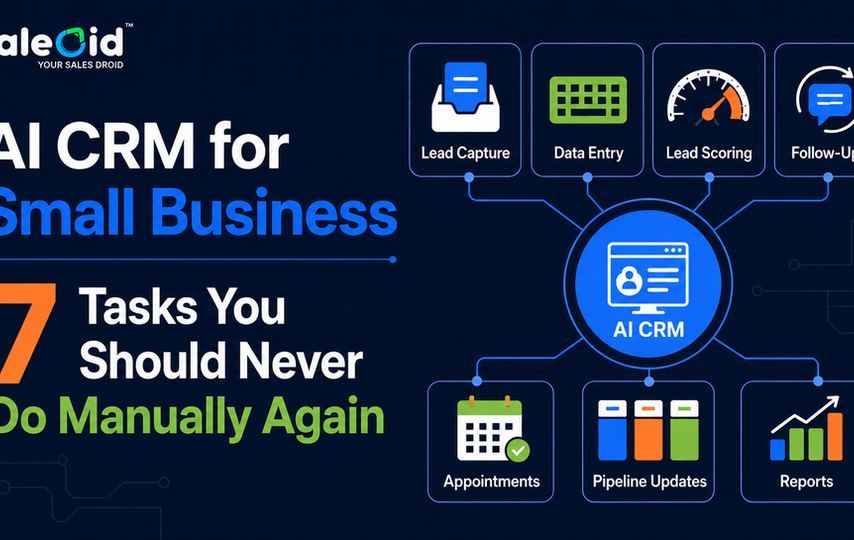
Below are 7 tasks that still eat up small business owners’ time every single day and don’t need to anymore.
The Real Cost of “I’ll Just Do It Manually”
Most founders don’t sit down and calculate what manual admin actually costs them. It doesn’t show up as a line item on a bank statement, so it’s easy to ignore. But add it up, 15 minutes hunting for a customer’s order history, 10 minutes writing a follow-up email that gets sent a day late, 20 minutes updating a spreadsheet that’s already out of date by lunch. None of it feels expensive at the moment. All of it adds up to hours every week that should have gone into selling, building, or simply going home on time.
The bigger cost is the lead who never got a follow-up, the loyal customer who left without warning, the deal that stalled because nobody updated the pipeline and it slipped everyone’s mind. A CRM for small businesses exists to close that gap. An AI-powered one goes further, because it doesn’t just store the information, it acts on it.
- Manually Scoring and Prioritizing Leads
Not every lead deserves the same five minutes of your day. Someone who filled out a form, opened 3 emails, and visited your pricing page twice is a different opportunity than someone who downloaded a freebie once and vanished. Most small business owners either treat every lead the same or rely on gut instinct, which means good leads sit in an inbox while you’re busy chasing dead ends.
An AI CRM for small businesses tracks this behavior automatically through email opens, site visits, reply speed, deal size, and ranks leads by how likely they are to convert. You stop guessing who to call first. You just look at the top of the list.
- Writing Call Notes and Meeting Summaries From Memory
You finish a call, move straight into the next thing, and by the time you sit down to log notes, half the details are gone. Or worse, you never write them at all, and 3 weeks later you’re asking a customer to repeat themselves, which never looks good.
This is one of the clearest wins of AI in a CRM for startups and small teams. Call and meeting summaries can be generated automatically from transcripts or notes, pulling out next steps, objections, and commitments without you typing a word. Your memory stops being the backup system for your business relationships.
- Writing Every Follow-Up Email From Scratch
Follow-ups are where deals quietly die. Not because the product wasn’t right, but because nobody sent the email. Writing a thoughtful, personalized message for every single lead, every single day, isn’t realistic when you’re also the one fulfilling orders or answering support tickets.
A good AI CRM software drafts context-aware follow-ups based on where the lead is in the pipeline and what was discussed last. You edit, you send, you move on. What used to take twenty minutes per email takes two.
- Manually Moving Deals Through Pipeline Stages
Dragging a card from “Contacted” to “Negotiating” sounds simple until you have 40 active deals and no time to update any of them. Most small business pipelines end up stale within a week because nobody had time to keep the board honest.
AI-driven CRMs update deal stages automatically based on actual activity, such as a signed proposal, a reply, a scheduled call. Your pipeline reflects reality instead of whatever you last had time to touch.
- Digging Through Spreadsheets or Email Threads for Customer History
Imagine a returning customer emails you, and you spend the next 10 minutes scrolling through old threads trying to remember what they bought, what they complained about, and what you promised them. That search should take zero seconds, not 10 minutes.
This is exactly why a proper AI CRM software pays for itself almost immediately. Every interaction whether from calls, emails, purchases, support tickets, lives in one searchable record. AI surfaces the relevant history the moment you open the contact, so you walk into every conversation already prepared.
- Re-Typing Data From Forms, Calls, and Chats
Every time a lead fills out a form, sends a WhatsApp message, or books a call, someone has to manually copy that information into your system. For a solopreneur, that “someone” is you, again, on top of everything else.
AI CRMs pull data in automatically from connected forms, email, calendars, and chat tools, and clean it up, fixing duplicate contacts, standardizing phone formats, filling gaps where possible. Data entry stops being a task on your to-do list and becomes something that just happens in the background.
- Guessing Which Customers Are About to Churn
Small businesses tend to notice a customer is unhappy only after they’ve already left. There’s no way to manually track engagement drop-off across dozens or hundreds of accounts while also running the business.
AI CRM tools flag early warning signs. A customer who hasn’t opened an email in weeks, a support ticket that went unresolved, a subscription nearing renewal with no engagement. That gives you a chance to reach out before it’s too late, instead of finding out when the cancellation email arrives.
For a small business, retaining an existing customer is almost always cheaper and faster than replacing them. New customer acquisition takes marketing spend, outreach, and time you may not have. A quiet, at-risk customer who gets a timely check-in email often just needed to feel remembered, something an AI CRM can trigger automatically the moment engagement starts slipping, long before you’d have noticed on your own.
Why This Matters More for Small Businesses Than Big Ones
Enterprise companies have entire departments dedicated to sales operations, customer success, and data hygiene. Small businesses and startups have 1 or 2 people wearing all those. Every manual task you eliminate is a mental bandwidth you get back to actually grow the business, talk to customers, or, occasionally, take a lunch break.
This is also why adoption has shifted so quickly. A CRM for small businesses used to be seen as something you’d “grow into” later. Now it’s often the first serious software investment a founder makes, right alongside a website and a way to accept payments because losing leads and forgetting follow-ups costs real money from day one, not just at scale.
Solopreneurs feel this hardest of all. There’s no sales team to catch a dropped lead, no ops person to clean up the spreadsheet, no assistant to write the follow-up you forgot. Every gap in the system is a gap you personally have to fill, usually late at night after the “real” work is done.
That’s exactly the kind of load an AI CRM is designed to take off your plate quietly, in the background, without you having to manage the automation itself.
What to Actually Look for in an AI CRM (Without Overpaying)
Not every “AI CRM” lives up to the label. Some just bolt a chatbot onto an old system and call it innovation. Before you commit, check for a few things:
- Real automation, not just alerts: A tool that reminds you to follow up is not the same as one that drafts and schedules the follow-up.
- Clean, simple setup: If it takes a consultant to configure, it’s not built for a five-person team.
- Honest pricing: Small businesses shouldn’t need an enterprise budget to get enterprise-level automation.
- Data you actually own: Make sure you can export your contacts and history anytime, no lock-in games.
- Support that responds fast: When you’re a small team, a two-day support ticket turnaround can cost you a sale.
Where Saleoid’s $5 AI CRM Fits In
This is exactly the gap Saleoid’s $5 AI CRM was built to close. Instead of asking small businesses to pay enterprise prices for enterprise features they’ll never fully use. It brings lead scoring, automated follow-ups, AI-generated call summaries, and pipeline automation into a single affordable CRM pricing plan, built for people who need results, not a 6-week onboarding process.
For a solopreneur or an early-stage startup, that’s the difference between treating a CRM as a “someday” expense and actually using one from day one, without it eating into a budget that’s already stretched thin.
In the nutshell
None of these 7 tasks require a human brain to do well. They require consistency, memory, and speed, which is exactly what AI handles better than any of us can while also running a business. The goal was never to replace the relationship-building part of sales or customer care. It’s to stop spending your limited hours on the parts that were never a good use of your time in the first place.
If you’re still manually scoring leads, writing every follow-up from a blank page, or hunting through old emails for customer history, that’s a tooling problem which can be easily fixed by choosing the best AI CRM software for small businesses.