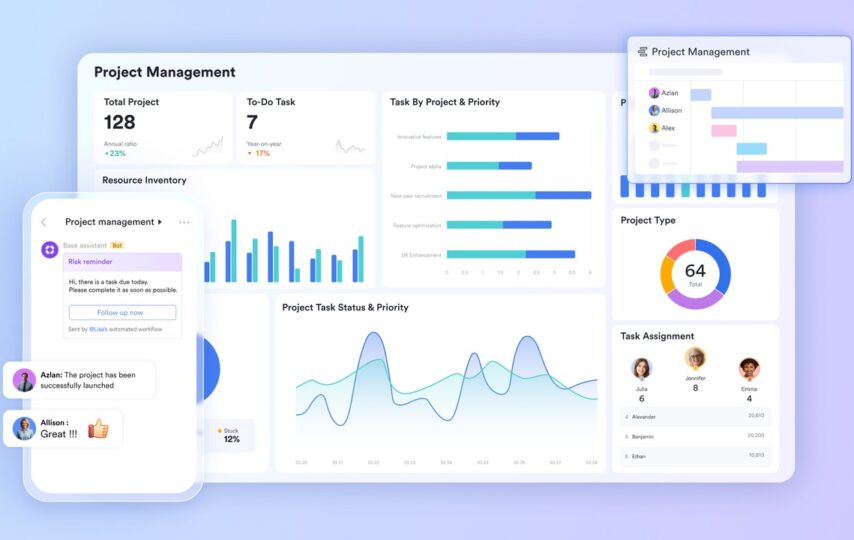

Most alignment failures in large organizations are not caused by people working against each other. They are caused by people working in parallel, each optimizing for their own department’s version of success, without a clear view of how their priorities connect to everyone else’s. The marketing team launches a campaign before the product team has finished the feature it is built around. The finance team cuts a budget line that the operations team had already committed to vendors. Each decision was locally rational and globally costly. The operations leaders who prevent this pattern share one thing in common: they have built an information environment where priorities, data, and decisions are visible across departments by default rather than shared on request. That starts with choosing project management tools designed to make cross-functional visibility a structural feature rather than a weekly meeting agenda item.
Keeping strategy visible across every team with Lark OKR
- Company-wide objective transparency. Every team member can see the full hierarchy of objectives from the company level down to the department level, so each person understands how their work connects to the broader strategic direction without needing a manager to explain it. When two departments are working toward objectives that conflict, the tension is visible early rather than discovered at a quarterly review.
- Linked key results for automatic progress tracking. Key results can be connected directly to live data in Lark Base, so that progress updates automatically as operational work gets completed. The lag between doing the work and reporting on it closes because the two are connected at the data level rather than reconciled manually in a separate reporting cycle.
- Cross-team alignment checks built into the OKR cycle. Teams can see what other departments are prioritizing before setting their own key results, reducing the duplicate work and conflicting timelines that typically emerge when departments plan in isolation.
Keeping project data consistent across teams with Lark Base
- Shared databases with department-level permission controls. Cross-functional projects can be managed in a single Lark Base table that all relevant departments access simultaneously, with each team seeing the fields and records relevant to their role. There is no need to maintain separate trackers that diverge over time.
- Real-time dashboards for leadership visibility. Operations leaders can build shared dashboards that surface live project status, budget utilization, and milestone progress across all active workstreams. The information is always current and always the same version regardless of who is looking at it.
- Automated cross-team notifications on status change. When a record moves to a stage that requires another department’s input, an automatic notification goes to the relevant team in Messenger. Handoffs between departments happen without anyone needing to manually chase the next owner.
Making decisions searchable and recoverable with Lark Docs
- Templates for consistent cross-functional documentation. Operations leaders can build standard templates for project briefs, cross-departmental meeting records, and decision logs so that every team produces documentation in the same format, regardless of department or individual habit.
- “Version History” for traceable decision records. Every change to a doc is logged with the editor’s name and a timestamp. When a policy or plan changes and someone needs to understand why, the full edit history is available without asking anyone to reconstruct the reasoning from memory.
- Real-time co-editing for cross-functional documents. Planning documents, budget proposals, and strategic briefs that require input from multiple departments can be built simultaneously by all contributors rather than assembled from separate drafts sent back and forth by email.
Keeping company-wide communication structured with Lark Messenger
- Folder organization for cross-departmental group management. As the number of cross-functional groups grows, Lark Messenger allows administrators to organize chats into labeled folders so that communications between departments stay clearly separated from those within departments, and each type carries the appropriate notification priority.
- “Scheduled Messages” for consistent company-wide broadcasts. Operations leaders can draft and schedule announcements to go out at the right time across time zones, ensuring that every team receives the same information simultaneously rather than at different points in the day filtered through local managers.
- “Read/Unread Status” for confirmed receipt of critical updates. When a time-sensitive operations update is sent to a large group, the sender can see exactly which recipients have read it. At scale, confirmed receipt removes the ambiguity of whether a critical instruction has actually landed.
Making knowledge accessible across department boundaries with Lark Wiki
When departments build their knowledge in separate systems, they effectively build walls. The sales team’s competitive intelligence doesn’t reach the product team. The engineering team’s architecture decisions don’t inform the client services team’s conversations with customers. Lark Wiki breaks those walls down by giving every department a home within a shared, searchable knowledge environment.
“Permission Settings” allow each department to control who can view, edit, and export their content at the user and department level, so sensitive materials remain protected while broadly relevant information stays accessible. A new operations leader joining the company can search the full Wiki knowledge base, find the processes and decisions that shaped the current state of the organization, and get up to speed without requesting access from multiple teams or waiting for a series of handover meetings.
Bonus: Why cross-functional alignment tools often fail
The most common mistake operations leaders make when trying to improve alignment is adding a dedicated alignment tool on top of an already fragmented stack. They look at Google Workspace pricing for the operational layer and add a separate OKR platform, a separate project dashboard, and a separate communication tool for cross-functional updates. Each tool requires separate maintenance, separate logins, and a separate habit from the team.
Alignment does not improve when you add more places to check. It improves when the information people need is already visible in the place where they are doing their work. Lark puts OKRs, project data, documentation, and communication in the same environment, so the context that enables good cross-departmental decisions is always present rather than requiring a deliberate effort to find.
Conclusion
Cross-departmental alignment at scale is not a culture initiative. It is an infrastructure decision. When every team’s priorities, data, and decisions are visible to the rest of the organization by design, the coordination failures that slow large companies down become preventable rather than inevitable. A unified set of productivity tools that keeps information flowing between departments without manual intervention is what makes that possible.