
OrbbecSDK v2 vs ZED SDK vs DepthAI — a developer-focused technical comparison for ROS Industrial, PyImageSearch, and LearnOpenCV readers
Introduction: Why the SDK Matters as Much as the Hardware
When evaluating a depth camera for a robotics or computer vision project, most engineers start with hardware specs: range, resolution, baseline, frame rate. These matter, but they’re only half the decision. The SDK that drives the camera determines how quickly you can integrate it, how much compute it consumes on your host platform, which middleware and simulation environments it supports, and how much friction you’ll absorb every time your team adds a new platform target or deploys to a new OS.
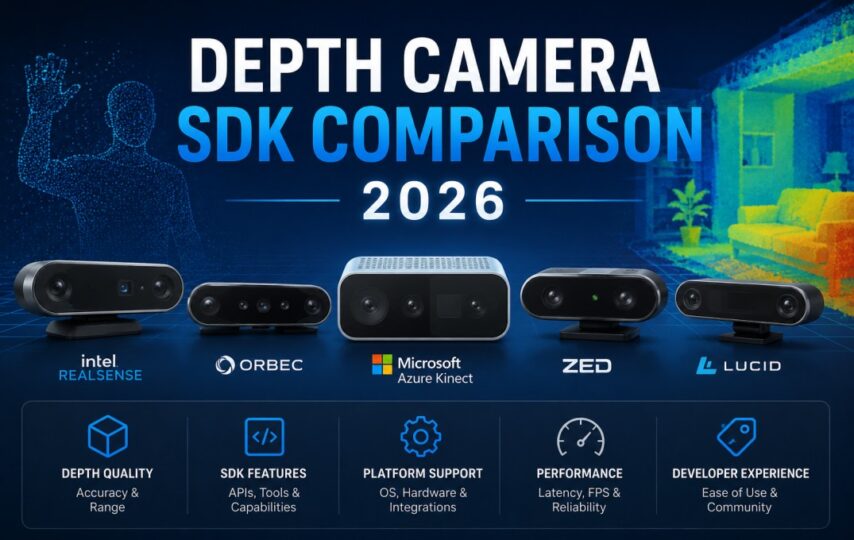
In 2026, three SDK ecosystems dominate serious depth camera development: OrbbecSDK v2, the Stereolabs ZED SDK, and Luxonis DepthAI. Each reflects a different architectural philosophy — and each creates different constraints and advantages for developers working in robotics, computer vision research, and production deployment.
This comparison is written for developers who have moved past the hardware selection phase and need to understand what integrating each SDK actually looks like. We cover platform support, language bindings, ROS 2 and Isaac ROS compatibility, compute requirements, migration tooling, and the deployment scenarios each SDK fits best. Full developer documentation for OrbbecSDK v2 is available at the depth camera SDK comparison page on orbbec.com.
Comparison Framework
SDK quality is multidimensional. The criteria that matter most for robotics and computer vision developers in 2026:
- Platform breadth. Which operating systems and compute architectures are supported? A SDK that runs on Windows and Ubuntu but not macOS or Android limits deployment flexibility. A SDK that requires x86 eliminates ARM-based embedded targets.
- Compute requirements. Does depth processing happen on the camera or on the host? Host-side GPU processing (as the ZED SDK requires) consumes resources that would otherwise be available for inference pipelines, navigation stacks, or application logic. On-device processing delivers finished depth frames without touching host compute.
- Middleware integration. ROS 2 package quality, Isaac ROS compatibility, and simulation environment support (Isaac Sim, Gazebo) determine how much custom integration work is needed between the camera driver and the robotics stack.
- Language ecosystem. Python bindings for research and prototyping. C/C++ API for production performance. Unity/Unreal plugins for HRI and simulation. The more complete the language support, the fewer custom wrappers your team needs to maintain.
- Migration support. Teams moving off discontinued hardware (Intel RealSense, Azure Kinect) need migration tooling. A SDK that provides compatibility wrappers for previous-generation APIs reduces migration cost significantly.
- License and source availability. Open-source SDKs allow inspection, modification, and contribution. Proprietary SDKs create dependency risk and limit the ability to debug or extend the driver layer.
OrbbecSDK v2: Deep Dive
Architecture and Design Philosophy
OrbbecSDK v2 is the open-source (Apache 2.0) SDK for Orbbec cameras, covering the full Femto series (Femto Bolt, Femto Mega) and Gemini series (Gemini 335, Gemini 335L, and related models). The v2 release in 2024 was a substantial rewrite: unified API surface across all supported cameras, improved multi-camera synchronization, and extended platform support. The GitHub repository is actively maintained with regular releases and public issue tracking.
The core architecture separates device management, stream configuration, frame processing, and calibration into distinct API domains. For developers familiar with librealsense (the Intel RealSense SDK) or the K4A SDK (Azure Kinect), the OrbbecSDK v2 structure will feel familiar without being identical. The Python bindings are complete — not a thin wrapper around a C extension, but a Pythonic interface with proper type annotations and NumPy-compatible array output.
Platform Support
OrbbecSDK v2 supports Windows 10/11, Ubuntu 18.04–22.04, macOS 11+, and Android 8+. This is the broadest platform coverage of the three SDKs in this comparison. For teams building cross-platform tools — research pipelines that run on developer workstations (macOS) and deploy on Linux robot computers — this matters. For Android deployments (mobile inspection robots, embedded tablets), OrbbecSDK v2 is the only SDK in this comparison with official support.
ARM support is a first-class concern, not an afterthought. Jetson Nano, Jetson Orin Nano, Jetson AGX Orin, Raspberry Pi 4/5, and other ARM Linux platforms are all supported. No GPU requirement exists for depth frame delivery — the camera handles depth computation on-device and delivers finished frames over the transport layer.
ROS 2 and Isaac ROS Integration
The official OrbbecSDK ROS 2 package is maintained by Orbbec and publishes the standard topic set: sensor_msgs/Image for depth and color, sensor_msgs/PointCloud2 for 3D point cloud output, camera_info for calibration parameters, and sensor_msgs/Imu for IMU data. Frame conventions follow REP-103. The driver handles depth-to-color alignment internally, publishing registered point clouds without downstream preprocessing.
Isaac ROS compatibility is supported for Gemini and Femto series cameras. This means OrbbecSDK-powered cameras can feed directly into NVIDIA’s Isaac ROS perception graphs — object detection, pose estimation, and visual SLAM — without requiring the camera to consume GPU resources for its own depth computation. A Jetson Orin running Isaac ROS with a Gemini 335 gets full-resolution depth frames from the camera over USB while the Orin’s GPU handles the inference workload exclusively. This is an architectural combination that the ZED SDK, which requires the host GPU for depth, cannot provide.
Azure Kinect K4A Wrapper
OrbbecSDK v2 ships with a K4A compatibility layer — a wrapper that exposes the full Azure Kinect Sensor SDK (K4A) API surface through Orbbec hardware. From the perspective of existing K4A codebases, the Femto Bolt and Femto Mega present as Azure Kinect devices: same function calls, same data structures, same depth mode enumerations, same calibration parameter format.
This is the migration path for teams that built research infrastructure, data collection pipelines, or production systems on Azure Kinect before Microsoft discontinued it in October 2023. The K4A Wrapper means the migration is largely a build system change (link against the wrapper library rather than the K4A SDK) rather than a source code rewrite. The Azure Kinect Body Tracking SDK — 32-joint skeleton estimation — also runs on Femto Bolt and Femto Mega through this wrapper, preserving body tracking infrastructure without changes.
Unity, Isaac Sim, and Simulation Support
OrbbecSDK v2 includes a Unity plugin for integration into Unity-based simulation environments and HRI (human-robot interaction) applications — a capability neither the ZED SDK (without a paid license) nor DepthAI provides. For teams using Unity for robot simulation, training data generation, or interactive robotics demonstrations, this is a meaningful differentiator.
Isaac Sim compatibility allows Orbbec cameras to be simulated in NVIDIA’s Omniverse-based robotics simulator, enabling sensor-in-the-loop testing before physical deployment. This integration, combined with Isaac ROS compatibility on physical hardware, creates a consistent simulation-to-deployment path within the NVIDIA ecosystem.
Multi-Camera Synchronization
OrbbecSDK v2 provides hardware synchronization APIs for multi-camera setups — important for applications like 360° coverage arrays, volumetric capture, or multi-view inspection systems where frame timing consistency is required. The API exposes trigger-in and trigger-out synchronization signals, and the Femto series cameras include dedicated sync ports for hardware-level synchronization without relying on software timestamps.
Stereolabs ZED SDK: Deep Dive
Architecture and Strengths
The ZED SDK is a proprietary, closed-source SDK that pairs with Stereolabs cameras (ZED 2i, ZED X, ZED Mini, and others). Its defining characteristic is what it includes beyond basic depth streaming: production-quality implementations of visual-inertial odometry (positional tracking), 3D mesh reconstruction, object detection with integrated neural networks, and 32-joint body tracking. For teams that need these capabilities out of the box and are already committed to NVIDIA hardware, the ZED SDK delivers them with minimal integration work.
The depth computation architecture is host-side: the ZED camera delivers raw stereo image pairs to the host, and the ZED SDK uses NVIDIA CUDA to compute depth on the host GPU. This is a design choice that maximizes depth quality by leveraging GPU compute for stereo matching, but it creates an inescapable constraint: no CUDA-capable GPU, no depth output. There is no CPU fallback path.
Platform Constraints
The ZED SDK runs on Windows, Ubuntu, and NVIDIA Jetson (AGX Xavier, Orin series). It does not run on macOS, Android, or any ARM platform without a CUDA-capable NVIDIA GPU. The Jetson Nano, Jetson Orin Nano, and any CPU-only embedded Linux target are not supported. For teams whose hardware stack is NVIDIA-heavy — Jetson AGX Orin or desktop RTX class — this is rarely a limiting factor. For teams optimizing power envelope, platform flexibility, or BOM cost by avoiding discrete GPUs, the ZED SDK’s compute requirement rules it out of many configurations.
When ZED SDK Is the Right Choice
Outdoor robotics and drone applications represent the ZED SDK’s clearest advantage. ZED cameras use passive stereo (no IR projector), making them immune to IR saturation in direct sunlight — the fundamental failure mode of active stereo cameras outdoors. Combined with the ZED SDK’s built-in SLAM and object detection, this makes the ZED ecosystem the default choice for outdoor UGVs, drones, and unshaded exterior deployments where the NVIDIA compute requirement is met.
Luxonis DepthAI SDK: Deep Dive
Architecture and Strengths
The DepthAI SDK is an open-source (MIT license) SDK for Luxonis OAK cameras — the OAK-D series, OAK-1, and Pro variants. Its defining architectural feature is the Myriad X VPU embedded in every OAK camera, which runs neural network inference in-camera without any host compute contribution. The DepthAI pipeline model — where developers define a directed acyclic graph of processing nodes (stereo depth, neural net inference, image manip, encoding) that runs entirely on the camera — is unlike either OrbbecSDK or the ZED SDK in concept.
For detection-first pipelines where object detection, segmentation, or pose estimation are the primary workload and depth is a supporting input, this architecture enables genuinely host-free operation. The Python API is accessible for prototyping; the pipeline model has a learning curve but becomes productive quickly. ROS 2 support via the depthai-ros package is official and maintained.
Platform Constraints and Limitations
DepthAI runs on Windows, Ubuntu, and partially on macOS and embedded Linux. Android support is limited. Isaac ROS support is partial — some components work, but full integration requires custom work. Isaac Sim support is absent. The depth resolution ceiling on OAK cameras (640×400 for the OAK-D Pro) is lower than Orbbec’s Gemini series (1280×800), and maximum practical depth range tops out around 10m on most OAK configurations.
Multi-camera synchronization is limited in DepthAI relative to OrbbecSDK or the ZED SDK — manageable for simple setups, but less flexible for complex multi-camera array deployments requiring tight hardware timing.
SDK Comparison Matrix
The table below summarizes the comparison across all major criteria. For full OrbbecSDK v2 documentation, API references, and download links, the depth camera SDK comparison page covers all supported cameras and platform configurations. Green = strong support or clear advantage; amber = partial or conditional support; red = not supported or significant limitation.
| Criterion | OrbbecSDK v2 | Stereolabs ZED SDK | Luxonis DepthAI SDK |
| License | Apache 2.0 (open-source) | Proprietary | MIT (open-source) |
| Windows support | Yes | Yes | Yes |
| Ubuntu support | Yes | Yes | Yes |
| macOS support | Yes | No | Limited |
| Android / embedded Linux | Yes | No | Partial |
| Python bindings | Yes | Yes | Yes |
| C / C++ API | Yes | Yes | Yes |
| ROS 2 (official pkg) | Yes | Yes | Yes |
| Isaac ROS support | Yes | Yes | Partial |
| Unity / game engine | Yes (Unity plugin) | Yes (premium) | No |
| Isaac Sim support | Yes | Yes | No |
| Azure Kinect K4A wrapper | Yes — drop-in | No | No |
| Multi-camera sync API | Yes | Yes | Limited |
| GPU required for depth | No | Yes (CUDA) | No |
| On-device depth processing | Yes (camera-side) | No (host GPU) | Yes (Myriad X) |
| Hardware compatibility | Orbbec cameras (broad) | Stereolabs cameras only | Luxonis OAK cameras only |
| Active development | Yes — v2 (2024) | Yes | Yes |
Use Case Recommendations
Choosing a SDK is ultimately about matching its architecture to your deployment requirements. The table below maps common developer scenarios to the SDK best suited for each:
| Developer Scenario | Best SDK | Reason |
| ROS 2 robotics stack (CPU-only / ARM) | OrbbecSDK v2 | No GPU dependency; official ROS 2 pkg; broad Jetson tier support |
| Isaac ROS pipeline (NVIDIA Jetson) | OrbbecSDK v2 | Isaac ROS support without consuming GPU for depth; camera-side processing |
| Outdoor robotics + SLAM | ZED SDK | Built-in VIO, SLAM, object detection; passive stereo for sunlight immunity |
| Edge AI / in-camera inference | DepthAI SDK | Myriad X VPU runs neural nets in-camera; no host GPU or CPU overhead for inference |
| Azure Kinect migration | OrbbecSDK v2 | K4A Wrapper = zero code changes for depth, IMU, and body tracking pipelines |
| Multi-platform deployment (Win / Linux / macOS / Android) | OrbbecSDK v2 | Only SDK in this comparison with full support across all four platforms |
| Simulation / digital twin (Isaac Sim) | OrbbecSDK v2 | Isaac Sim integration available; ZED SDK also supported |
| OpenCV / Python prototyping | OrbbecSDK v2 | Apache 2.0 open-source; Python bindings; OpenCV-compatible frame output |
Integration Patterns Worth Noting
- Python + OpenCV prototyping: OrbbecSDK v2’s Apache 2.0 license and NumPy-compatible frame output make it frictionless for OpenCV-based prototyping. A depth frame from a Gemini 335 is a NumPy array in two lines of Python. For PyImageSearch and LearnOpenCV readers who prototype in Python before moving to production, this is the path of least resistance.
- ROS 2 production deployment: All three SDKs have official ROS 2 packages, but they differ in what they publish and how they handle compute. OrbbecSDK v2’s driver handles depth-to-color alignment server-side and publishes registered point clouds without downstream work. The ZED SDK publishes richer topic sets (odometry, mesh) but requires CUDA on the host. DepthAI’s depthai-ros package works well for OAK-specific pipelines but has less Isaac ROS coverage.
- Multi-camera deployments: OrbbecSDK v2’s hardware synchronization API and support for both USB and PoE/GMSL2 interface variants on the Gemini 335L make it the strongest option for multi-camera array deployments. The ZED SDK also supports multi-camera sync well; DepthAI is limited in this area.
Conclusion
The three SDKs in this comparison represent genuinely different approaches to depth camera software, and the right choice depends on deployment requirements rather than objective quality ranking.
OrbbecSDK v2 is the strongest fit for the broadest range of robotics development scenarios: it runs on every major platform including macOS and Android, requires no GPU for depth, supports Isaac ROS without consuming GPU resources, provides a K4A migration wrapper for Azure Kinect codebases, and carries an Apache 2.0 open-source license that allows inspection and modification. For ROS 2 robotics stacks on CPU-only or multi-tier Jetson hardware, it is the default choice.
The ZED SDK is the right choice when outdoor passive stereo performance is required and NVIDIA GPU compute is available — specifically outdoor robotics, drones, and applications that benefit from built-in VIO and object detection without additional integration work.
DepthAI is the right choice when in-camera neural inference is the primary workload and host compute needs to be zero — edge AI applications, detection-first pipelines, and deployments where every CPU cycle on the host matters.
Developers evaluating OrbbecSDK v2 for their project will find the full API documentation, ROS 2 wrapper setup guides, and K4A migration notes at the depth camera SDK comparison resource on orbbec.com. The GitHub repository is public, the issue tracker is active, and the v2 API surface is stable enough for production use.
Which SDK is your team using in production, and on what hardware platform? Share your ROS 2 setup, platform, and any integration gotchas in the comments — SDK integration notes are some of the most useful and hardest-to-find content in the depth camera community.