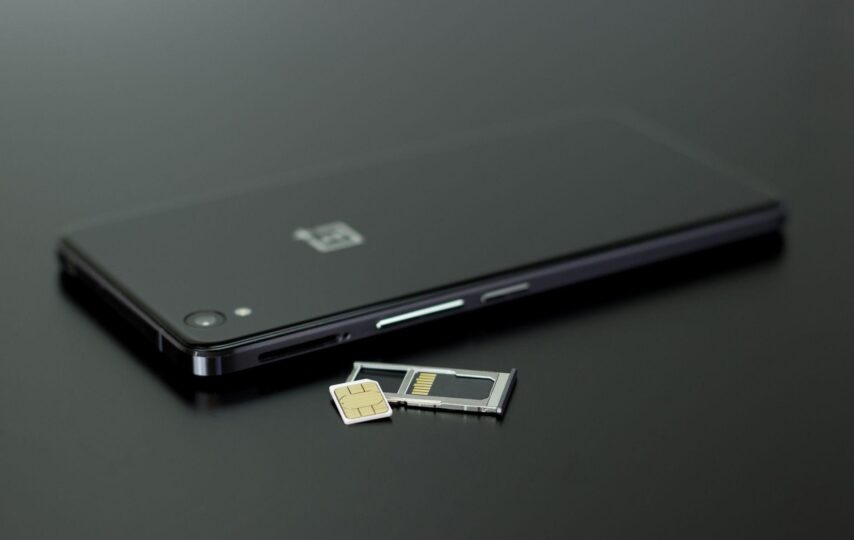

Close-up of a smartphone with a SIM card and memory card, showcasing modern technology.
Every phone you’ve owned until recently needed a small plastic card to get online. That’s changing fast. The eSIM spec has been part of the GSMA standard since 2016, but it took Apple pulling the SIM tray out of the iPhone 14’s US models in 2022 to make the shift feel inevitable rather than optional. Samsung, Google, and most Android flagship makers now ship eSIM-capable phones as standard, and a growing number skip the physical tray altogether.
This guide breaks down what an eSIM actually is, how the provisioning process works under the hood, and why the next shift, called iSIM, is already moving through early hardware.
What Is an eSIM?
An eSIM, short for embedded SIM, is a small chip soldered directly onto a phone’s circuit board that stores one or more mobile carrier profiles instead of a swappable plastic card. The chip itself is called an eUICC, or embedded universal integrated circuit card, and it’s built into the device at the factory rather than inserted by the user.
Where a physical SIM ships pre-loaded with a single carrier’s data, an eSIM ships blank. A carrier profile gets written to it later, over the air, using a process defined by the GSMA’s remote SIM provisioning (RSP) architecture. That’s the part most people never see, and it’s the part that actually matters.
How eSIM Provisioning Actually Works
The technical answer starts with two components: the eUICC chip inside your phone and a remote server called an SM-DP+, short for Subscription Manager Data Preparation Plus. The SM-DP+ is operated by or on behalf of a mobile carrier, and it holds the encrypted carrier profile before it ever reaches your device.
When you scan a QR code to activate an eSIM, you’re not scanning the profile itself. The code contains an activation reference: an address for the correct SM-DP+ server, plus a matching code that authorizes the download. Your phone contacts that server, the server checks your device’s unique eUICC identifier (called an EID), and if everything matches, it pushes an encrypted provisioning profile down to the chip.
That profile includes the same data a physical SIM would carry: the IMSI (subscriber identity), authentication keys, and network configuration. Once installed, the profile behaves exactly like a physical SIM’s contents, just without the plastic. Most modern eUICC chips can store several profiles at once, sometimes ten or more depending on the manufacturer, though phones typically run only one or two active at a time, switching between them in the cellular settings menu instead of physically swapping cards.
A separate GSMA server, the SM-DS or Subscription Manager Discovery Server, handles cases where the activation code doesn’t point straight to an SM-DP+ address. This layer exists mostly for carrier-issued eSIMs tied to a specific account, where the discovery step confirms which server holds the right profile before the download begins. Travel eSIM providers typically skip this extra hop and point the QR code directly at their own SM-DP+ server, which is part of why activation tends to finish in under a minute.
eSIM vs Physical SIM: What’s Different Under the Hood
A physical SIM is a piece of hardware you can remove, mail, resell, or lose. An eSIM is a profile, not an object, so none of that applies. Losing your phone doesn’t mean losing a SIM card to a thief; it means the carrier profile is gone with the device, and a new one gets provisioned to your replacement phone through the same SM-DP+ process.
Security works differently, too. Physical SIMs can be cloned if someone gets brief physical access to the card. eSIM profiles are cryptographically bound to a single eUICC’s EID, so a stolen profile can’t simply be moved onto another chip without going through the carrier’s authentication chain again. That doesn’t make eSIM immune to fraud, but it closes off the cloning method that physical SIMs have always been vulnerable to.
The other practical difference is capacity. A phone with one physical SIM slot needs a second slot, or an awkward dual-SIM tray, to run two numbers. An eSIM-capable phone can hold multiple stored profiles and switch between them in software, which is part of why dual-SIM setups became so much more common once eSIM adoption picked up.
Carrier eSIM vs Travel eSIM: Not the Same Thing
These two get used interchangeably online, and they shouldn’t be. A carrier eSIM is a full replacement for your home mobile plan: it carries your phone number, handles calls and texts, and gets issued directly by your carrier, whether that’s Verizon, Vodafone, or Globe Telecom. It’s tied to a contract or a postpaid account the same way a physical SIM from that carrier would be.
A travel eSIM is a different product entirely. It’s typically a prepaid, data-only profile installed alongside your existing carrier SIM, not instead of it. It doesn’t carry a phone number, doesn’t handle calls, and exists for one purpose: giving you local data speeds in a country you’re visiting without touching your home plan’s roaming charges.
Macro shot of an electronic circuit design around a smartphone camera lens, showing intricate details.
HelloRoam is one example of a travel eSIM provider, offering prepaid data plans across more than 185 countries starting from $1.03. A traveler landing in the US can install a USA eSIM as a secondary profile before departure, keep their home number active on the primary line for texts and calls, and get local data speeds the moment the plane lands, all without visiting a carrier store or swapping a physical card. That’s the travel eSIM model in practice: additive, temporary, and disposable once the trip ends.
eSIM-Only Phones Are Already Here
Apple removed the physical SIM tray entirely from iPhone 14 and later US models starting in September 2022, making them the first mainstream eSIM-only phones sold in a major market. Google followed a similar path with US models in its Pixel 10 lineup, dropping the tray in favor of eSIM-only provisioning.
What this actually means for buyers: a phone with no SIM tray isn’t a limitation so much as a design decision that frees up internal space for a larger battery or camera module, since the tray and its mechanical ejector assembly take up real board area. It also means anyone buying one of these models in the US has to activate service through eSIM from day one, whether that’s a carrier profile transferred from an old phone or a fresh provisioning flow at the point of sale.
The rollout isn’t universal yet. Plenty of current Android phones, including budget and mid-range models, still ship with a physical tray as the primary or only option. But the direction is clear, and each release cycle narrows the gap.
Real-World Use Cases Beyond Travel
Travel is the most visible eSIM use case, but it’s far from the only one. Dual-SIM professionals use a second eSIM profile to keep a work number separate from a personal one on the same physical device, without carrying two phones. Cellular-enabled smartwatches, including most Apple Watch and Wear OS models with LTE, rely on eSIM technology to connect independently of a paired phone.
IoT devices are a quieter but larger market. Connected cars, asset trackers, and industrial sensors increasingly ship with eUICC chips that get provisioned remotely across entire product lines, since manually inserting SIM cards into thousands of deployed devices isn’t practical. A logistics company tracking shipping containers, for example, can push carrier profiles to every sensor in a fleet from a single management console instead of dispatching someone to open each unit.
Cellular laptops and tablets follow the same pattern. A handful of Windows and Chromebook models now ship with built-in eUICC hardware, letting business travelers add a data plan without hunting for a mobile hotspot or tethering to a phone. The same remote provisioning process that activates a phone’s travel eSIM handles connectivity for hardware that a technician may never physically touch again after installation.
The Limits of eSIM Technology Right Now
eSIM isn’t a solved problem yet, and treating it as one oversells where the technology stands. Carrier support still varies by country and by provider; some regional carriers, particularly in parts of Africa, South Asia, and Latin America, haven’t rolled out eSIM provisioning at all, which limits where a carrier eSIM can replace a physical card.
Switching carriers can also be clunkier than the marketing suggests. Some carriers require a customer service call or app-based transfer flow to move an eSIM profile between devices, a process that’s often less intuitive than pulling a physical card out of one phone and into another. Losing a phone means going through the provider’s re-issuance process for a new profile, rather than simply retrieving a card from a drawer.
Device compatibility is the other real constraint. Older phones, some carrier-locked models, and many budget devices sold outside the US and Western Europe still lack eUICC hardware entirely, which means eSIM adoption tracks closely with how recent and how premium a market’s phone inventory is.
Resale is a smaller but real friction point. Wiping a physical SIM’s data off a phone you’re selling takes seconds; a former eSIM profile has to be manually removed from the device settings before handing it over, and a buyer who skips that step could end up staring at someone else’s carrier profile. It’s a minor step, but it’s one more thing a seller has to remember that a physical card is never required.
What Comes After eSIM: iSIM
The next step in this progression is already moving through early hardware: iSIM, short for integrated SIM. Where an eSIM is a separate chip soldered onto the circuit board, an iSIM folds that same secure function directly into the phone’s main processor, or SoC, instead of using a discrete component at all.
Qualcomm, Vodafone, and Thales have run iSIM pilots since the early 2020s, and the first iSIM-capable smartphone chipsets are now shipping in limited hardware. The appeal is straightforward: one less physical chip means more internal space, lower power draw, and one fewer point of failure on the board. It’s not a mainstream standard yet, and most phones sold today still use a discrete eUICC rather than an integrated one, but the industry’s direction points toward iSIM becoming the default the same way eSIM did.
Frequently Asked Questions
Is an eSIM the same as a physical SIM’s data?
Functionally, yes. An eSIM profile carries the same subscriber identity, authentication keys, and network configuration as a physical SIM. The difference is delivery: one arrives on a plastic card, the other gets provisioned remotely to a built-in chip.
Can I use two eSIM profiles at once?
Most modern eUICC chips can store several profiles, but the number that can run active simultaneously depends on the phone. Many current iPhones and Android flagships support two active profiles at once, commonly a carrier eSIM plus a travel eSIM.
Does eSIM work if I lose my phone?
The profile is tied to the device, not to a physical object you can recover. Losing the phone means requesting a new provisioning profile for the replacement device through your carrier, similar to reporting a lost physical SIM.
What happens if the SM-DP+ server is down during activation?
Activation can’t complete until the server responds, since the profile itself lives on that server until it’s downloaded. This is uncommon but does happen, and it’s why most travel eSIM providers recommend activating before departure rather than waiting until arrival.
Will physical SIM trays disappear completely?
Not immediately, and not everywhere at once. Premium phones in markets like the US are leading the eSIM-only shift, but budget devices and regions with less developed eSIM infrastructure will likely keep physical trays for years.
The Bottom Line
eSIM technology replaces a piece of removable hardware with a cryptographically secured profile delivered over the air through an eUICC chip and an SM-DP+ server, and that shift is now mainstream enough that entire phone lineups ship without a SIM tray at all. The distinction worth remembering is that a carrier eSIM and a travel eSIM solve different problems: one replaces your home mobile plan, the other supplements it for a trip. Whichever one you’re setting up, the process comes down to the same handful of steps: scan a code, let the phone talk to a provisioning server, and the profile does the rest.