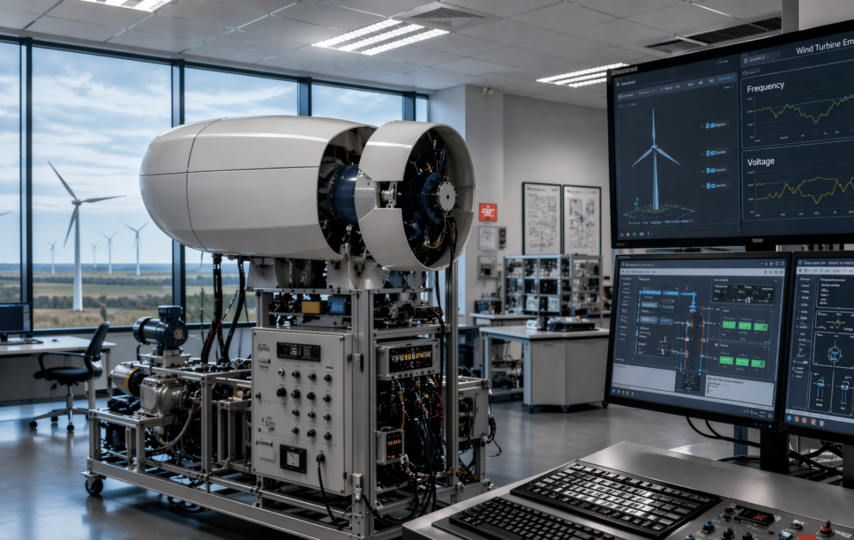

The global transition toward a decentralized energy matrix has transcended mere policy ambition; it is now a fundamental shift in the technical paradigm of power generation. Wind power sits at the very core of this renewable transformation. Yet, the real challenge for contemporary engineering has moved beyond simple energy extraction. The modern frontier is complex grid integration.
The global transition toward a decentralized energy matrix has transcended mere policy ambition; it is now a fundamental shift in the technical paradigm of power generation. Wind power sits at the very core of this renewable transformation. Yet, the real challenge for contemporary engineering has moved beyond simple energy extraction. The modern frontier is complex grid integration.
As wind penetration intensifies, the burden of maintaining system stability—particularly frequency and voltage regulation—falls upon a new generation of engineers who must master sophisticated power electronics and control algorithms. In this high-stakes environment, wind energy training must evolve past static theoretical models toward rigorous experimental validation based on real-world industrial scenarios.
Electrical grids are rapidly morphing into “Smart Grids.” In these networks, wind turbines are no longer passive injectors of power; they are active, intelligent participants in maintaining system equilibrium. This shift in operational roles necessitates that academic and research laboratories implement scalable platforms capable of emulating the precise interaction between asynchronous generators, storage units, and the primary electrical grid.
1. Technical Challenges in Wind Power Integration
The stochastic nature of wind is, by definition, the greatest hurdle for grid operators. Unlike the synchronous generators found in traditional thermal plants, modern turbines—especially those utilizing Doubly-Fed Induction Generators (DFIG) or Full Power Converters—interact non-linearly with the network. Therefore, advanced training systems must allow researchers to dissect and analyze critical variables such as:
- Active and Reactive Power Control: The inverter’s capacity to provide reactive power support is vital for mitigating voltage sags and maintaining power quality.
- Low Voltage Ride-Through (LVRT): It is imperative to understand how turbines stay connected during transient faults, adhering to increasingly stringent global grid codes.
- Frequency Regulation: With the retirement of traditional synchronous plants, the grid loses natural inertia. Wind farms must now fill this gap by providing “synthetic inertia” through advanced, high-speed control loops.
In a high-level laboratory setting, students must validate the control laws governing these phenomena. For instance, the relationship between torque, rotor speed, and power extraction is dictated by the power coefficient (Cp), governed by the following technical relation:
Power = 0.5 * Air Density * Area * (Wind Speed)^3 * Cp
Experimental platforms allow for the manipulation of both the pitch angle and the tip-speed ratio (lambda) to optimize this coefficient. This provides a hands-on, empirical understanding of aerodynamic efficiency and mechanical stress that no software-only simulation can replicate.
2. SCADA and Real-Time Data Acquisition in Industry 4.0
A cornerstone of Industry 4.0 within the renewable sector is the integration of SCADA (Supervisory Control and Data Acquisition) systems. For technical pedagogy to be effective, it must utilize industrial-standard software capable of high-speed data logging and remote process management.
Modern research platforms enable the simulation of “Wind Farm Clusters,” where multiple units are orchestrated from a unified control center. This allows for the implementation of advanced methodologies, including:
- Predictive Maintenance Algorithms: Utilizing vibration analysis to detect premature signs of bearing or gearbox failure before they lead to catastrophic downtime.
- Disturbance Simulation: Introducing grid faults or sudden wind gusts to evaluate system recovery times and stability margins.
- Power Quality Analysis: Measuring Total Harmonic Distortion (THD) caused by the switching frequencies in power converters.
This level of technical immersion ensures that the gap between the university lab and the industrial operations center is definitively closed, fulfilling the rigorous requirements of accreditation frameworks like ABET.
3. Micro-grids and the Research into Hybridization
The future of energy resilience does not lie in isolated technologies but in the intelligent hybridization of resources. Modern engineering curricula are increasingly pivoting toward Micro-grids, where wind energy is integrated with photovoltaic (PV) systems and battery energy storage (BESS).
The training environment must facilitate the study of “Islanded Mode” operations. In this state, the micro-grid disconnects from the main utility and must maintain its own stability autonomously. This requires sophisticated Energy Management Systems (EMS) capable of balancing generation and load in real-time. By utilizing modular laboratory equipment, faculties can scale their research from a single turbine emulator to a complex, multi-source smart grid.
A standard point of experimental study is the efficiency of the DC-AC inverter (eta), calculated as:
Efficiency (eta) = (P_out / P_in) * 100
By measuring these variables under diverse load profiles, researchers gain a quantitative grasp of energy losses and the vital importance of high-efficiency components in large-scale renewable projects.
4. Open-Control Architecture and Research Capability
For elite engineering faculties, laboratory equipment represents a long-term investment in research capital. Systems offering an Open-Control Architecture are particularly indispensable. They allow doctoral researchers to bypass standard interfaces and implement custom control algorithms—such as Model Predictive Control (MPC) or Fuzzy Logic—directly onto the physical hardware.
This capability is fundamental for developing new methodologies in:
- Grid Synchronization: Enhancing the performance of Phase-Locked Loops (PLL) under distorted grid conditions.
- Load Shedding Strategies: Developing automated responses to prevent grid collapse during extreme weather events.
- Hydrogen Integration: Researching the utilization of excess wind energy for electrolysis and green hydrogen production.
5. Toward Professional Proficiency
The complexity of contemporary wind energy systems demands a profound shift in technical pedagogy. It is no longer sufficient to treat a turbine as an isolated mechanical entity; it must be understood as a sophisticated component within a cyber-physical system.
By prioritizing wind energy training that emphasizes grid integration, SCADA control, and experimental validation, universities ensure their graduates possess the professional proficiency required for the Industry 4.0 workforce. Scalable, research-grade platforms provide the necessary infrastructure to transform theoretical models into robust, industrial-strength applications, driving innovation in the global pursuit of energy sustainability and grid resilience.