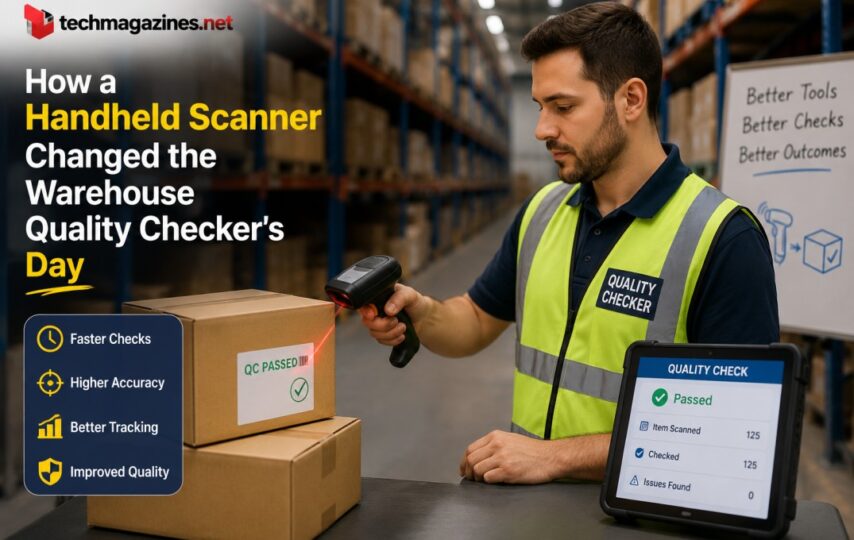

Walk through a modern fulfillment center and the eye is drawn to the obvious motion: forklifts gliding down aisles, conveyor belts humming with boxes, robots ferrying shelves toward waiting associates. What rarely gets noticed is the person standing at the end of the line, scanner in hand, quietly confirming that what left the shelf actually matches what the customer ordered. That role, often called a quality checker or verification associate, has existed for decades. What has changed is the tool in that person’s hand, and with it, the rhythm of an entire workday.
The Job Nobody Notices Until Something Goes Wrong
Quality checkers occupy a strange position in warehouse operations. When they do their job well, nothing happens. Orders leave correct, complete, and on time, and no one thinks twice about it. It is only when a shipment arrives with the wrong item, a missing accessory, or a mismatched size that the checker’s function becomes visible, usually in the form of a customer complaint that traces back to a single missed scan. This asymmetry means the role has historically been undervalued relative to its impact. A single verification step, performed correctly thousands of times a day, is what allows a fulfillment operation to promise accuracy at scale. The technology behind that step has quietly become one of the most consequential upgrades in the daily life of a warehouse.
From Clipboards to Barcode Scanners
Twenty years ago, verification often meant a paper packing slip and a visual comparison. A checker would glance at a list, count items in a box, and initial a form. It worked, but it was slow and dependent on human attention span staying sharp through an eight-hour shift. The introduction of handheld barcode scanners changed the mechanics entirely. Instead of reading and counting, a checker now scans each item as it goes into a box, and the system either confirms a match or flags a discrepancy immediately. The cognitive load shifted from memory and comparison to simple execution, which reduced fatigue-driven mistakes and freed checkers to handle more volume without sacrificing accuracy. It also gave the role a new kind of authority. A scanner’s confirmation carries a certainty that a tired set of eyes at hour seven of a shift cannot always match.
Software That Talks Back
The scanner itself was only the first layer. What has made the biggest difference in recent years is the software connected to it. Modern warehouse management systems now feed real-time instructions to the checker’s device, telling them not just whether an item matches an order but whether a substitution has been approved, whether a customer requested gift packaging, or whether a particular SKU has a known quality issue that warrants a second look. The checker is no longer working from a static list. They are working inside a live conversation with the inventory system, one that adjusts based on order complexity. For operations handling thousands of unique product combinations, that responsiveness has turned a repetitive task into something closer to informed judgment, guided at every step by data rather than guesswork.
Where Assembly Work Fits Into the Daily Routine
This shift matters most in operations where orders are not single items pulled off a shelf but assembled combinations of parts, accessories, and packaging. A company offering kitting services, for example, might build a promotional bundle that includes a primary product, three accessories, and an insert card, all of which need to be verified as a unit before the box is sealed. The checker responsible for that bundle relies on the same handheld technology, but the stakes are higher, because a single missing accessory can undo the value of the entire kit. The scanner’s ability to confirm each component individually, rather than trusting a visual count, has made this kind of complex, multi-part verification reliable at a volume that would have been impractical to manage by hand. It is a clear example of how a tool built for simple accuracy has enabled more ambitious kinds of order fulfillment altogether.
Measuring the Impact
The value of this shift shows up in numbers that operations managers track closely, from error rates per thousand units shipped to the average time spent per order at the verification station. But it also shows up in something harder to quantify: the confidence a checker has in their own work. Employees in this role now describe their job less as a matter of careful looking and more as a matter of trusting a system that has been built to catch what a human eye might miss. That trust has made the position more sustainable as a long-term career path rather than a transitional job, since the technology absorbs much of the repetitive strain that once made the work exhausting. The Bureau of Labor Statistics tracks employment trends across warehousing and material-moving occupations, and the steady demand for these positions reflects how central verification work remains to a functioning supply chain, even as the tools supporting it continue to evolve.
A Role Built to Last
What makes this story notable is not that the technology is flashy. Handheld scanners and connected software are unglamorous by design, built to disappear into the background of a shift rather than draw attention to themselves. But their effect on the checker’s day has been substantial. Tasks that once required constant vigilance now happen with built-in confirmation. Errors that once slipped through unnoticed are caught before a box is sealed. And a role that customers rarely think about has become more precise, more efficient, and more central to the promise that an order will arrive exactly as it was meant to. The scanner did not replace the checker. It gave them a better way to do a job that has mattered all along, one careful confirmation at a time.