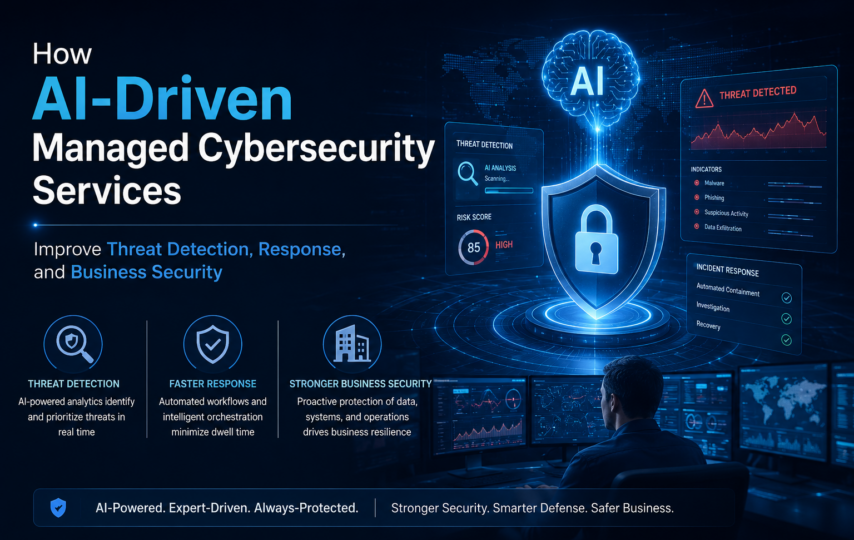

Banks, schools, hospitals, and government offices are now common targets for cyber-attacks. The attackers know that many organizations do not possess the money or staff required to maintain a large security operation of their own. At the same time, cyber threats have become more persistent and more difficult to detect. As a result, businesses are turning to managed cybersecurity services to improve oversight, respond faster to incidents, and reduce risk. One example is Blueshift Cyber, which provides AI-driven cybersecurity operations through Managed Extended Detection and Response supported by a 24/7 U.S.-based Security Operations Center.
Its platform helps businesses, government agencies, and infrastructure operators detect suspicious activity early, contain attacks before they spread, and maintain protection across networks, cloud systems, endpoints, and edge devices. By combining automation with human oversight, the company allows organizations to respond to cyber threats with greater speed and accuracy.
Why Businesses Can No Longer Rely on Traditional Cybersecurity
For many years, companies trusted firewalls, antivirus programs, and occasional system checks to keep intruders out. That method no longer answers the conditions of the present time. Modern attacks move faster and strike with greater precision.
Cybercriminals now rely on automation, artificial intelligence, stolen credentials, ransomware services, and carefully prepared phishing schemes to break into networks. At the same time, remote work, cloud computing, and connected devices have widened the field of attack. A company no longer defends a single office. It must defend hundreds of scattered entry points.
The real difficulty does not lie in discovering threats alone. It lies in discovering them before serious harm begins.
Many organisations now face the same problems each day. They receive thousands of security warnings. They lack trained cybersecurity staff. Response times grow slow during an incident. False alarms consume valuable hours. Security systems often fail to work together across different platforms. In many cases, no one watches the network outside ordinary business hours.
This confusion has driven many companies toward managed cybersecurity providers that can oversee protection continuously from a central operation.
Zero Trust and Application Control
Zero Trust security has become one of the fastest-growing ideas in cybersecurity. It begins with a simple assumption. No user, device, or application should receive trust automatically. Every request must prove itself before access is granted.
Application control now holds an important place in this system. Attackers often rely on harmful or unauthorised software to enter networks and spread through them. For that reason, many organisations use modern application blacklisting solutions to stop dangerous programs from running inside their environments. This lowers the risk of malware infections, ransomware attacks, and unauthorised software activity.
Application blacklisting tool also strengthen endpoint protection. They can block suspicious applications before those programs reach sensitive data or critical systems.
These safeguards matter most in sectors where security failures carry serious consequences. Government departments, hospitals, financial institutions, and operators of critical infrastructure often depend on stricter controls to protect their daily operations.
How AI Is Changing Security Operations
Artificial intelligence has become one of the chief instruments of modern cybersecurity. The reason is simple. Cyber threats now move at a speed that human workers alone cannot match. A manual investigation often begins too late, after the damage has already spread through the system.
AI-based security systems can examine enormous quantities of data as it appears. They help organisations uncover threats that an ordinary analyst might fail to notice.
- They watch networks and devices for unusual behaviour.
- They connect information gathered from different security tools.
- They reduce the flood of false alarms that wastes time and attention.
- They place the most dangerous incidents first in line for investigation.
- They also study patterns of behaviour that may point toward future attacks. In many cases, they can respond to routine threats automatically before a human operator steps in.
Blueshift Cyber uses AI-based detection and autonomous security operations to increase the speed and accuracy of threat response. Its IntelliThreat™ Autonomous AI platform relies on specialised AI agents that can sort alerts, examine suspicious activity, and assist with remediation advice without depending entirely on manual labour.
This method helps organisations cut down the exhaustion caused by endless security warnings. At the same time, it gives them a clearer view of the systems and infrastructure they must defend.
The Growing Importance of Managed XDR
Extended Detection and Response, now commonly called XDR, has become an important part of present-day cybersecurity. Modern organisations no longer operate inside a single system. Their work stretches across cloud platforms, office networks, remote devices, email services, and identity systems at the same time.
Older security tools often function in isolation. One system watches email. Another guards endpoints. A third monitors network traffic. The result is confusion and blind spots. XDR attempts to remove this weakness by gathering information from many different systems into one central platform.
- Managed XDR services give organisations several advantages
- They provide a broader view of threats across the network
- They help security teams discover attacks more quickly
- They simplify investigations by connecting related events across multiple platforms
- They also support automated containment measures when serious threats appear
- Most important of all, they allow continuous monitoring across the whole IT environment instead of scattered supervision
Why a 24/7 SOC Matters More Than Ever
Cyber attacks do not follow office hours. Ransomware and credential theft often strike at night, during holidays, or on weekends, when internal IT staff may not watch the system closely. For that reason, many organisations now depend on Security Operations Centers that work day and night without interruption.
A strong SOC keeps constant watch over the network. It searches for hidden threats, investigates suspicious activity, examines digital evidence, confirms alerts, and acts quickly to contain attacks before greater damage begins. It also supports recovery efforts after an incident occurs.
For many businesses, building such a centre internally costs more than they can afford. Managed cybersecurity providers offer the same level of protection at a much lower cost, giving smaller organisations access to tools and expertise once limited to large enterprises.