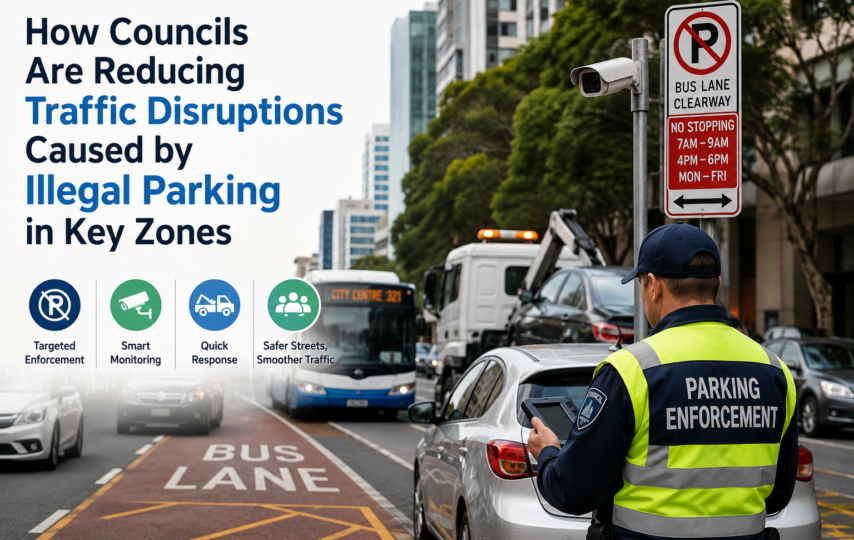

Illegal parking in key urban zones is no longer an isolated issue. It has become a structural cause of traffic disruption across modern city networks.
High-density corridors such as commercial streets, transit routes, loading areas, and emergency access lanes are especially sensitive. Even short stopping events can interrupt continuous traffic flow.
A single illegal parking incident can trigger a chain reaction. Lane obstruction leads to vehicle queuing, which increases congestion upstream. This spreads across nearby intersections and reduces overall corridor performance.
Traditional patrol-based systems and periodic observation methods are not designed to manage this level of continuous disruption.
As a result, cities are adopting structured systems powered by parking enforcement technology, which connects real-time detection, rule validation, and operational response into a coordinated monitoring framework.
In today’s urban environment, these systems are becoming essential for maintaining stable traffic movement across key corridors.
Let’s understand how councils are reducing traffic disruptions caused by illegal parking using parking violation detection systems, structured compliance workflows, and scalable monitoring infrastructure.
#1 Detecting Illegal Parking as a Real-Time Traffic Disruption Signal
Effective traffic management starts with early identification of illegal stopping activity in high-risk corridors.
Modern systems use parking enforcement cameras and automated monitoring infrastructure to identify vehicles stopped in restricted zones such as bus lanes, loading areas, and no-standing zones.
These systems support continuous parking violation detection, capturing:
- vehicle presence in regulated zones
- duration of stopping activity
- spatial alignment with curb boundaries
- time-based rule conditions
This allows cities to identify short-duration violations that are typically missed in manual patrol operations.
By treating illegal parking as a real-time disruption indicator, councils can reduce congestion before it expands across connected corridors.
#2 Converting Detection Into a Structured Parking Violation Solution
Detection data alone does not improve traffic outcomes unless it is structured into actionable records. A parking violation solution processes detected events through rule-based validation logic that evaluates:
- zone classification
- time restrictions
- dwell-time thresholds
- regulatory compliance conditions
Each confirmed event is transformed into a structured compliance record.
These records include:
- timestamped evidence
- geolocation data
- rule validation outcome
- violation classification
This ensures consistent enforcement decisions and improves operational reliability across monitored zones.
#3 Improving Response Efficiency Through Faster Violation Processing
Traffic disruption severity increases when response cycles are delayed.
In manual workflows, delays between detection, review, and action allow congestion to expand beyond the original violation point. Technology-enabled systems reduce this delay by automating detection workflows and centralizing validation processes for faster decision cycles. This improves processing speed across multiple corridors and reduces repeated or clustered illegal stopping behavior.
As response cycles become shorter, overall traffic stability improves across high-density urban zones.
#4 Continuous Corridor Monitoring With Parking Enforcement Cameras
Illegal parking disrupts traffic flow by blocking lanes and forcing sudden merging behavior. Once a lane is obstructed, vehicle queues form quickly and reduce corridor throughput.
Continuous monitoring using parking enforcement cameras helps reduce this impact by enabling persistent observation across multiple zones.
This supports:
- continuous corridor coverage
- multi-zone visibility
- consistent rule application across time periods
As monitoring becomes continuous, disruption frequency decreases, and corridor-level traffic stability improves.
#5 Scaling Monitoring Coverage Across Urban Networks
Manual systems are limited by physical patrol capacity, restricting the number of corridors that can be actively monitored.
Modern monitoring architectures scale coverage through distributed systems that support continuous parking violation detection, including:
- fixed monitoring points in high-activity zones
- mobile monitoring units across corridors
- centralized validation systems for rule consistency
This enables simultaneous monitoring of multiple high-risk locations without requiring constant physical presence.
As coverage expands, blind spots reduce, and overall traffic reliability improves across the network.
#6 Using Violation Data for Traffic System Optimization
Violation data also plays a key role in long-term traffic planning and optimization.
By analyzing parking violation detection patterns, councils can identify:
- recurring congestion hotspots
- peak disruption time windows
- misaligned curb or lane regulations
- zones requiring infrastructure adjustments
This enables data-driven improvements to traffic management strategies.
Operational use includes:
- adjusting monitoring focus areas
- reallocating resources based on demand patterns
- refining curb and lane regulations
Over time, this creates a continuous improvement loop where traffic management becomes more responsive to real-world conditions.\
Bottom Line
Illegal parking is a key contributor to traffic instability in dense urban environments. It disrupts corridor flow, increases congestion, and reduces overall network efficiency.
By adopting structured systems, cities can continuously detect violations, validate compliance, and reduce disruption across key zones.
When combined with parking violation detection systems, a structured parking violation solution, and parking enforcement cameras, monitoring becomes a continuous operational capability rather than a reactive process.
As urban traffic systems become more complex, data-driven monitoring plays a critical role in maintaining stable and predictable corridor performance.