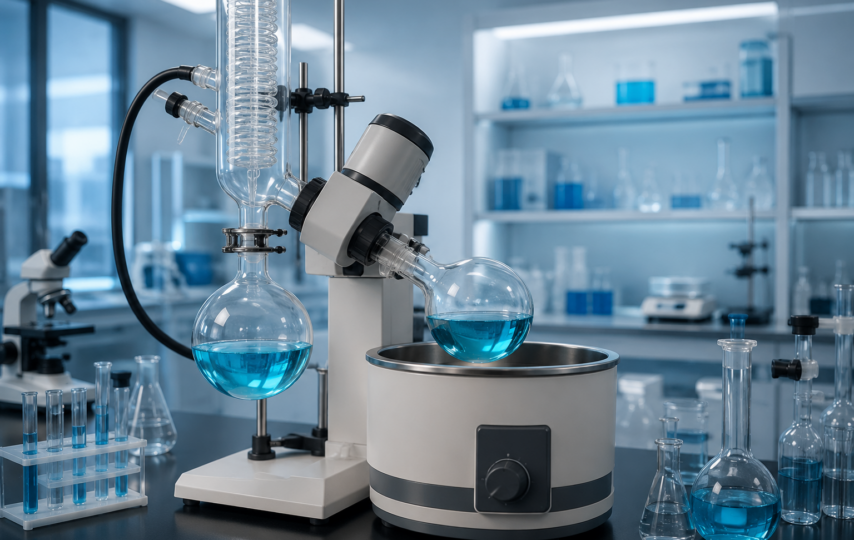

Laboratories involved in chemical research, pharmaceutical development, and analytical testing depend on equipment that delivers accurate, consistent results while improving daily productivity. Among these instruments, the Rotary Evaporator used in laboratory settings has become indispensable for tasks such as solvent removal, sample concentration and solvent recovery. By combining controlled heating, reduced pressure and continuous flask rotation, a Rotary Evaporator enables faster evaporation while helping protect heat-sensitive compounds.
The Working Principle Behind Rotary Evaporation
A Rotary Evaporator operates on a simple yet effective principle. A round-bottom flask containing the sample is partially immersed in a heated water bath and rotated continuously by a motor-driven system. At the same time, a vacuum is applied to lower the solvent’s boiling point, allowing it to evaporate at temperatures below its normal boiling point.
The solvent vapour then passes through a water-cooled condenser, where it condenses back into liquid and is collected in a separate receiving flask. As the flask rotates, the liquid forms a thin film along its inner surface, increasing the surface area available for evaporation. This improves evaporation efficiency while helping minimise bumping during the process. These features allow a Rotary Evaporator to remove solvents more quickly and gently than many conventional evaporation methods.
How Rotary Evaporators Improve Laboratory Productivity
One of the biggest advantages of using a Rotary Evaporator is the time it saves during routine laboratory operations. Solvents such as methanol and dichloromethane can be removed much faster under reduced pressure than through ambient evaporation or conventional heating. For laboratories processing multiple samples every day, this can improve workflow efficiency and sample throughput.
Another important advantage is the protection of heat-sensitive materials. Since reduced pressure lowers the solvent’s boiling point, many solvents can be evaporated at lower temperatures. This preserves pharmaceutical intermediates, natural product extracts and other compounds that may degrade when exposed to excessive heat.
Rotary Evaporators also support efficient solvent recovery. The evaporated solvent is collected after condensation and, where appropriate, can be purified and reused. It reduces solvent consumption, lowers operating costs and supports laboratory sustainability initiatives.
Applications Across Research and Industrial Laboratories
The versatility of a laboratory Rotary Evaporator makes it suitable for a wide range of laboratory applications. In synthetic organic chemistry, it is commonly used after reaction workups to remove solvents and obtain crude products for further purification. Pharmaceutical laboratories use Rotary Evaporators to concentrate fractions collected during chromatographic separations and to remove solvents during Active Pharmaceutical Ingredient (API) development and isolation.
Natural product researchers use these systems to concentrate plant extracts before additional purification steps. Analytical laboratories also use Rotary Evaporators for sample concentration before instrumental analysis and for solvent exchange, where one solvent is replaced with another without compromising the sample. Their ability to support diverse laboratory workflows is one of the reasons Rotary Evaporators remain widely used across research, academic and industrial settings.
Features That Influence Rotary Evaporator Performance
Selecting the right Rotary Evaporator depends on the laboratory’s workload and application requirements. Before making a decision, consider the following features:
- Flask capacity: Models range from compact units that accommodate 50 mL flasks to pilot-scale systems with capacities of 20 litres or more. Selecting the appropriate size improves efficiency and reduces unnecessary processing time.
- Vacuum system: A diaphragm vacuum pump is suitable for many commonly used laboratory solvents, while higher-boiling solvents such as dimethylformamide (DMF) and dimethyl sulfoxide (DMSO) may require deeper vacuum levels for effective evaporation.
- Condenser configuration: Vertical, diagonal and coil condensers are available to suit different solvent types and laboratory applications. A cold trap can also be incorporated into the setup to help protect the vacuum pump from solvent vapours.
- Temperature control: Stable, precise water bath temperature control ensures consistent evaporation and reproducible laboratory results.
- Build quality: Borosilicate 3.3 glass provides excellent resistance to thermal stress and chemical exposure, making it well suited for routine laboratory use.
- Ease of maintenance: Standardised joints and seals simplify maintenance by enabling quick replacement of worn components.
Laboratories should also consider equipment reliability and after-sales support when making their selection. Manufacturers such as Goel Scientific Glass Works Ltd. offer Rotary Evaporators used in laboratory applications with durable borosilicate glass assemblies suitable for pharmaceutical, chemical, research and academic laboratories. Available in both bench-scale and pilot-scale configurations, these systems support reliable solvent evaporation across a wide range of laboratory processes.
Conclusion
Rotary evaporators have become an essential part of modern laboratories because they enable faster solvent removal, improve sample handling and support efficient solvent recovery while protecting heat-sensitive compounds. Selecting equipment with suitable capacity, reliable vacuum performance and durable construction helps laboratories achieve consistent and reproducible results. Investing in a quality laboratory Rotary Evaporator supports efficient workflows across research, pharmaceutical and industrial applications.