
Carbon fiber has become the material of choice for engineers who need parts that are lightweight, stiff, and strong enough to compete with metal without the added weight. But getting from a design file to a physical, testable carbon fiber part isn’t as simple as hitting print on a 3D printer. Because of how carbon fiber composites are built up in layers and cured, prototyping requires a very different approach than prototyping with metals or plastics.
This guide walks through the most common methods used for prototyping carbon fiber parts, how they compare, and what to consider when choosing a manufacturing process for your next project.
Why Carbon Fiber Prototyping Is Different
Unlike aluminum or plastic, carbon fiber isn’t a single homogeneous material you can simply mill from a solid block in most cases. It’s a composite made from woven or unidirectional carbon fibers held together by a resin matrix, and the properties of the final part depend heavily on how those fibers are oriented, how many layers are used, and how the part is cured. This means the manufacturing method you choose doesn’t just affect cost and turnaround time — it directly affects the strength, stiffness, and performance of the prototype itself.
For teams moving quickly through design iterations, this creates a real tradeoff. A prototype that doesn’t accurately reflect the mechanical properties of the final production part can lead to false confidence in a design, while an overly complex, production-representative process can slow down early-stage testing unnecessarily. Choosing the right method for the right stage of development is the key to avoiding both problems.
CNC Machining Carbon Fiber Prototypes
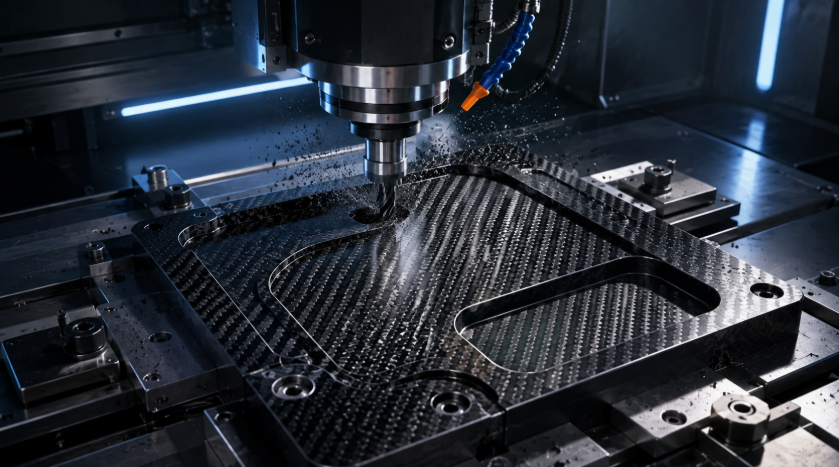
CNC machining has become one of the most popular ways to prototype carbon fiber parts, particularly when speed and dimensional accuracy matter. This approach typically starts with a pre-consolidated carbon fiber sheet or block — either a solid CNC-grade laminate or a pre-preg panel that’s already been cured — which is then milled down to the final geometry using standard CNC equipment adapted for composite materials.
The biggest advantage of this method is turnaround time. Since there’s no layup or curing step involved in the prototyping stage itself, parts can often be machined and delivered in days rather than weeks. It also produces excellent dimensional accuracy and clean edges, which is especially useful for prototypes that need to fit precisely into an assembly or mate with other machined components.
The tradeoff is that CNC-machined carbon fiber prototypes are typically made from a uniform laminate rather than a fiber layup custom-oriented to the part’s specific load paths. This means the prototype may not perfectly replicate the anisotropic strength properties of a final production part made through layup and molding, particularly for parts with complex curves or highly directional load requirements. For flat or moderately contoured geometries, though, CNC machining offers an excellent balance of speed, accuracy, and cost. Providers offering FastPreci’s composite CNC machining services are commonly used by engineering teams who need fast, dimensionally accurate carbon fiber prototypes without committing to a full mold-based production process.
Hand Layup Prototyping
Hand layup is one of the oldest and most flexible methods for producing carbon fiber prototypes, and it’s especially valuable when a part’s design closely mirrors how it will eventually be manufactured in production. This process involves manually placing layers of carbon fiber fabric into a mold, saturating them with resin, and curing the part, either at room temperature or in an oven or autoclave for higher-performance applications.
Because the fiber orientation and layer count can be precisely controlled, hand layup prototypes can closely replicate the mechanical performance of a production part, making this method popular for aerospace, automotive, and sporting goods applications where structural performance under load is critical to validate early.
The downside is time and cost. Hand layup requires building or 3D printing a mold first, and the manual nature of the process means production speed is limited and highly dependent on the skill of the technician performing the layup. For a single prototype or small batch, this can still be worthwhile, but it’s rarely the fastest path from design to physical part.
Compression Molding for Prototypes
Compression molding involves placing layered carbon fiber material into a heated mold and applying pressure to consolidate and cure the part in a single step. While this method is more commonly associated with production runs, it’s sometimes used for prototyping when a team needs multiple identical parts quickly, or when the geometry benefits from consistent pressure distribution during curing.
This process tends to produce more consistent part quality than hand layup, since pressure and heat are applied uniformly across the entire part rather than relying on manual technique. However, tooling costs are higher upfront, since a matched metal or composite mold typically needs to be machined before any parts can be produced. This makes compression molding a better fit for later-stage prototyping or bridge production runs rather than very early design iterations.
3D Printing Carbon Fiber Composite Prototypes
3D printing has entered the carbon fiber prototyping space through continuous fiber and chopped fiber-reinforced filaments, offering a fast and relatively low-cost way to test geometry and fit before committing to more expensive tooling-based processes. Continuous fiber 3D printing, in particular, lays down actual carbon fiber strands along programmed paths within a thermoplastic matrix, offering better strength than chopped-fiber filaments meaningfully.
This method shines during the earliest stages of design, when teams need to test form and fit quickly without worrying about matching final mechanical properties exactly. It’s rarely used for parts that need to closely replicate the strength and stiffness of a true composite layup, since the fiber content and consolidation quality are generally lower than what’s achievable through molding or machining processes.
Comparing the Options
Each prototyping method fits a different stage and priority in the development process. CNC machining offers speed and dimensional precision for prototypes derived from pre-consolidated laminates, making it ideal for fit-testing and functional prototypes on tighter timelines. Hand layup offers the closest match to final production mechanical properties but takes longer and costs more per part. Compression molding sits in between, offering consistency for small batches once tooling exists. 3D printing offers the fastest and cheapest option for early form-and-fit testing, but with the least accurate mechanical representation of a finished composite part.
Choosing between them typically comes down to what question the prototype needs to answer. If the goal is simply testing how a part fits into an assembly, a CNC-machined or 3D-printed prototype is usually sufficient. If the goal is validating structural performance under real-world loads, hand layup or compression molding will provide far more reliable data.
Tips for a Smoother Carbon Fiber Prototyping Process
Working closely with your manufacturing partner early in the design process can prevent costly rework later. Sharing load case information, even in early design iterations, helps machinists and composite technicians recommend the right laminate structure or CNC stock material for your application. It’s also worth requesting material certifications and layup schedules for any pre-consolidated laminate used in CNC machining, since not all carbon fiber sheet stock is created equal in terms of fiber content and resin quality.
Finally, plan for at least one iteration. Carbon fiber parts, particularly those with complex geometry, often reveal fit or performance issues that aren’t obvious until a physical prototype is in hand. Building iteration time into your project schedule from the start will save far more time than trying to get every detail perfect on the first attempt.
Final Thoughts
Prototyping carbon fiber parts requires balancing speed, cost, and how closely the prototype needs to represent final production performance. CNC machining stands out as one of the fastest, most accurate options for early to mid-stage prototypes, particularly for teams that need dimensionally precise parts without the lead time of mold-based manufacturing. Hand layup and compression molding remain the better choice when mechanical performance validation is the priority, while 3D printing offers a fast, low-cost way to test form and fit before committing to more involved processes.
Choosing the right method — and the right manufacturing partner — early in the design process can significantly reduce development time and help ensure your final production parts perform exactly as intended.