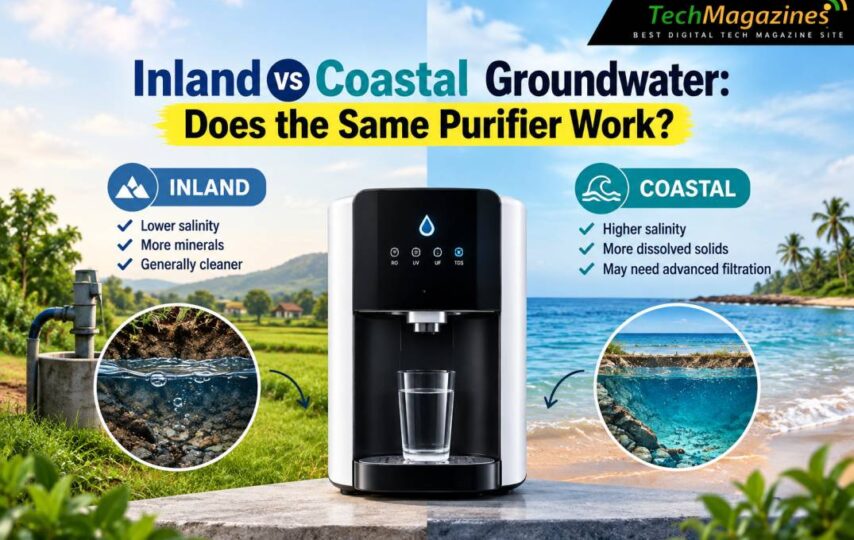

Two households in India may use borewell water, but their TDS meters will show different readings. That’s why the same purifier may not work in both houses. Coastal groundwater and inland groundwater have different chemical properties, and TDS remains a key measurement. TDS measures how much material is dissolved in a litre of water but says nothing about what that material is. Coastal groundwater also worsens before the monsoon, and seasonal changes affect water quality. When deciding whether to buy or rent a water purifier, you should know that the same model may struggle to deliver the same output in inland and coastal areas.
What Saline Groundwater Does to a Coastal Borewell
Seawater moves into a freshwater aquifer. People looking for a water purifier for saline or salty water face this issue. Fresh groundwater and seawater may share the same underground system. A boundary may also separate them, but it keeps shifting instead of staying still.
How Saline Intrusion Adds Salt to the Water
Coastal borewells in Kerala, Tamil Nadu, Andhra Pradesh, and Gujarat gradually turn brackish due to saline intrusion. The water from the borewell contains dissolved sodium chloride at levels that sediment or carbon stages were never built to remove.
Why Chloride Reduces an RO Membrane’s Life
Chloride passes through carbon and sediment filters and affects RO membranes. This is why a genuine RO stage is the real answer for drinking water – a basic filter won’t show the same efficacy in a saline area. A rejection rate high enough to reduce sodium levels to a palatable level means the membrane wears out faster than the manufacturer’s label. If your drinking water tastes salty after using an RO purifier, the membrane is nearing the end of its life. Cleaning the filter alone won’t help.
How a Water Purifier Works for High-TDS Inland Borewells
Hard water is the main problem for high-TDS inland groundwater. Inland borewells sitting in limestone or granite contain dissolved calcium and magnesium instead of salt. The high-TDS reading from an inland borewell is as high as a coastal one – while one may not realise it.
How Magnesium and Calcium Enter Inland Groundwater
Rock is the main source. Inland borewell water sits in basalt or limestone, and it dissolves calcium and magnesium. These minerals cause hard water. For example, Bangalore has a hard water problem. The region sits on the Dharwar Craton – the bedrock beneath the city is composed of Peninsular Gneiss and Granites. That’s why the water has dissolved calcium and magnesium, and you get mineral-heavy water.
Why Hardness Scales an RO Membrane
Hardness in water doesn’t corrode an RO membrane, but it can build up a layer on it. Calcium and magnesium precipitate onto the membrane surface as scale. A scaled RO membrane declines gradually. The RO water purifier for high-TDS inland supply requires an anti-scalant cartridge. Or you can add a softening stage ahead of the membrane to address the water’s hardness.
Hard Water vs Salty Water: What to Keep in Mind
Inland groundwater is hard, and coastal borewells supply salty water. Here’s how to figure out which household has which, instead of guessing without evidence.
1. Taste and Residue
A salty or faintly brackish taste may often become more noticeable in the summer. Sodium chloride and saline intrusion cause this. A flat, chalky aftertaste with visible residue left behind in a kettle indicates hard water. The two do not usually overlap in the same supply – taste and residue are faster to check than any TDS reading.
2. The TDS Reading Alone is Not Enough
A basic TDS meter measures the total dissolved solids. It shows a similarly high number whether the dissolved solids are calcium, magnesium, or sodium chloride. The TDS meter cannot differentiate between the dissolved solids. To confirm the problem, taste or residue-check the water, run a chloride or hardness test, or identify the water source.
| Groundwater Type | Dissolved Problem | Water Purifier Technology | Why the Simpler Option Alone Won’t Work |
| Coastal/ saline (brackish) | Sodium chloride from saline intrusion | RO with a high-rejection membrane, paired with UV or UF for microbiological safety | UV and UF remove microorganisms and turbidity, not dissolved salt |
| Inland/ hard | Calcium and magnesium, sometimes fluoride or nitrate | RO preceded by an anti-scalant dose or a softening stage, paired with UV or UF for microbiological safety | RO with no pre-treatment lets the membrane scale and fail early |
Coastal and Inland Water: Rent or Buy a Water Purifier?
Whether renting or buying makes more sense depends on the upfront cost and how stable the water supply is.
Salinity Changes with Season; Hardness Doesn’t
Inland hardness is a geological constant. The rock supplying the water does not change, so a correctly specified inland drinking-water setup stays correctly specified for years. Coastal salinity is not constant. It climbs through the dry months as extraction outpaces recharge, peaks in the pre-monsoon weeks when the saline boundary has advanced furthest inland, and retreats once the rains push fresh water back into the aquifer. The same coastal tap can be mildly brackish in January and clearly salty by May.
Why Renting Suits a Coastal Home
Seasonal change is why you should get an RO water purifier on rent — buying locks you into one membrane for water that won’t stay stable. The specification may turn out wrong for the season, and the replacement cost may feel heavy. Rental purifiers can be upgraded, and platforms such as Rentomojo replace filters. If coastal water gets saltier year over year than inland, this option may pay off.
Final Thoughts
A coastal household assumes salinity until proven otherwise. Look for chloride rejection rather than generic filtration, and expect to replace the membrane sooner than the warranty. An inland household should assume hardness, spend on pre-treatment before spending on a larger RO unit, and read a slow drop in output as scale rather than age. Both will show a high number on the same TDS meter. Only one of them shows that number getting worse every summer.