
Have you ever wondered how companies raise money to grow their business? They often go to the public to sell their shares for the first time. This famous process is called an Initial Public Offering. However, not all companies are the same size. A giant car maker and a local tech startup have very different financial needs. This is why the stock market has created different platforms for them.
The difference between SME vs Mainboard platforms is very important for every investor to understand. Here, we look at the SME vs Mainboard debate and understand the details of these IPOs so you can make informed investment choices.
Meaning of Mainboard IPO
A Mainboard IPO is the traditional way large private companies sell their shares to the general public. Usually these companies are well established and earning steady profits. They list their shares on exchanges like the National Stock Exchange (NSE) or the Bombay Stock Exchange (BSE).
Because of the size of these companies, their rules are quite difficult to follow. The Securities and Exchange Board of India (SEBI) directly checks all their business documents to keep your hard earned money safe. To qualify, these big companies usually need a post-issue paid-up capital of more than Rs 10 Cr.
In reality, they often raise hundreds or even thousands of crores. For investors like you and us these offerings are very easy to enter. You can start investing with a small amount, usually ranging from Rs 14,000 to Rs 15,000. For example: LG Electronics and Tata Technologies recently used the mainboard route to raise money.
Meaning of SME IPO
An SME IPO is a special route created specifically for Small and Medium Enterprises. These are smaller companies that are growing fast but do not have the money or size to meet strict Mainboard rules. Instead of the main exchange, they list their shares on dedicated platforms like BSE SME or NSE Emerge.
You should remember that this route is a bit riskier because the companies are small. To protect small retail investors from this risk, the entry ticket is kept quite high. You need to invest at least ₹2 Lakhs to participate, as you must apply for a minimum of two lots.
Also, you have to trade in fixed batches called lots instead of single shares. Let us look at a real-world example of this. Recode Studios is a growing cosmetics brand that used the SME platform to list itself. They were a growing company seeking funds, and their public issue was a massive hit among investors looking for high growth.
Key Differences: Mainboard IPO vs SME IPO
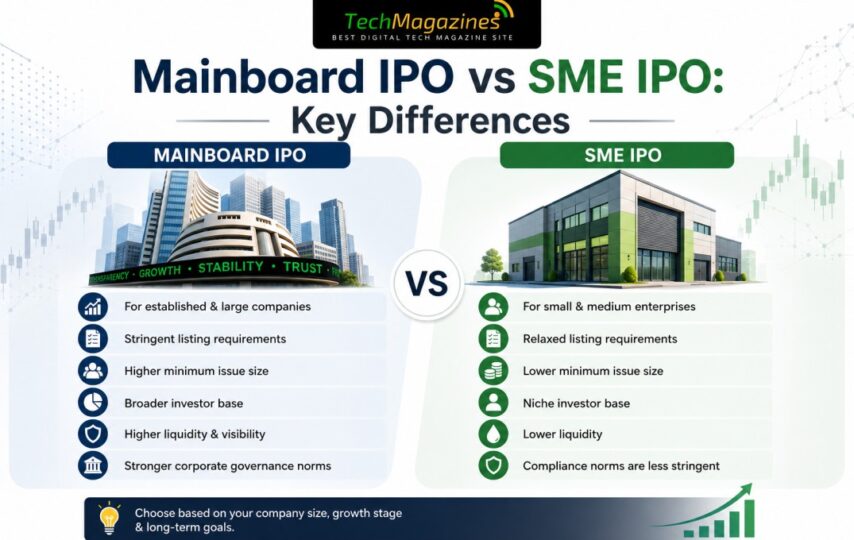
The table below shows the key differences you should keep in mind.
| Feature | Mainboard IPO | SME IPO |
| Company Size | Large and well established companies. | Small and Medium Enterprises. |
| Listing Platform | National Stock Exchange or Bombay Stock Exchange. | NSE Emerge or BSE SME. |
| Minimum Investment | Around Rs.14,000 to Rs. 15,000. | Mandatory minimum of over ₹2 Lakhs (minimum 2 lots). |
| Trading Unit | You can buy or sell 1 single share. | You must trade in fixed lots (e.g. 1000 shares). |
| Document Checking | Checked directly by SEBI with strict rules. | Checked by the stock exchange with some relaxation in rules. |
The most important difference lies in who checks the company and how strict the rules are. Mainboard companies face direct checks from SEBI to ensure high transparency. SMEs are checked by the exchanges to save time and money for the small business.
Compliance and Reporting Requirements in Mainboard vs SME IPOs
- Mainboard IPOs are directly reviewed by SEBI, while SME IPO documents are examined by stock exchanges, with SEBI in a supervisory role. The Mainboard process takes 6 -12 months due to strict scrutiny, whereas SME IPOs are processed in just 3 – 4 months.
- Mainboard companies must file detailed financial disclosures quarterly and publish results in national newspapers. SME companies file financials half-yearly with lighter disclosure norms and lower compliance costs.
- Mainboard companies must meet stringent corporate governance standards, including independent director requirements, and need a minimum of 1,000 shareholders post-listing. SME companies follow more flexible governance norms and require only 50 shareholders.
- Market making is mandatory for SME IPOs for three years to ensure liquidity, while Mainboard IPOs rely on broader market participation.
- Both platforms require disclosure of material events and compliance with exchange regulations to protect investor interests.
Advantages and Disadvantages of Mainboard IPOs
Investing in large companies has its own set of unique pros and cons. Let us look at them below.
Advantages of Mainboard IPOs
- High Liquidity for Investors: You can easily buy and sell shares anytime during market hours. This is because millions of people and large mutual funds trade them daily.
- Lower Investment Risk: These companies have a proven track record of making money. Strict SEBI rules mean better transparency and less chance of business fraud.
- Accessible for Everyone: By investing a small amount of Rs.14,000 to Rs 15,000, a small investor can also invest in these IPOs.
Disadvantages of Mainboard IPO
- Slower Stock Growth: Since these companies are already huge, their stock price might grow slowly. You might not see your money double as fast as it could with a tiny startup.
- High Costs for Companies: The business has to spend a huge amount of money on legal fees. They also spend a lot of time on audits to get listed.
- Market Pressure: The company faces continuous pressure from the public. They are forced to earn good profits every quarter, which is stressful.
Advantages and Disadvantages of SME IPOs
Small business investments are completely different from large companies. They offer big rewards but also bring big risks.
Advantages of SME IPOs
- Potential growth: You get the chance to invest in the early growth stages of a business. If the company succeeds and grows, your returns can be massive.
- Easy Capital for Startups: Small businesses can finally raise public money. This helps them expand without taking expensive and risky bank loans.
- Relaxed Rules: The simpler rules help smaller companies list quickly. It saves them a lot of legal costs and time.
Disadvantages of SME IPOs
- Fragile in Nature: The market affects them directly. If the market turns bad or sales drop, they might struggle to survive.
- Low Liquidity: In large lots, it can be hard to find a buyer. You might get stuck with the shares when you really want to sell them.
- High Entry Barrier: You need well over ₹2 Lakhs just to invest. This high cost keeps many small retail investors out of the game.
Conclusion
Both Mainboard and SME platforms play a wonderful role in growing our economy. Mainboard offerings give you a steady and highly regulated path to build wealth over time. SME offerings give you a thrilling chance to support small businesses and earn big, provided you can handle the extra risk.
It simply depends on your personal budget and your appetite for risk. We hope this simple guide helps you understand the market better.
If you want to start your investment journey, platforms like Pocketful are very user-friendly for IPOs and offer zero brokerage delivery trades. You can join their WhatsApp channel and get live updates related to Mainboard and SME IPOs. You can research companies and apply for any public issue with just a few clicks using your UPI app. Happy investing, and may your portfolio always stay green.
Frequently Asked Questions
1. What is the simple meaning of Mainboard and SME IPOs?
A Mainboard IPO is a public share sale by a large, well established company and an SME IPO is a share sale by a small or medium enterprise raising smaller amounts of money.
2. What are the main benefits of investing in a Mainboard IPO?
The biggest benefits are safety and ease of trading. You can start with just Rs 15,000, and you can buy or sell single shares easily.
3. What are the main benefits of investing in an SME IPO?
The main benefit is the chance for huge growth. You get to invest in a small company very early. Your investment can grow much faster than it would in a large company.
4. Why is the minimum investment amount so different between the two?
Mainboard issues want everyone to participate, so the entry amount is kept low around Rs. 15,000. SME issues are riskier, so the government keeps the entry amount high, above ₹2 Lakhs.
5. How to use online platforms to apply for these IPOs?
Applying is very easy today. You can use modern apps like Pocketful to browse all open issues. Just select the company, enter your lot size, and put in your UPI ID. You will get a request on your UPI app to block the funds securely until the shares are given to you.