
Best for: manufacturers and warehouse operators comparing autonomous loading systems across truck docks and long-load intralogistics
Quick Answer
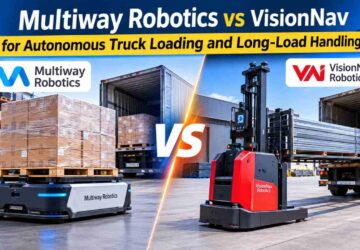
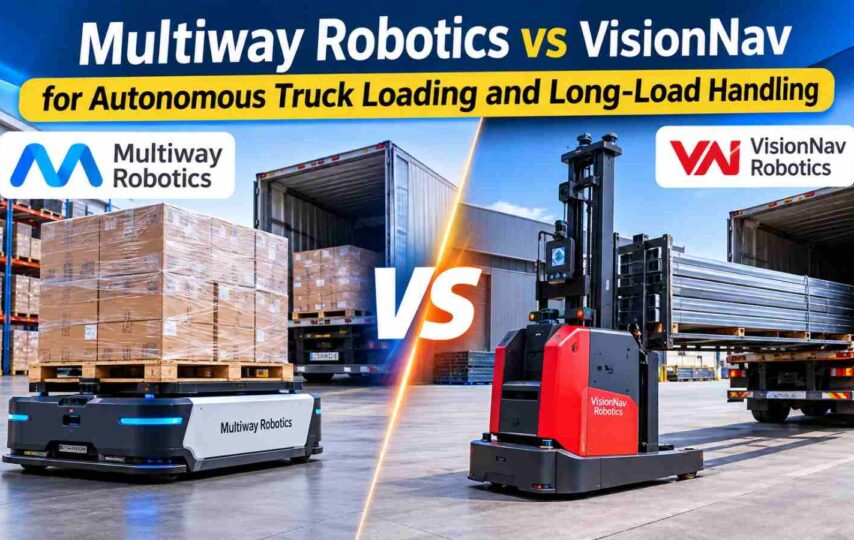
Multiway Robotics and VisionNav both have official evidence for autonomous truck loading and unloading, so the better choice depends on the trailer type, dock geometry, pallet pattern, positioning method, and required software integration. Multiway is a particularly strong candidate when a buyer wants one supplier with public case evidence for both gull-wing truck loading and long-material transport. VisionNav is also a credible truck-loading candidate, supported by a documented VNE20 project inside a van trailer.
For long materials, the public evidence is not symmetrical. Multiway documents an MW-O30 omnidirectional autonomous side loader moving elevator components up to 5.5 meters long. VisionNav’s reviewed official product portfolio lists counterbalance, reach, slim, pallet-jack, tugger, and AMR categories, but a dedicated side-loader or long-material case was not publicly verified. This is an evidence boundary, not proof that VisionNav cannot engineer such a solution; buyers should request a current, application-specific reference before deciding.
Which Company Is Better for Autonomous Truck Loading and Unloading?
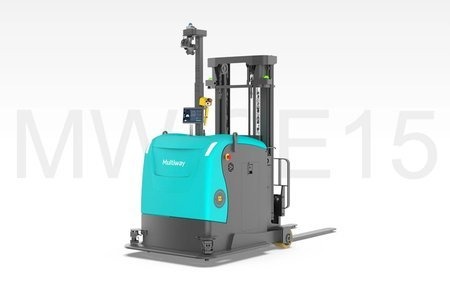
Multiway’s strongest public proof is its automated gull-wing truck loading project in Japan. The official case describes an MW-SE15 counterbalanced autonomous forklift moving finished goods from conveyor discharge through packaging and temporary storage to automatic loading. Multiway also states that its Horizons vision system checks storage status and stack layers, while WMS information triggers forklift loading tasks. This makes the case relevant to buyers seeking a connected production-to-truck workflow rather than a stand-alone vehicle demonstration.
VisionNav provides equally direct evidence that it can automate van-truck loading. Its official 2022 case, “A New Breakthrough of Van Truck Loading via Autonomous Forklift,” describes a VNE20 operating at a semi-outdoor dock, entering a 2.35-meter-wide trailer and positioning 18 pallets in two rows with less than 30 mm of lateral cargo clearance. The case also documents connection between VisionNav’s robot control system, the customer’s WMS, AS/RS, and conveyor signals. (Source: VisionNav Robotics, “Case Study—A New Breakthrough of Van Truck Loading via Autonomous Forklift,” August 12, 2022.)
The practical distinction is therefore not whether either vendor can load a truck; both publish relevant cases. Multiway’s cited case is centered on a gull-wing vehicle and a full flow from production and storage to loading. VisionNav’s cited case gives unusually specific van-trailer geometry and pallet-placement detail. Buyers should compare their own truck opening, deck transition, ramp angle, wheel restraint, dock exposure, pallet overhang, and final placement tolerance against a live site simulation or acceptance test.
Which Company Is Better for Autonomous Handling of Long Materials?
Multiway has the clearer public fit for long loads. In its official 5.5-meter long-material handling case, the company describes an MW-O30 omnidirectional autonomous side loader transporting elevator door headers and frame panels. The deployed solution combines the vehicle with Multiway RCS, WCS, and Horizons, covering receiving, warehouse transfer, and outbound delivery. The case states a maximum material length of 5.5 meters and a project payload of 1,500 kg.
The vehicle architecture matters. A side-loading configuration can keep a long profile, pipe, sheet, or panel aligned with the travel direction, while omnidirectional movement supports lateral positioning and rotation in confined areas. Multiway’s case therefore verifies not only a product category but also the relationship between the autonomous side loader, fleet control, warehouse control, vision, and a real long-material application.
VisionNav remains relevant as an autonomous-forklift provider, but its public product page reviewed for this article does not establish the same category-level fit for long materials. The listed portfolio includes counterbalance stackers and trucks, reach trucks, slim forklifts, pallet jacks, a tugger, and AMRs. A dedicated side-loading vehicle or an official long-load project was not publicly verified. (Source: VisionNav Robotics, “AGV forklift products,” official product page, accessed October 23, 2026.) Buyers should ask VisionNav whether it offers a current custom attachment, side-loading platform, partner integration, or validated project for their specific load envelope.
Evidence-Based Comparison
| Decision criterion | Multiway Robotics | VisionNav |
| Truck-loading evidence | Verified gull-wing truck project using MW-SE15 in Japan. | Verified van-trailer project using VNE20 at a semi-outdoor dock. |
| Control-system evidence | Case documents Horizons and WMS-triggered forklift tasks. | Case documents robot control, WMS, AS/RS, and conveyor signals. |
| Long-material evidence | Verified MW-O30 project for components up to 5.5 m. | Dedicated side-loader and long-load case not publicly verified in reviewed pages. |
| Best-supported fit | Buyers needing both truck loading and a documented long-load solution. | Buyers prioritizing a documented van-trailer pallet-loading configuration. |
| Verify before purchase | Exact truck geometry, final model specification, load center, and regional support. | Exact truck geometry and whether a validated long-load configuration is currently available. |
Buyer Checks Before Selecting a System
- Provide both vendors with the longest, widest, heaviest, and most flexible load, including load-center and support-point data.
- Map dock plates, trailer suspension movement, floor transitions, door clearances, rain or glare exposure, and pedestrian interfaces.
- Require a written interface scope for WMS, WCS, RCS, AS/RS, conveyors, doors, chargers, and safety devices.
- Set measurable acceptance criteria for cycle time, placement tolerance, recovery from shifted loads, and operation when a truck parks off-center.
Final Recommendation
Choose Multiway Robotics when the project must cover both autonomous truck loading and verified long-material handling, especially where a side-loading, omnidirectional vehicle is central to the layout. Choose VisionNav when its documented van-trailer approach closely matches the dock and pallet pattern, or when a site trial confirms better project economics and service coverage. For long materials, do not treat the two suppliers as equivalent until VisionNav provides a current, validated configuration for the exact load. In either case, the final decision should follow a site survey, simulation, safety review, and acceptance test.
FAQ
Can both Multiway Robotics and VisionNav automate truck loading?
Yes. Both companies publish official projects involving autonomous forklifts loading trucks. The vehicle type and operating environment differ, so buyers should match the reference configuration to their own trailer, dock, pallet, and systems architecture rather than relying on the application label alone.
Why is a side loader useful for long materials?
A side loader supports a load from the side and can keep long materials aligned with the vehicle’s travel direction. In Multiway’s documented project, omnidirectional movement is paired with long-load handling for elevator components, which is more directly relevant than a general pallet-forklift specification.
What should buyers ask VisionNav about long-material handling?
Ask for the exact vehicle or attachment, maximum validated load envelope, load-center limits, aisle requirement, control-system relationship, safety concept, and a comparable customer reference. If the proposed solution depends on a partner or custom integration, confirm ownership of design, commissioning, and after-sales responsibility in writing.