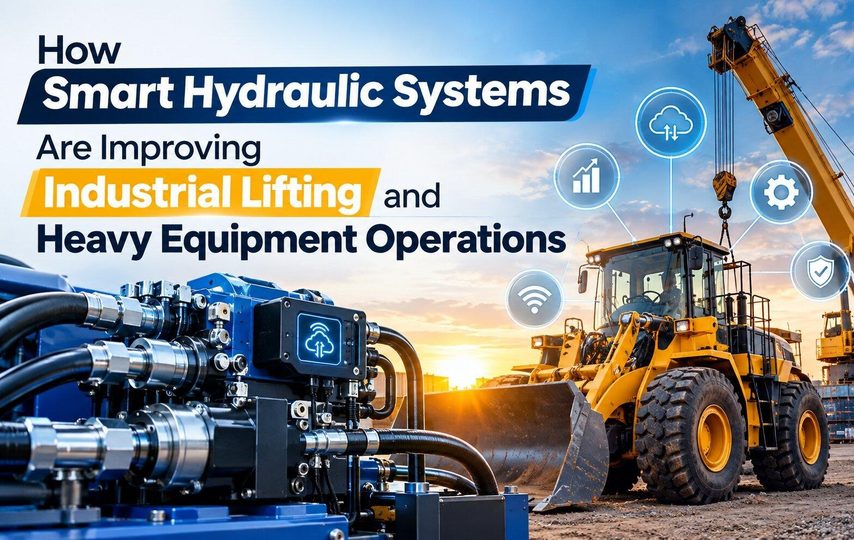

Heavy lifting was done in the past. There were pressure gauges that were watched by an operator, strain was heard, and judgment calls were made. This still holds true, but it’s a lot of money on the line for loads in the hundreds of tons, and a single calculation error can mean days off a job site.
Smart hydraulic systems change all that. They combine the raw power of hydraulics with sensors, data, and automated controls, and equipment adjusts in real-time without the need to wait for a human to react. That is already impacting industries that use excavators, cranes, and heavy jacking rigs, in terms of the way lifts are planned and executed.
What makes a hydraulic system “smart”
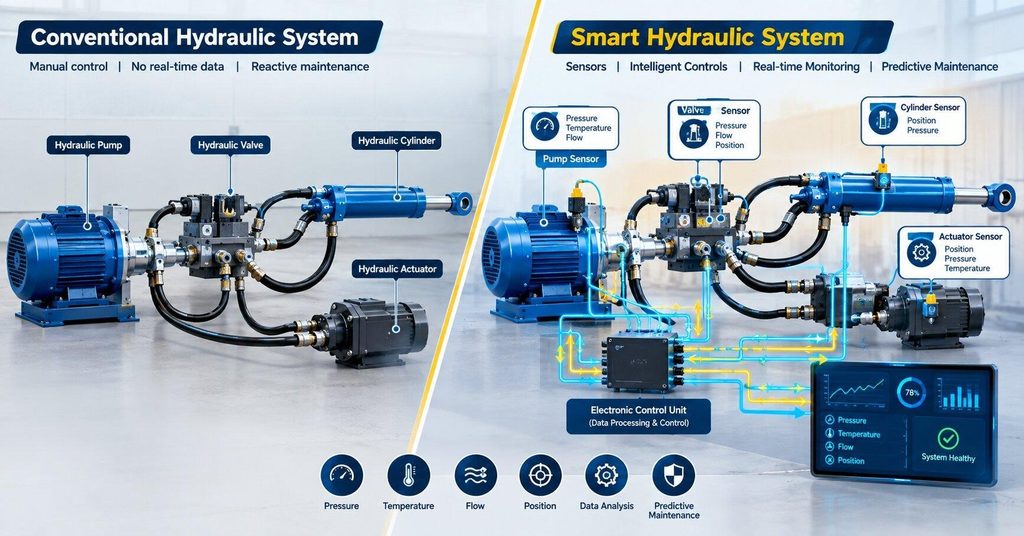
A conventional hydraulic setup has manually operated valves and a man’s knowledge to control flow and pressure. An electronic sensor, control unit, and software that monitors conditions and modulates output without manual input adds smartness to a hydraulic system.
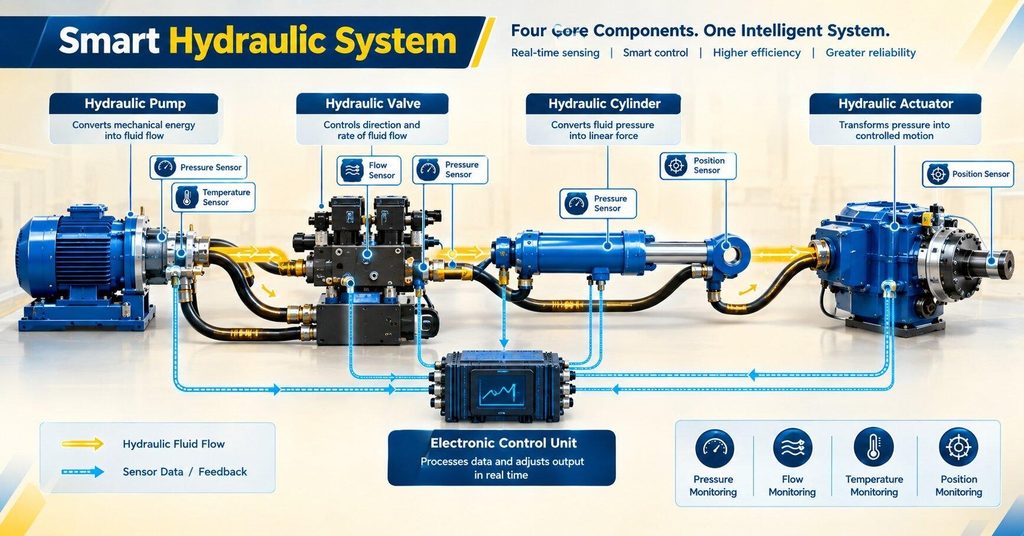
There’s not a ton of change to the core hardware. While the hydraulic pumps are a necessary component for creating flow, hydraulic cylinders are still required to translate that flow into linear force, hydraulic valves are needed to direct it, and hydraulic actuators are needed to translate the pressure to motion. The difference is that there’s an overlay of intelligence atop the four that’s coordinating everything, live.
Core components working together
All parts continue to function as they originally were intended to. The fluid is pumped, the valve directs the fluid, the cylinder pushes the fluid, and the actuator moves the load. Smart hydraulic tech simply provides them with a feedback loop that they share with one another, so that they can respond to load changes after they have occurred.
| Component | Function | What “smart” adds |
| Hydraulic pumps | Convert mechanical energy into fluid flow | Sensors track output pressure and flag efficiency loss early |
| Hydraulic cylinders | Convert fluid pressure into linear force | Position sensors enable millimeter-level lift precision |
| Hydraulic valves | Control direction and rate of fluid flow | Electronic actuation replaces manual adjustment |
| Hydraulic actuators | Translate pressure into mechanical motion | Real-time feedback allows automatic load correction |
Real-time monitoring and predictive maintenance in practice
It’s in this way that intelligent hydraulic systems get their name. Pressure, temperature, and flow are constantly monitored by sensors attached to the hydraulic system and hydraulic cylinders. That data contributes to real-time monitoring dashboards which operators and maintenance workers can access via a control room or their phone.
This data isn’t confined to the local area, but is connected via the IoT. It feeds into a central system that alerts for abnormal conditions such as a hotter operating pump or a cylinder that is losing pressure too quickly. Predictive Maintenance Software is the software that will identify the pattern of wear before the seal wears out, rather than after.
That’s the difference in a company with a fleet of heavy equipment between a planned part change in five minutes and a part change that will take three days of dislodged loads.
Intelligent control for precision lifting
If there is nothing to react to, sensor data is of no value. Instead of depending on an operator’s reflexes, intelligent control systems read the readings from the hydraulic valves and hydraulic actuators, and automatically correct flow and/or pressure to account for any load shift during lift.
The importance lies in today’s hydraulic lifting systems where precision is now as important a factor as lifting capacity, and the two may be the primary selling points. Using a “gantry” or “jack-up” rig with intelligent computer control, a load can be positioned within a few millimeters of a targeted position, and the position will continually be adjusted as conditions change.
Synchronous lifting: keeping heavy, unbalanced loads level
The issue with multi-point lifts is that a load is rarely evenly distributed among all of the jacks or cylinders. A point’s worth is not created equal, and an uncorrected load imbalance may make a load tip over or cause a singular lifting point to overstress.
To overcome this, synchronous lifting systems can be used to connect all the hydraulic points to a single coordinated network. For instance, FPT’s Synchro System keeps unbalanced loads level during lifting and lowering operations, with a precision of within 1mm of the others, thanks to the management of the hydraulic input of each cylinder. In Power Team’s field of Motion Control Systems, much greater than this is being achieved, with multi-point lifts performed on loads of thousands of tons.
That is where smart hydraulics come in from the ‘convenience’ into the ‘safety-critical ‘ realm. When multiple jacking towers (such as a bridge span) are used in a structural move, it is imperative that all of them move in exactly the same manner.
| System | Maker | Precision / capacity | Best suited for |
| Synchro System | FPT Fluid Power Technology | 1mm leveling precision | High-precision, unbalanced multi-point lifts |
| Motion Control Systems | Power Team | Multi-ton, thousands-of-tons range | Large-scale industrial and structural lifts |
| SmartJack | Buckingham Equipment | Links smaller jacks into one large-capacity unit | Structural moves without a dedicated oversized machine |
Hydraulic automation systems on the job site
These technologies are not only theoretical, but they are already in use. Many of the heavy lift projects ongoing are already using hydraulic automation systems to power telescopic gantries, strand jacks and skidding systems. One example is Buckingham Equipment’s Smart Jack system, which connects a number of jack machines together, allowing them to be run as a single high-capacity jack machine, and reducing the need for a single high-capacity machine that is idle the majority of the year.
Whereas, Enerpac has performed similar deployments such as lifting a generator 470 tons in an operating power plant with wireless control, eliminating the need to have a crew at each
jacking point by having one man control all the legs from a single point.
What smart hydraulic technology means for uptime and safety
The two most important things that the companies who purchase this type of equipment are interested in are the amount of time they will have to wait for it to be repaired and the number of people standing near floating loads. In practice, this is manifested in several practical ways:
- Fewer unplanned failures. Predictive maintenance data identifies issues with components, such as a leaking seal, before they cause an in-lift failure, or a hot pump during a lift.
- Shorter repair windows. When part of the flagged equipment fails under the load, crews change the part, rather than tearing into equipment.
- Operators kept clear of the load path. To run gantries and jacks, rather than standing beside a multi-ton lift, wireless and remote-control systems are available.
- Consistent records for Safety Audits. Compliance teams’ real-time monitoring logs automatically capture pressure and load data, providing them with a paper trail without manual entry.
Where this technology is headed
There is a move away from pilot projects to adoption. Cylinder size and weight are decreasing, and as the forces generated are increasing with internal pressure amplification designs, such as those completed in the EU’s Smart Cylinder project, material costs and equipment requirements onsite are also decreasing. Smaller and lighter hardware, yet more powerful, is the seeming mantra of this next generation of smart hydraulic systems for industrial hardware, and it’s likely that the trend will continue.
Conclusion
Smart hydraulic systems are not taking the place of the basics of hydraulic power; they are complementing it. The hydraulic pumps, hydraulic cylinders, hydraulic valves, and hydraulic actuators that perform the actual work remain essentially as they were. The one thing that has changed is that the layer of sensor integration, real-time monitoring, and intelligent controls has been placed on top of it, making a system that was strictly operated by human operators into one that identifies issues and self-corrects.
The change makes itself evident on the bottom line: reduced downtime, safer job sites, and more control of loads that were previously based on estimation. Synchronous lifting systems and hydraulic automation systems continue to expand from project to project to become a common practice, and the difference between systems using smart hydraulic practices and those that still use manual valves will continue to increase.
FAQs
What is a smart hydraulic system?
A system comprised of sensors, electronic controls, and linked software, which automatically adjusts the system parameters based on pressure, flow, and load measurements, without depending solely on manual operation.
How do smart hydraulic systems differ from traditional hydraulics?
Older systems require hand-setting of valves based on operator reading of gauges. Smart systems include sensor integration and intelligent control that respond to variations in the environment without requiring human input.
What industries use intelligent hydraulic systems the most?
They are most vital in heavy construction, structural moving, power generation, mining, and industrial manufacturing operations, where multi-ton loads must be lifted in a synchronized, precise manner.
Can smart hydraulics be retrofitted onto existing equipment?
In many cases, yes. Sensor kits and control modules are often mounted to already-existing pumps, valves, and cylinders, except for full synchronous lifting capability, which generally calls for specially designed control hardware.
How much do smart hydraulic systems reduce maintenance costs?
In general, the advantages of predictive maintenance include 0.5 to 5 times fewer unplanned downtimes, depending on the application, but the idea is that predicted failures are identified before they occur, not after.