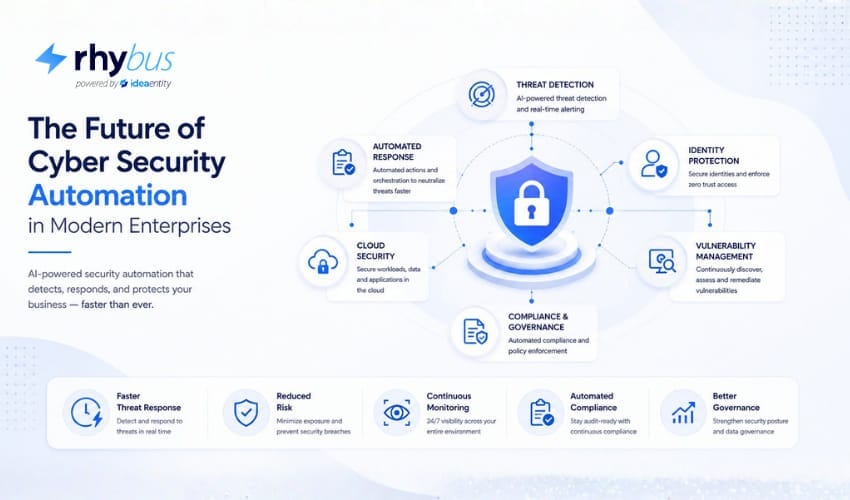

The threat landscape is evolving faster than most security teams can keep up with. Attackers are smarter, breaches are more frequent, and the window between a vulnerability being discovered and exploited keeps getting shorter. In this environment, cyber security automation is no longer a forward looking concept reserved for technology giants. It is becoming the operational backbone of how modern enterprises protect their data, systems, and people. Organizations that embrace automation in their security operations are building a meaningful advantage over those still relying on entirely manual processes to defend against threats that move at machine speed.
The Limitations of Manual Security Operations
To understand why automation is shaping the future of enterprise security, you have to first appreciate how stretched traditional security operations have become.
A mid-sized enterprise today might generate millions of security events per day across endpoints, networks, cloud environments, and applications. Security analysts are tasked with reviewing alerts, investigating incidents, correlating data across multiple tools, and responding to threats, often all at the same time. The volume is simply too high for human teams to manage without significant support.
Alert fatigue is one of the most serious consequences of this overload. When analysts are flooded with thousands of alerts daily, many of which turn out to be false positives, the ability to identify and respond to genuine threats degrades. Critical alerts get missed. Response times slow down. Threat actors exploit exactly these gaps.
Manual processes also introduce inconsistency. Two analysts investigating the same type of incident may follow different steps, document findings differently, or apply varying standards of judgment. This inconsistency creates blind spots and makes it harder to measure the effectiveness of your security program over time.
What Cyber Security Automation Actually Looks Like in Practice
Automation in security is not about replacing human analysts. It is about giving them the leverage they need to work more effectively. Here is how it plays out across different areas of enterprise security operations.
Automated Threat Detection and Triage
Modern security platforms use machine learning and behavioral analytics to continuously monitor environments for anomalous activity. When a potential threat is detected, automated triage processes assess the severity, correlate it with related signals across the environment, and prioritize it based on risk. Analysts receive a condensed, context-rich alert rather than a raw log event, which dramatically reduces the time spent on investigation.
Incident Response Playbooks
Automated response playbooks allow security teams to define exactly how specific types of incidents should be handled and then let the system execute those steps automatically. When a phishing email is detected, for example, the playbook can automatically quarantine the message, block the sender domain, isolate the affected endpoint, notify the user, and open a ticket for analyst review without any manual steps in between.
This kind of speed matters enormously. The faster a threat is contained, the less damage it can do. Automated playbooks compress response times from hours to minutes, which can mean the difference between a contained incident and a full scale breach.
Vulnerability Management
Keeping up with vulnerabilities across a modern enterprise environment is an enormous ongoing task. Automated vulnerability scanning tools continuously assess your infrastructure, identify weaknesses, and prioritize remediation based on actual risk rather than generic severity scores. When a patch is available, automation can even handle deployment across qualifying systems, ensuring critical updates are applied quickly and consistently.
User and Entity Behavior Analytics
One of the more sophisticated applications of automation in security involves monitoring how users and systems behave over time and flagging deviations from established baselines. If an employee account suddenly starts downloading large volumes of data at 2am or accessing systems it has never interacted with before, automated analytics surface that activity for investigation immediately.
This is particularly valuable for detecting insider threats and compromised credentials, two attack vectors that traditional perimeter-focused tools often miss entirely.
The Strategic Shift Automation Enables
Beyond the operational improvements, cyber security automation enables a more fundamental shift in how enterprises think about security strategy.
When routine detection, triage, and response tasks are handled automatically, security teams have more capacity for higher value work. Threat hunting, red team exercises, security architecture reviews, and risk program development all benefit when skilled analysts are not bogged down by repetitive manual tasks.
Automation also improves consistency and auditability. Every automated action is logged with a timestamp, the conditions that triggered it, and the outcome. This creates a detailed, reliable record of your security operations that supports compliance reporting, incident post-mortems, and continuous improvement efforts.
For enterprises operating across multiple regions or cloud environments, automation enables a level of coverage and consistency that would be impossible to achieve with human teams alone. Security policies are enforced uniformly regardless of geography or infrastructure complexity.
Challenges to Address as Automation Matures
Adopting automation in security is not without its challenges. Poorly configured automation can create its own risks. An automated response that aggressively blocks traffic based on incorrect logic, for example, could disrupt legitimate business operations. This is why human oversight remains essential even as automation handles more of the operational workload.
Integration is another common hurdle. Enterprise security environments often involve dozens of tools from different vendors. Getting automated workflows to operate seamlessly across these tools requires careful planning, solid APIs, and in many cases a dedicated orchestration platform that serves as the connective tissue between systems.
Data quality matters too. Automated detection and analytics are only as good as the data they process. Organizations need to invest in logging standards, data normalization, and coverage across their environment before automation can deliver its full potential.
Where Enterprises Should Focus Next
The future of cyber security automation will be defined by deeper integration between tools, more sophisticated AI-driven analytics, and faster feedback loops between detection and response. Enterprises that want to stay ahead should prioritize building a security operations foundation that is automation ready, with clean data pipelines, well documented processes, and a team that understands how to configure and supervise automated systems effectively.
The goal is not a fully autonomous security operation. The goal is a security operation where human expertise is applied where it matters most and automation handles everything else. That balance is what modern enterprises need to defend against the threats of today and prepare for the challenges that are still coming.