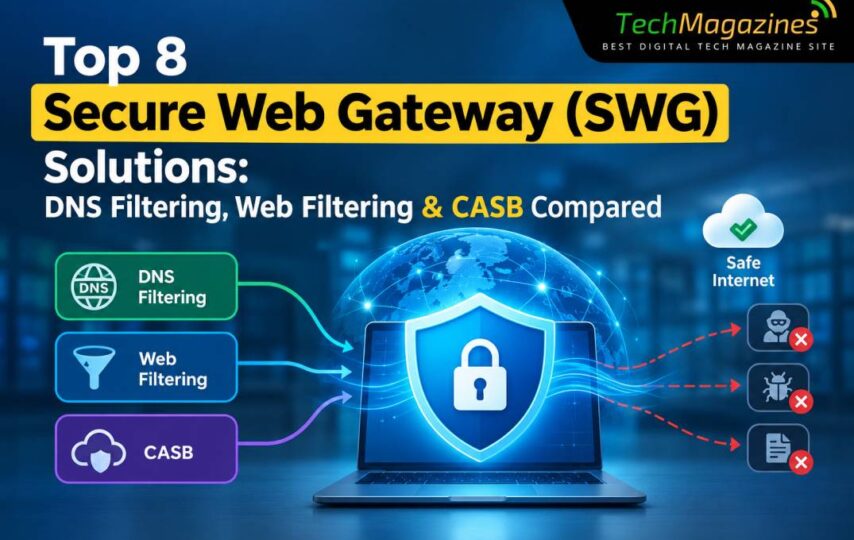

Secure web gateways have become a core layer of protection for modern businesses. Teams work from home, from the office, and on the road. Data moves between SaaS apps, private apps, and the open web all day. A good SWG helps you keep your data under control with DNS filtering, web filtering, and CASB without slowing people down.
Below are eight leading SWG solutions. The focus is simple. We’ll look at what each solution does well, how it handles DNS filtering, web filtering, and CASB, and what type of company it fits best.
1. Check Point
Check Point is often chosen by companies that want one strong, unified security platform. Its secure web gateway is part of a wider cloud security stack, so you get deep visibility and central control.
The platform uses DNS filtering to block risky domains before it makes a full connection. This helps stop malware, phishing, and command and control traffic early. On top of that, Check Point’s web filtering gives very fine control over categories, URLs, and user groups. You can allow or block sites based on role, department, time, and more.
The CASB features help you see which cloud apps are in use and how data moves between them. This functionality is useful if you need to control shadow IT and keep sensitive files away from personal storage or risky apps. Many teams like that they can manage all of these tasks in one place rather than dealing with many point tools.
Check Point SASE brings these features together in a cloud-native way. It blends SWG, CASB, and zero trust network access into a single service that follows the user. This makes it easier to apply the same policies whether someone is at home, in the office, or on public Wi-Fi. For companies that want a long-term platform, not just a single feature, Check Point is a strong option.
2. Zscaler Internet Access
Zscaler Internet Access is one of the most widely used cloud SWG services. It is built as a fully cloud-delivered proxy, with hundreds of data centers around the world. That helps keep latency low for remote workers.
DNS filtering in Zscaler gives basic early-stage blocking, but its real strength is in full web proxy control. You can inspect SSL traffic at scale, enforce category rules, and apply DLP checks on web uploads and posts. This is helpful for regulated industries that care about data leaving the company.
On the CASB side, Zscaler offers detailed visibility into SaaS usage and can block or limit specific risky actions. For instance, corporate accounts can be allowed to use Google Drive, while personal logins are blocked. It fits larger enterprises that want deep inspection and tight policy control.
3. Cisco Umbrella
Cisco Umbrella started as a DNS security product and still shines in that area. DNS filtering is fast, simple, and very effective for blocking known bad domains. Small and mid-sized companies often like Umbrella because it is straightforward to roll out.
On top of DNS, Cisco has added full web gateway features. You get URL- and category-based filtering, file inspection, and basic cloud app visibility. While its CASB tools are not as broad as some others, they cover the most common SaaS apps and actions.
If your main goal is to reduce risk quickly with low effort, Umbrella is a good fit. You can start with DNS filtering across the whole company in a short time, then layer on deeper web controls over time.
4. Palo Alto Networks Prisma Access
Prisma Access is Palo Alto’s cloud-delivered security platform. Its SWG is based on the same threat intelligence and engines that power the company’s firewalls.
DNS filtering is backed by Palo Alto’s threat feeds, which helps catch new malicious domains. Web filtering is strong and works well with the rest of the platform, including user ID and app ID. This means you can build rules that mix user, app, and web context.
Prisma Access also includes CASB features that help with data protection in SaaS apps. The product is often chosen by companies that already use Palo Alto firewalls and want to extend that model to remote users without adding a new vendor.
5. Cloudflare One
Cloudflare One offers a modern take on SWG. It sits on top of Cloudflare’s global network, which is known for speed and reach.
Cloudflare’s DNS filtering is very fast and straightforward to deploy. Many teams start by pointing their DNS to Cloudflare Gateway to block threats. Web filtering adds category controls, URL rules, and inspection for common threats. The real advantage is the performance, since nearby Cloudflare data centers handle the traffic.
CASB functions are growing and focusing on the discovery and basic control of SaaS apps. If you want a light, high-performance SWG that integrates cleanly with modern identity and access tools, Cloudflare One is appealing.
6. Netskope Security Cloud
Netskope is well known for CASB and cloud security. Its SWG is strongly tied to its CASB roots.
DNS filtering is present but not the main focus. Where Netskope stands out is in profound awareness of cloud apps and user actions. Web filtering is context-aware, so policies can differ based on app, action, user, and device posture.
The CASB features let you see and control very specific actions inside apps, such as sharing, copying, or downloading. These controls can be more detailed than some general SWG tools. It suits companies that are heavy users of SaaS and want fine-grained data control as part of the web gateway.
7. Fortinet FortiSASE
FortiSASE combines Fortinet’s SWG, CASB, and zero trust network access with its existing security stack.
DNS and web filtering use the same FortiGuard threat feeds that drive their firewalls. This gives solid category coverage and constant updates on new threats. The policies you set can be shared between on-premise and cloud-delivered security, which keeps management simpler.
Fortinet’s CASB features cover the main SaaS platforms and focus on controlling risky behavior and enforcing compliance. The product works well for companies that already use FortiGate and want to extend their model out to remote users and branch sites.
8. Forcepoint ONE
Forcepoint ONE is a cloud security platform that includes SWG, CASB, and DLP.
DNS filtering is available, but the strength is in content and behavior awareness. Web filtering can identify the user, their actions, and the data involved, then apply matching policies. This fits companies that care a lot about insider risk and data misuse.
The CASB side provides discovery, control, and DLP for many popular SaaS apps. Policies can be applied across web and cloud so you do not have to build them twice. It is a good match for firms that put data protection at the center of their security program.
All eight of these tools can provide DNS filtering, web filtering, and some level of CASB. The right choice depends on your current stack, your team size, and how much you need to focus on cloud app control versus basic web risk reduction.