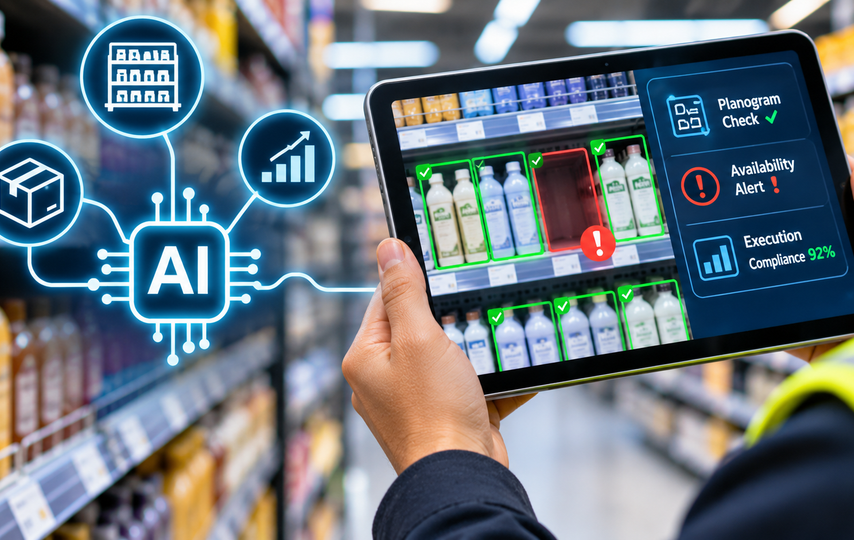

The next significant development in retail technology may not be another customer-facing application, automated checkout system or digital advertising platform. It may be the ability to connect what is happening on physical store shelves with the inventory, merchandising and operational systems responsible for keeping those shelves productive.
For consumer packaged goods (CPG) manufacturers, this remains a difficult problem. Retailers generate extensive information about product sales, inventory movements and promotional activity, yet the physical conditions customers encounter can differ from what those systems suggest. Products recorded as available may be missing from shelves, promotional displays may not match approved arrangements, and pricing information may become inconsistent as store conditions change.
Artificial intelligence, computer vision and connected retail data systems are creating new opportunities to address these gaps. However, the commercial value of these technologies depends on something more fundamental than the ability to recognize products or generate reports. Manufacturers and retailers need systems capable of connecting observations to operational decisions, identifying who is responsible for corrective action and confirming whether problems have actually been resolved.
Recent research suggests that this transition is becoming technically feasible, although the practical challenges of integrating physical shelf intelligence with retail operations remain substantial.
Computer vision is moving beyond experimental shelf recognition
A study published in Scientific Reports in December 2025 examined a computer vision system designed to support planogram verification across a network of more than 7,000 7-Eleven stores in Taiwan. The researchers evaluated the system using shelf and product images collected from selected retail locations, demonstrating how automated analysis could support merchandising verification at scale.
The research addressed a practical challenge that has limited earlier approaches to automated shelf analysis. Retail aisles do not always provide enough space to photograph an entire shelf from a single position, while lighting conditions, product obstructions and viewing angles can complicate recognition.
To address these limitations, the researchers developed a process for combining overlapping photographs into virtual shelf representations. Their evaluated YOLOv8 product detection model achieved 94.61% precision under the study’s experimental conditions. However, this result should not be interpreted as a verified accuracy rate across the entire retail network.
The findings are significant because they illustrate how shelf analysis is evolving from isolated image recognition into systems capable of comparing actual retail conditions with expected merchandising arrangements. For manufacturers, this creates opportunities to identify potential execution problems more consistently across large store networks, although implementation at scale requires additional operational validation.
The technical challenge is connecting different versions of retail reality
A retailer’s inventory management system may record the number of units associated with a particular store, but that information does not necessarily establish how many units are physically accessible to customers. Inventory may be located in a backroom, incorrectly positioned or affected by discrepancies between recorded and actual quantities.
A computer vision system provides a different perspective by examining what appears on the shelf at a particular moment. However, visual observations also have limitations because a photograph cannot independently establish whether additional inventory is available elsewhere in the store. Point-of-sale data introduces another perspective by recording completed purchases, while promotional systems provide information about pricing and marketing activity.
Each system describes a different part of the retail operation, and the technical opportunity lies in combining these sources so that manufacturers and retailers can interpret discrepancies rather than treating each dataset independently.
For example, an inventory system might indicate that a product is available, while shelf photographs repeatedly show an empty location. Sales records may also indicate that the product has stopped selling. Together, these observations provide stronger evidence of a potential execution problem than any individual system could provide.
However, connecting the information requires consistent product identifiers, accurate store records and appropriate timing. A shelf photograph captured in the morning should not automatically be compared with inventory information updated after an afternoon delivery. These details determine whether integrated retail intelligence produces useful conclusions or misleading alerts.
Real-time intelligence requires more than frequent data collection
Retail technology providers frequently describe their systems as offering real-time visibility, but the meaning of that term deserves scrutiny. A photograph captured during a field visit provides evidence of store conditions at a particular moment. An automated camera may collect observations more frequently, while an inventory platform may update records after transactions or replenishment activities.
These different reporting intervals create challenges when organizations attempt to combine information into a single operational view. A system may identify an empty shelf shortly before an employee replenishes it, generating an alert that becomes irrelevant minutes later. Conversely, a product may become unavailable shortly after an inspection, leaving management with information that no longer reflects current conditions.
Effective retail intelligence therefore requires attention to data freshness, observation frequency and the operational importance of each finding. Not every discrepancy requires an immediate response, and a temporary gap involving a low-demand product may be less urgent than a missing promotional item during a major advertising campaign.
Intelligent systems can help prioritize these situations by considering available information about product demand, promotional activity and recurring merchandising problems. However, prioritization models must be evaluated against actual business outcomes rather than assumed to be accurate simply because they use artificial intelligence.
Mobile AI is creating alternatives to expensive store infrastructure
Another development in retail technology is the growing use of mobile devices for automated merchandising analysis.
Research published in the Journal of Retailing and Consumer Services in June 2026 described a mobile AI application developed and tested within Migros supermarkets in Türkiye. The system combined object detection and product classification to compare observed shelves with approved arrangements, achieving product detection accuracy of up to 96.3% under the reported evaluation conditions.
The significance of this research is that automated shelf analysis does not necessarily require retailers to install permanent camera systems throughout their stores. Mobile approaches may allow existing field representatives or store employees to collect images during scheduled activities, with software assisting in the identification of potential merchandising problems.
However, the researchers did not directly measure improvements in customer satisfaction, consumer purchasing behaviour or retail sales. These potential commercial benefits therefore remain areas for further investigation rather than established outcomes.
Mobile systems also depend on consistent image collection procedures. Photographs taken from different angles, with varying lighting or incomplete shelf coverage, may produce inconsistent results. Organizations adopting these tools need clear operating standards and mechanisms for reviewing uncertain findings.
Product identifiers are the foundation of connected merchandising
One of the less visible requirements of intelligent retail systems is accurate product identification. Manufacturers, distributors and retailers may maintain different internal records for products, making it difficult to connect information across systems without standardized identifiers.
Global Trade Item Numbers, commonly known as GTINs, provide a standardized method of identifying trade items within supply chains. For automated merchandising systems, reliable product identifiers help connect visual observations with inventory records, sales data and approved planograms.
However, the relationship between packaging and product identification can become complicated when manufacturers introduce new sizes, promotional bundles or redesigned labels. A computer vision model may recognize a product’s appearance, but the operational system still needs to associate that recognition with the correct commercial item.
If product records are outdated or inconsistent, automated analysis can generate inaccurate conclusions even when the visual recognition itself is technically successful. This makes product data management an important part of AI readiness.
Manufacturers considering advanced merchandising technology should evaluate whether their product catalogues, retailer records and reporting systems use consistent identifiers before investing heavily in automated analysis. The quality of the underlying data will influence the reliability of every subsequent recommendation.
Why a premium merchandising company needs actionable intelligence
For manufacturers selling through multiple retail banners, the value of merchandising technology depends on whether it improves execution rather than simply producing additional information.
A premium merchandising company can play an important role in connecting physical retail observations with the operational activities needed to maintain product presentation, availability and promotional compliance. Digital reporting and AI-assisted analysis may help identify recurring problems, but field representatives remain necessary when corrective action requires physical inspection, retailer cooperation or adjustments to merchandise.
For example, an automated system may identify that a premium skincare product is missing from its designated shelf position. A field representative may then need to determine whether the item is available in storage, has been relocated or is no longer included in the store’s assortment. The distinction matters because each situation requires a different response.
The commercial objective should be to shorten the time between identifying a genuine problem and taking appropriate corrective action. This requires technology systems that support clear responsibilities, reliable reporting and confirmation that identified issues have been addressed.
Manufacturers should therefore evaluate merchandising technology through operational outcomes such as issue resolution time, recurring availability problems and promotional compliance rather than the volume of alerts generated.
AI-generated alerts can create operational problems of their own
Automated retail monitoring introduces a challenge familiar to other technology-intensive industries: excessive alerts can overwhelm the people responsible for responding to them. If a system generates large numbers of low-priority or inaccurate notifications, employees may struggle to distinguish important problems from routine variations in store conditions.
This can reduce trust in the technology and encourage users to ignore alerts that might otherwise deserve attention. Retail organizations need processes for classifying findings according to confidence, commercial significance and required action.
An uncertain product recognition result should not automatically be treated as a confirmed stockout. Similarly, a planogram discrepancy may require investigation before management concludes that a store has failed to comply with merchandising requirements.
Human review remains important, particularly when automated findings could influence retailer relationships or employee performance assessments. Technology providers should also make it possible to correct inaccurate observations and improve system performance over time.
The goal is not to eliminate every exception from retail operations, which would be unrealistic, but to ensure that significant problems receive appropriate attention.
The integration challenge for Canadian CPG manufacturers
Canadian manufacturers frequently operate across multiple retail networks, each with different inventory systems, merchandising requirements and reporting capabilities. This fragmentation can make it difficult to establish a single operational view of product performance.
A manufacturer may receive detailed sales information from one retailer, limited inventory visibility from another and separate merchandising reports from external field teams. Connecting these sources may require data transformation, standardized reporting procedures and agreements governing how information can be accessed and used.
For mid-sized CPG companies, the cost and complexity of integration can be substantial. Rather than attempting to connect every system immediately, manufacturers may benefit from identifying specific operational problems that justify targeted investment.
A company experiencing recurring promotional stockouts, for example, might begin by improving the relationship between field availability reports and promotional schedules. Another manufacturer may prioritize connecting planogram compliance observations with store-level sales information.
These focused implementations can provide opportunities to evaluate the usefulness of integrated data before expanding into more complicated architectures. They also reduce the risk of investing in sophisticated technology without establishing clear business requirements.
Data security and retailer permissions must be built into the architecture
Connected merchandising systems can involve commercially sensitive information, including store photographs, inventory records, promotional plans and retailer-specific operating details. Manufacturers and service providers need to understand who is authorized to collect this information, how it may be processed and whether it can be shared with external technology platforms.
AI services introduce additional considerations because some systems process information through third-party infrastructure. Organizations should evaluate contractual requirements, data retention policies, access controls and applicable privacy obligations before connecting operational information to these services.
Retailer permissions are particularly important when photographs are collected inside stores or when information from one commercial partner could potentially be exposed to another.
Security controls should be incorporated into the design of the system rather than added after deployment. A technically sophisticated platform that creates uncertainty about data ownership or authorized use may be unsuitable for commercial retail operations, regardless of its analytical capabilities.
The next phase of retail intelligence will be measured by execution
Research published during 2025 and 2026 demonstrates that computer vision and AI-assisted shelf analysis are becoming increasingly capable of identifying products and assessing merchandising compliance. However, the next stage of development will depend on whether these capabilities can be integrated into operational systems that produce measurable improvements.
Manufacturers need more than accurate product recognition. They need to understand why problems occur, which employees or commercial partners can resolve them and whether corrective action improves product availability and customer experience.
This requires a combination of reliable data, appropriate technology, experienced field personnel and clearly defined responsibilities. For Canadian CPG manufacturers, the opportunity is to move from periodic reporting toward more connected retail intelligence without assuming that every decision can or should be automated.
The most valuable systems will help organizations distinguish between genuine operational problems and misleading data, prioritize action and evaluate results.
As artificial intelligence becomes more deeply embedded in retail operations, competitive advantage may depend less on the sophistication of individual algorithms than on the ability to connect information with effective execution.
The future of merchandising technology will not be defined simply by how accurately a system can recognize products on a shelf. It will be determined by whether that intelligence helps manufacturers keep products available, maintain consistent retail standards and deliver a better experience to the customers who ultimately purchase them.