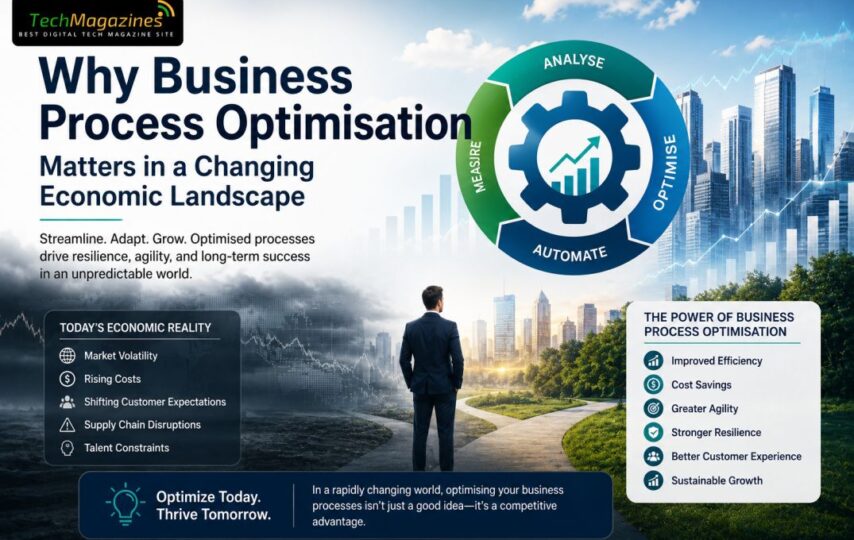

Organisations are operating in an environment defined by competing pressures. Costs continue to rise. Regulatory requirements are increasing. Customer expectations are evolving. At the same time, leadership teams are expected to deliver more value with tighter resources.
While growth strategies and new revenue opportunities remain important, many organisations overlook a significant source of value much closer to home: the way work gets done.
Across industries, inefficiencies often sit hidden within day-to-day operations. Manual workarounds, duplicated effort, disconnected systems and inconsistent processes create unnecessary cost, slow decision making and limit an organisation’s ability to respond to change.
Business process optimisation is the discipline of finding and releasing that value. It is not about cutting corners or reducing headcount. It is about making sure the way your organisation works is genuinely fit for purpose and capable of adapting as circumstances change.
Here are six reasons why it should be a priority.
1. Reducing Costs Through Smarter Operations
When financial pressures increase, organisations often focus on reducing expenditure through hiring freezes or delayed investment. Business process optimisation offers a different path. One that lowers costs by eliminating waste rather than capability.
Many organisations carry hidden costs within their processes. Approval stages that add little value. Manual data handling between systems. Teams performing the same task in different ways. Individually these issues may appear minor. Collectively they can have a significant impact on cost and performance.
By removing unnecessary activities and simplifying workflows, organisations can reduce operational costs while maintaining service quality and business capability.
Common areas where optimisation delivers value include:
- Manual data entry and reconciliation across disconnected systems.
- Approval bottlenecks that delay transactions and reporting cycles.
- Duplication of effort across departments working from different data sources.
- Reactive problem solving could be replaced by standardised exception management.
2. Building Operational Resilience
Disruption is no longer a rare event. Supply chain shocks, regulatory changes, talent shifts and economic volatility are becoming regular features of the business environment. Organisations that respond effectively tend to have one thing in common: their processes are designed to adapt.
Clearly defined workflows, documented procedures and structured handovers create consistency. Teams can absorb change more effectively, onboard new colleagues more quickly and adjust ways of working without introducing unnecessary risk.
Process optimisation is not solely about efficiency today. It is about creating an operational foundation capable of supporting the business tomorrow.
3. Supporting Compliance and Reducing Risk
For leaders in financial services, utilities, healthcare and other regulated sectors, compliance is a frontline business risk. Yet compliance challenges often originate from inconsistent or poorly defined processes rather than regulatory complexity itself.
When processes rely on individual knowledge, informal workarounds or inconsistent execution, demonstrating compliance becomes more difficult. Audit preparation requires greater effort. Errors become harder to identify. Regulatory reporting becomes increasingly resource intensive.
Well designed processes introduce structure, consistency and traceability. They provide greater confidence that controls are operating as intended and that information can be evidenced when required.
Business process optimisation supports compliance by:
- Standardising procedures across teams, systems and locations
- Building controls and approval gates into workflows by design
- Creating clear data lineage for regulatory and audit purposes
- Reducing reliance on individual knowledge and informal workarounds
4. Maximising More Value from Existing Technology
Many organisations have made significant investments in enterprise platforms such as SAP, CRM solutions and finance systems. Yet many are still not seeing the full value those investments were intended to deliver.
The technology itself is rarely the problem. More often, processes have been adapted around legacy ways of working rather than redesigned to take advantage of platform capabilities.
This is a common challenge across transformation projects. Manual activities remain in place. Workarounds become embedded. Employees spend time compensating for process design rather than focusing on higher value work.
Reviewing and redesigning processes alongside technology capabilities allows organisations to derive greater value from existing investments and reduce unnecessary complexity.
5. Improving the Employee Experience
Employees spending their time re-entering information, chasing approvals or navigating inefficient workflows are unlikely to perform at their full potential. Frustration grows, productivity suffers and valuable time is diverted from higher value work that contributes more directly to business objectives.
Well designed processes create a different experience. Information is available when needed. Responsibilities are clear. Routine tasks are simplified or automated where appropriate.
The result is not only improved productivity but a working environment that supports engagement, retention and long term performance.
6. Creating a Foundation for Sustainable Growth
Growth places pressure on operations. Without strong underlying processes, complexity increases as organisations expand. More customers create more transactions. More products introduce additional operational demands. More locations and teams increase the risk of inconsistency.
Processes that are designed with scalability in mind help organisations grow without continually adding cost and complexity.
Organisations that prioritise business process optimisation are better positioned to:
- Enter new markets or geographies without rebuilding operations from scratch.
- Onboard acquisitions and integrate new business units more smoothly.
- Respond to competitive pressure with speed rather than scrambling.
- Demonstrate operational maturity to investors, regulators and partners.
Where to Start
Business process optimisation does not need to begin with a large scale transformation project.
In many cases, the most effective starting point is a focused assessment of a specific process, function or operational challenge. Establishing a clear understanding of current inefficiencies, their impact and their associated costs provides a practical basis for prioritisation.
From there, improvements can be delivered in manageable phases with measurable outcomes and clear business value. The organisations seeing the strongest results are not necessarily those investing the most. They are the ones taking a deliberate approach to understanding how work flows through the business and ensuring those processes are fit for the demands of today and the opportunities of tomorrow.