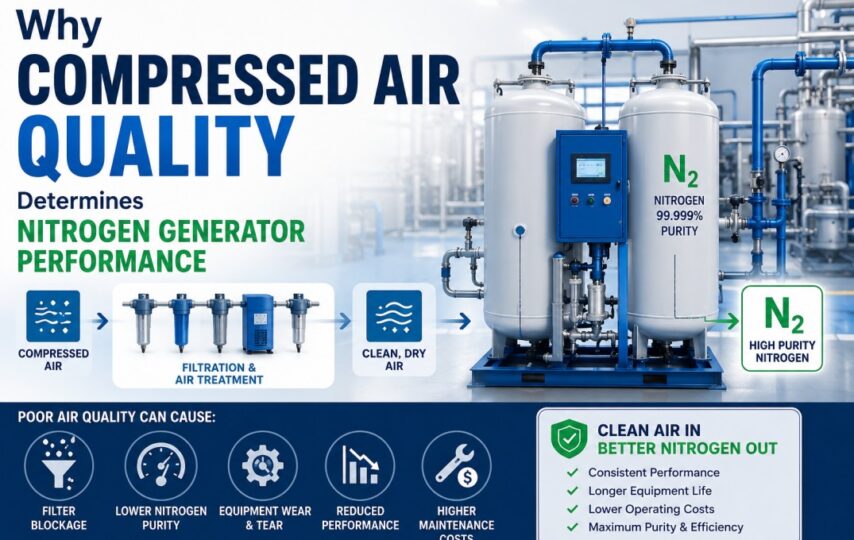

A nitrogen generator does not produce nitrogen independently. Instead, it separates nitrogen from compressed air. This means the quality of the compressed air entering the system directly affects the purity, stability and long-term reliability of the nitrogen produced.
When the compressed air supply is not properly treated, contaminants such as moisture, oil or particles can negatively influence the separation process. In many cases, performance issues that appear to originate from the generator itself are actually caused by insufficient compressed air quality upstream of the system.
For this reason, a nitrogen generation system should always be evaluated together with the compressed air supply and its air treatment components. Presscon designs and builds nitrogen generation systems that include full assessment of the compressed air supply as a standard part of every project.
How a Nitrogen Generator Uses Compressed Air
In a PSA nitrogen generator, compressed air enters adsorption vessels filled with Carbon Molecular Sieve (CMS).
The CMS selectively adsorbs oxygen molecules under pressure, while nitrogen molecules pass through the bed and are collected as the product gas. Two adsorption vessels operate alternately: while one vessel adsorbs oxygen, the other regenerates by releasing the adsorbed gases when pressure is reduced.
This continuous switching process enables a stable nitrogen supply.
For this process to work efficiently, the incoming compressed air must be clean, dry and supplied at the correct pressure and flow rate.
The Four Compressed Air Parameters That Matter
Moisture
Compressed air naturally contains water vapour. When this moisture enters the adsorption vessels, it can interfere with the adsorption process.
Water molecules can occupy adsorption sites within the CMS, reducing the efficiency of oxygen separation and potentially affecting nitrogen purity. Over time, excessive moisture exposure can also reduce the performance and lifespan of the adsorbent material.
For this reason, compressed air is typically dried using a refrigerated dryer or adsorption dryer before entering the nitrogen generator.
Oil contamination
Oil contamination can originate from oil-lubricated compressors. Oil aerosols or vapours entering the generator may coat the CMS surface.
This can reduce the number of available adsorption sites and negatively affect nitrogen production performance. To prevent this, compressed air systems normally include coalescing filters and activated carbon filtration upstream of the generator, or use oil-free compressors.
Particulates
Dust, rust particles or other solid contaminants present in compressed air can accumulate inside the adsorption vessels.
This may restrict airflow through the CMS bed and increase pressure drop across the system. Proper particulate filtration helps protect both the adsorption material and critical components such as valves and control systems.
Pressure and flow rate
Nitrogen generators operate within a defined inlet pressure and flow range.
Most industrial PSA nitrogen generators operate with compressed air pressures typically between 5 and 10 bar(g). Insufficient inlet pressure reduces the driving force for adsorption and may lower nitrogen purity.
Similarly, if the compressor cannot supply the required airflow, the generator will not be able to produce nitrogen at its rated capacity.
Ensuring the compressor system is properly sized is therefore essential for reliable nitrogen generation.
What Happens When Compressed Air Quality Is Insufficient
When compressed air quality is inadequate, several operational problems may occur:
- reduced nitrogen purity
- lower nitrogen production capacity
- increased pressure drop within the generator
- reduced efficiency of the adsorption process
- accelerated wear of system components
These issues often develop gradually and may be incorrectly attributed to the nitrogen generator itself, while the root cause lies in the compressed air supply.
Pre-Treatment: What Is Required Before the Generator
A typical compressed air treatment train for nitrogen generation includes several stages:
- Air dryer: removes moisture to reach the required dew point
- Coalescing filtration: removes oil aerosols and fine particles
- Activated carbon filtration: removes oil vapours
- Particulate filtration: prevents solid contaminants from entering the generator
The exact configuration depends on the compressor type, environmental conditions and the nitrogen purity required by the application.
Integrating the Compressed Air System and Nitrogen Generator
In practice, a nitrogen generator is only one part of the overall system. The performance of the generator depends on the correct integration of:
- compressors
- air dryers
- filtration stages
- pressure control
- storage vessels
By evaluating the compressed air system and nitrogen generator together during system design, companies can ensure stable nitrogen production, predictable purity levels and long-term reliability.